Blue Apron: Is It Worth a Try


My daughter gets it off and on–yes, you can cancel weeks when you do not want what they have, etc.  Although I cook yummy, nutritious meals for myself, I realized I was in a food rut of sorts and decided it might be worth a try to explore new food horizons.  To date, I have made two of week one recipes, Crispy Catfish and Five-Spice Chicken.

Crispy Catfish??  Boring?? The title seems quite inaccurate to me.  No deep frying, nothing like that.  Unusual, yes!  Besides cat fish, it includes kale, semi-pearled farro, Thomcord grapes ( I know, I never heard of them before either), rosemary, along with some more ordinary ingredients.  Catfish is not my favorite fish but ok.  Would I have ever gone out and bought farro?  Probably not.  Would I ever have thought to cook grapes to put over fish?  No.  The recipe calls for cooking the farro, sautéing the kale with garlic, then mixing the two together.  Rosemary and chopped almonds sautéed together with the grapes made an incredibly savory-sweet relish.  I had some left over so later cooked a cod loin and served the relish and faro/kale salad with it.  I will definitely saute rosemary, almonds, and grapes together again.

Tonight I made the Five-Spice Chicken.  I remain uncertain as to whether I have seen cremini mushrooms in the stores here.  The ingredients included those, baby fennel, collard greens, Chinese five-spice powder, hoisin sauce, ginger, sesame oil, soy sauce, and vermicelli rice noodles.  The only thing not included I had to also use was olive oil which I buy in the largest containers because I love the stuff. Would I ever have made this dish without Blue Apron?  Probably not.  It was delicious and since I cook for one and everything comes for two or, if you choose, a family, I have leftovers for later in the week.

What is the down side?  You may not like all the combinations provided for a certain week so you cancel.  I am quite concerned about the packaging and how to recycle all this stuff.  Their website says everything is made to recycle.  However, to do that you have to live where recycling is available.  I do not except for the box.  The recipes are detailed but not all that speedy so it does take more time than I normally take to cook.

Will I try this again?  Yes, when I like all the combinations in a week.  I still have to try the vegetarian option for this week, a Thai curry.  What showed up with that?  A very lovely looking little squash I never heard of before.  You can choose various options including vegetarian.  What will I repeat?  While I might not be able to find this special kind of grape, I will saute grapes with rosemary and almonds again.  I will use collard greens and fennel more often.

The Fly, Wine, and Fennel


I look .

The fly floats in my glass of Seven Deadly Zins,

full to two golden flowers half way up the rim.

What kind of flowers?

I look.

Unsure, I watch the fly struggle, floundering around

in the deep red, the color that turns tongues

purple drunk.

I look.

Dead.  It floats.

Not poor, frugal.  I debate.

Should I throw the wine out?  Drink it?

I take the silver teaspoon–from the six piece

set Father gave Mother in 1946 on their

first anniversary–dip it in the dark, remove

fly, throw it down the antique copper sink drain.

I pick up the glass.

I look,

swirl the wine around in the bowl, take a sip.

Surely 15 percent alcohol kills germs.


img_2384


It was past seven, time to fix dinner.  Since I live a lone, I often fix dinner for two, save half, and have dinner ready for a hectic evening after work.  Just warm in the microwave.

Cod with Fennel, Mint, and Lemon

Two cod loins–one if extra large

1 heaping tablespoon chopped garlic

Olive oil

1/2 to 1 cup finely sliced small carrots

1/2 large poblano pepper, seeded and coarsely chopped

several cauliflower florets thinly sliced

crushed dried mint

essential oil of lemon and fennel (if you do not use essential oils,

you can use 1 tsp. ground fennel and lemon juice to taste)


Pour enough olive oil in a ten inch skillet to totally cover the bottom.  Saute garlic and carrots in the olive oil until carrots are almost tender.  Sprinkle a small handful of mint over the garlic and carrot mixture.  Add cauliflower and poblano pepper.  When poblano peppers are about to change color, add the cod.  Sprinkle drops of lemon and fennel essential oil over the cod–or the ground fennel and lemon juice.  Cook until the cod flakes.    Serve over rice.  I use basmati.


Driving on Your Own in Costa Rica–Hotel Playa Negra


On March 17, I related the story of having to leave the first hotel in this area after dark with nowhere to go–see first post on driving on your own.  It was not until I awakened the next morning, dressed, and went in search of coffee, that I realized just how lucky we were.  I left my daughter and grandson asleep and ventured toward the restaurant indicated by a small sign.  I had not walked far when this scene greeted my eyes.

IMG_2068

Horses right by the beach.  Perhaps these were the horses one could ride–I had just seen a sign indicating horse back riding was available.  Then I walked a bit further and these scenes welcomed me.

IMG_2069

IMG_2070

IMG_2071

Except for the two dogs you can see here, no one was at the beach.  The tranquility amazed me.

IMG_2072

I walked back inside the restaurant–here I am standing at its edging looking toward the beach–ordered cafe con leche and luxuriated in our incredibly good karma.  This place exceeded all expectations considering our experience the previous night.

IMG_2074

This photo was taken from the beach looking back at the restaurant.  Except in colder areas like San Jose and Monteverde, I never saw or ate in any enclosed restaurants.  Even the fanciest are open air like this one.  Hotel Playa Negra is the only hotel near Playa Negra next to the beach.  It is a quiet, peaceful place with yoga, horse back riding, surf boarding lessons–the surf here is for beginners.  The restaurant serves a wide variety of food, but since I especially like the typical cuisine, it seemed perfect–more gallo pinto, platanos fritos, cafe con leche.


Costa Rica Adventure, Day Five–Part Two: Santa Anita Rainforest Ranch


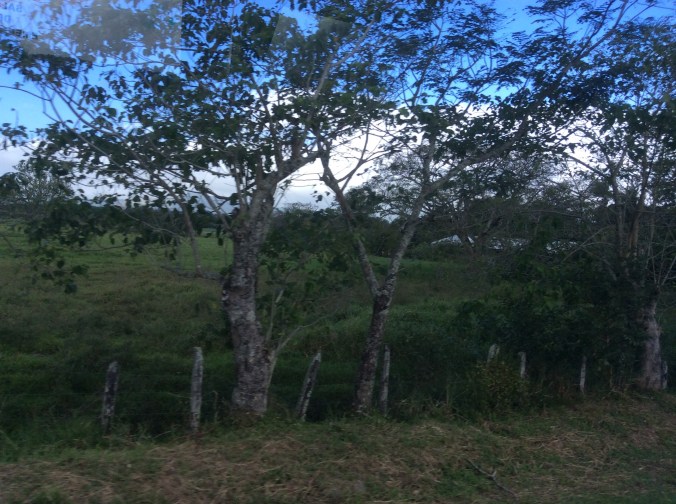
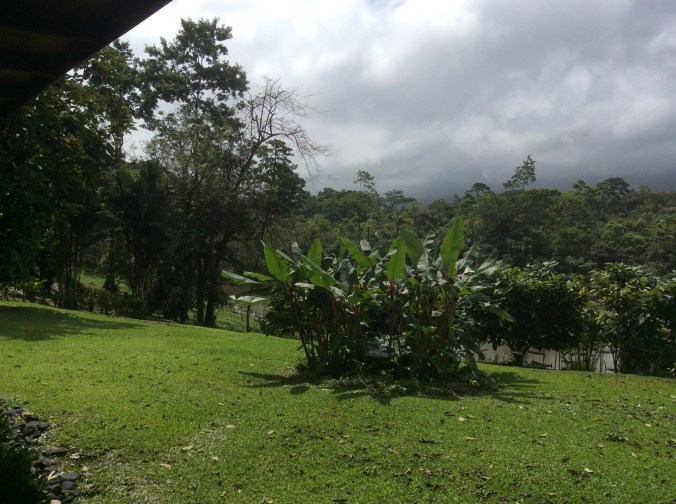
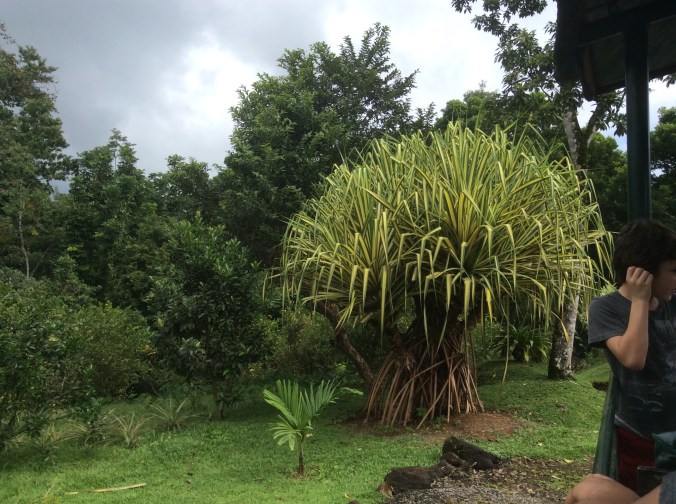
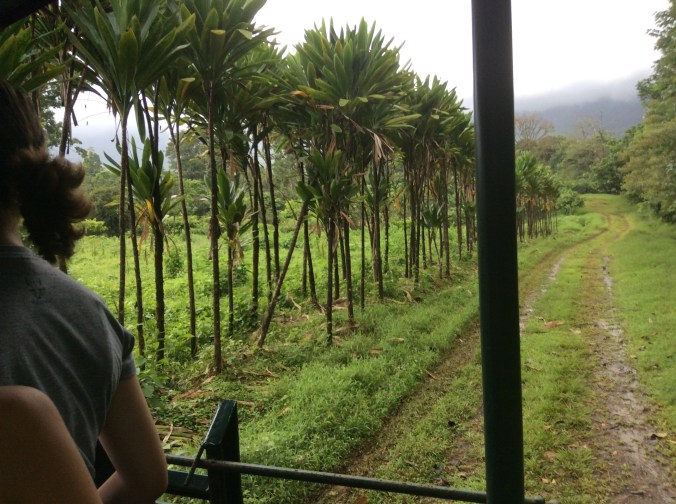
After visiting the Tony’s gallery, we headed north on mostly non-paved, narrow roads.  The clouds increased; the landscape became greener if that is possible.  We crossed to the Caribbean side near the Nicaraguan border.

IMG_2001

IMG_2007

IMG_2008

IMG_2014

The previous photos were taken from the bus window on the way to La Anita which is located more or less just above where the a is located in the word Cordillera at the top of the map.  It lies near Rincon de la Vieja National Park (Volcano Vieja) past Volcano Miravalles–the volcano covered in clouds in the previous Costa Rica post.

IMG_2010

As soon as we arrived, we came to the veranda of the building where they process cacao.  This view overlooks the road in and a small pond.

IMG_2012

Ginger plants in front of the pond, bouquets of ginger flowers, and rain clouds greeted us.

IMG_2011

I had no idea that the ginger roots we eat come from plants that look like this.  We later ate lunch in the building in the distance.  First, seated on picnic tables on the veranda, we drank pure chocolate grown on the ranch and coffee grown on another property at higher altitudes.  Cacao requires lots of rain and tropical heat.  This coffee is shade grown at much higher altitudes, e.g. 1500-2000 meters, by 700 families who belong to the cooperative which produces the coffee.  The coffee from here (Finca la Anita, Costa Rican Dota Mountain Coffee) requires much less sugar even for those who love lots of sugar in their coffee.

The couple who own and run La Anita primarily grow organic cacao.  Originally, they sold what they grew and did not process it there.  They decided to accomplish what they wanted, to grow and sell the most sustainable quality chocolate in the world, they would have to control the entire process themselves.  One of their specialties is a healthy replacement for Nutella, La Anita Chocolate Spread.  We bought four little containers and carried them around the rest of the trip.  Rather than spreading it on something, I keep it in the refrigerator and spoon out a tiny sco0p when I want a super treat.


IMG_2015

Nearly constant rain and heat produce a botanical heaven.

IMG_2016

A tractor pulled wagon took us through the lushness to the area with the cacao trees grow.

IMG_2017

IMG_2018

We finally arrived where the cacao grows.

IMG_2019

In addition to cacao, they grow other crops because cacao takes a long time to grow and the chocolate market worldwide is very unstable.

IMG_2020

Open up cacao and you find all this fuzzy stuff inside.  Yes, it is actually tasty.  Like with coffee, you eat–actually mostly just suck on it–the outside.  The bean is the seed inside.

IMG_2021

If you want to walk around here, sandals are not a good idea–too many snakes, many of which are poisonous like the fer-de-lance.  Yes, they live here.  Like where I live, this requires looking at the ground and paying attention where you are walking. This is the owner.  The name La Anita comes from his wife.IMG_2023

IMG_2024

The view of the lake from the building where we ate lunch.

IMG_2025

This is the hearts of palm plant which shortly after this photo was taken became the main ingredient of ceviche of hearts of palm which we ate for lunch.

IMG_2026

Making ceviche of hearts of palm in the white square bowl.

IMG_2028

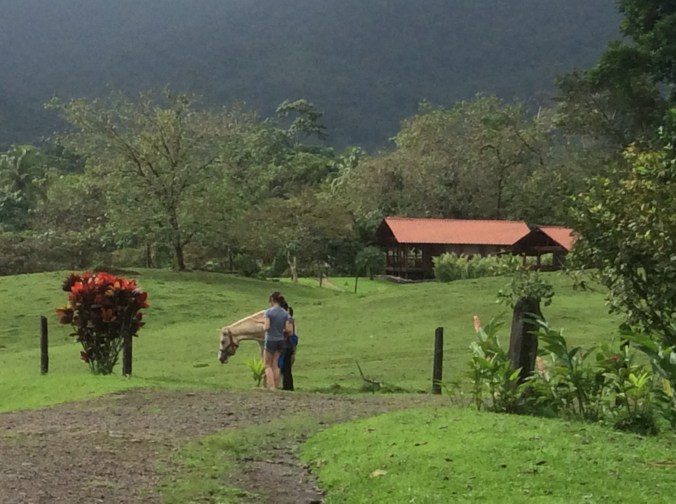
After lunch I walked down the road to the pasture with the horses.  In the background are cabins they rent.  From here the traveler can tour several national parks including Rincon de la Vieja National Park which is quite close.

This is one of the rainiest parts of Costa Rica, located on the northern Caribbean side.  It rained several times while we were here.  The rain stops for a while, a downpours arrives, it stops.  This process continually repeats.


Don’t eat This or Else…


This title showed up as an article in my latest “Yoga Journal”.  We hear warnings all the time about various foods so much so that sometimes I wonder just what I should eat.  The article details research on three foods which may be dangerous to ingest.

The first one is rice which really frightened me at first because I really, really like rice and eat it multiple times a week.  The problem with rice is arsenic, yes, arsenic.  Everyone knows that arsenic is not good.  Due to arsenic containing herbicides and pesticides, harmful levels have been found in rice.  Why?  Rice grows in water and therefore absorbs ten times more arsenic than other grains.  This not only means humans need to be careful about eating rice but also other products such as brown rice syrup found in infant food and energy bars.  Is organic safer?  No.  And forget eating brown rice because it contains 80 per cent more arsenic than white rice.  These rice warnings also apply to products made from rice including crackers, pasta, cereal, even rice milk.

Does this mean eliminate all rice?  Not necessarily.  Some rice has much less arsenic than others.  The safest rice from the arsenic standpoint is white basmati from India, Pakistan, and California.  Lundberg is one company that tests for arsenic so their rice should be safe as well.  Rinsing rice thoroughly helps.  You can also cook it in extra water and drain like you would pasta.  Boiling leaches out the arsenic.

The verdict is still out regarding GMOs.  Some countries have banned GMO foods totally.  According to the article in “Yoga Journal”, the only GMO crops commercially grown here currently are soybeans, corn, canola, cotton, alfalfa, sugar beets, papaya and some summer squash.  The FDA has approved an apple that does not turn brown and a potato that produces less carcinogenic compounds when cooked at high temperatures.  If you want to avoid GMO, look at the list above.  Some farmers are growing non-GMO soybeans.  However, they usually go to foreign markets which do not want GMO products, e.g. China.

For me, the worst on the list, carrageenan, remains the most hidden because most people do not even know they are eating it.  Where is it?  In ice cream, yogurt, nut milk, canned whipped cream, cottage cheese, salad dressing.  Why care?  New evidence indicates it may cause all sorts of health problems from gastro-intestinal inflammation to cancer and diabetes.  The only way you will know if this is in a food product is to carefully read the label.  Some zero fat yogurt contain it and some do not.  Silk brand nut milk does not contain it whereas several other popular brands do, e.g the ones that are not in the refrigerated section at the grocery. Some companies are fazing it out of all their products; this includes Horizon and Silk.

The only way to eat for good health and be safe it seems is to keep up on the latest research and read the labels.  Know what you are eating.  Bon appetit.

IMG_1430

Note:  the rice used here is basmati from Pakistan.

My Ideal Audience


The fourth assignment in my newest experiment, Word Press’ Blogging 101 class, is to write a post for my ideal audience. My immediate reaction was, “There is no such person; I do not have an ideal audience.”  I might be able to come up with three or four persons, some of whom might like the recipes, others might enjoy the travel posts, and another group might react to comments on the environment, international politics, and sundry controversial topics.  Finally, a few, perhaps more, might relish the occasional poetry pieces.  After all, my haiku posts attained more readers than I ever expected.  The challenge then might be to write a post combining several of these but how?  Here we go on another adventure.

My idea reader would enjoy literature, especially the serious and more especially literature from other countries and cultures, like to eat hot foot from diverse cultures, travel to other places besides here and Europe, care about the environment, follow international politics, and, even though not previously mentioned, like horses, prefer the country to the city, and enjoy a wide variety of music.  Do such individuals exist?  Where are they and how do I find them?

Here is my first attempt at covering at least two of these topics:

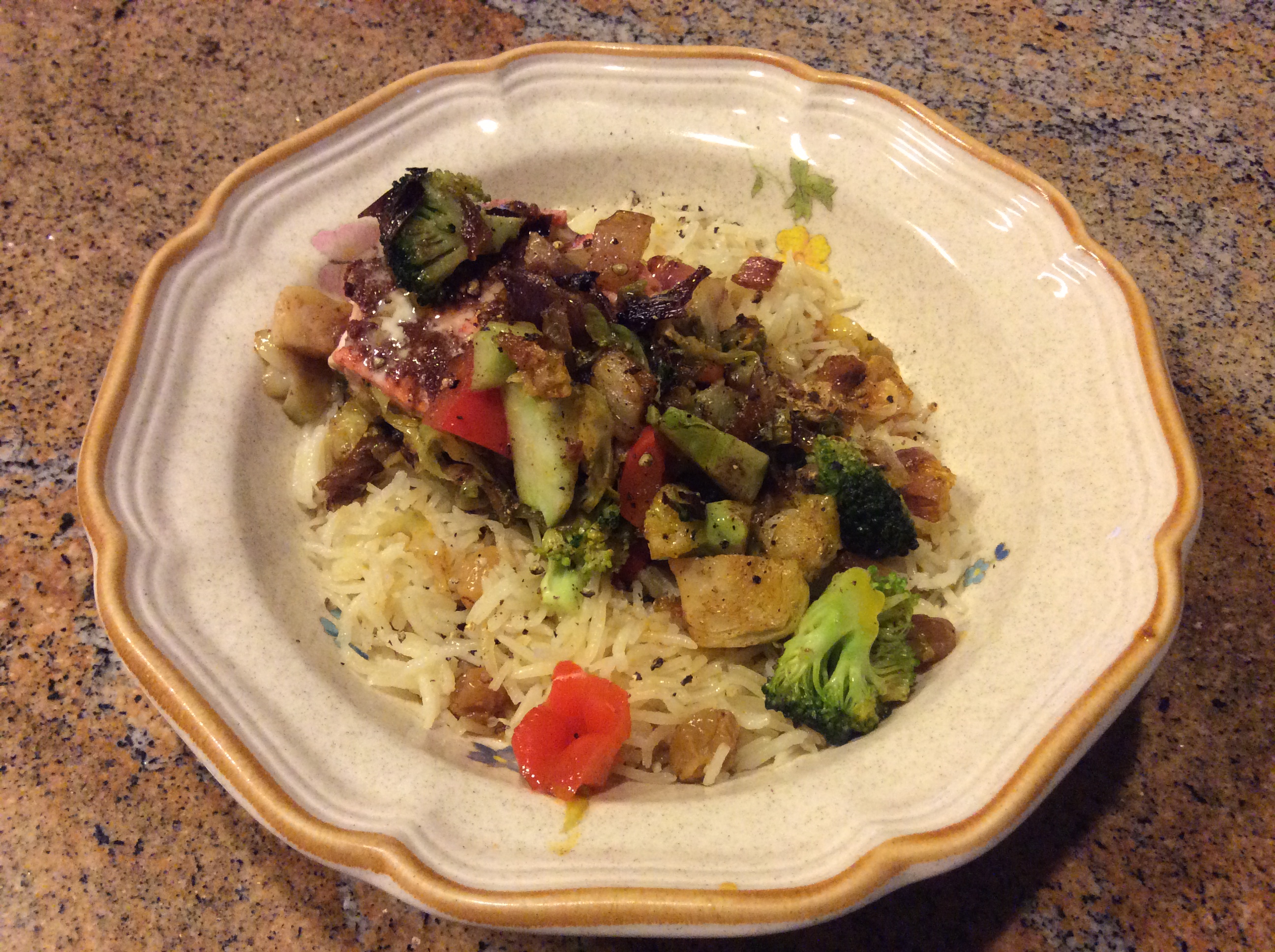
Last summer, as former followers know, I traveled with friends to Ethiopia for three weeks via Dubai.  Because I love the stuff, I brought back an entire kilo of berbere.  Mine follows the special recipe of my Ethiopian friend’s mother.  She had it made special just so we could bring it home.  Actually there were three kilos in my bag but only one for me.  My new favorite salmon recipe involves the use of berbere.  Unlike some, hers is more rich and spicy rather than really hot.  This will serve one to two, just increase the amount of all the ingredients to suit the number of people you plan to feed.

1-2 portions wild sockeye salmon–you could use any type of course

4 medium to large brussel sprouts, coarsely chopped

1/2 purple onion chopped coarsely

Several broccoli florets

1/2 ripe bell pepper, seeded and chopped

Olive oil

Berbere

Cover the bottom of a skillet with olive oil.  Add onions and sauté until translucent.  Add the brussel sprouts and sauté until nearly tender.  Add the peppers and broccoli.  Sprinkle a light layer of berbere over all the vegetables as you cook them.  Stir occasionally.  Add the salmon, skin side down.  Sprinkle berbere over the salmon so the salmon is covered but only lightly.  You can add more to taste.  Continue cooking until the salmon flakes.

I serve this with rice.  The rice in the photo is basmati.  See previous posts for the special way I cook rice.  Sometimes I vary the vegetables using poblano peppers, carrots, Swiss chard–whatever I happen to have or feel like eating at the moment.  Pick what you like.

IMG_1430

This, honestly, is nothing like real Ethiopian food in part because I do not have teff and do not know how to make injera.  The photo below shows me and friends in a restaurant in Gonder, Ethiopia, in my idea of food heaven.

IMG_0757

Rye Bread with Cardamon and Golden Raisins


Every year for so many years I fail to recall, I have made this bread during the holiday season.  Why then, I have no idea because the bread is not just for winter or anything in particular.  It makes three loaves and a good present; maybe that was the original reason.  It also takes more time than ordinary bread; I usually have time off during this season.

2 packages yeast

1/2 cup warm water

1 1/2 cups light cream or evaporated milk

2 cups unsifted, unbleached flour

3 eggs

2/3 cup sugar

1 cup butter, melted and cooled

2 tsp. fresh ground cardamon

1 cup golden raisins

1 cup milk

2 cups rye flour

1 cup whole wheat flour

3 – 3 1/2 cups unbleached flour

In a large bowl dissolve yeast in water. Stir in the cream or evaporated milk.  Add the 2 cups flour; beat until smooth.  Cover and let rise in a warm place until doubled.  Stir in the eggs, sugar, butter, golden raisins, and cardamon.  Beat until smooth.  Add the milk and rye flour and stir until combined.  At this point using a dough hook makes it easier.  Add the whole wheat flour and enough of the unbleached flour to make a stiff dough.  Sprinkle remaining flour onto a board or granite counter top.  Knead until smooth.  Oil a large bowl, place dough in bowl and turn to grease both sides.  Let rise until doubled.  Punch down and work into a smooth ball.  Divide into three equal portions.  Place in three pans of your choosing (I use one regular loaf pan and two cake pans).  After dough has risen to double in size, bake in a 350 degree oven.  While loaves are still hot, brush with butter.  Allow loaves to cool before removing from the pans.

This bread is especially good with Swiss cheese or other similar cheeses and makes a tasty left over turkey sandwich.


Talapia with Beets, Red Peppers, Swiss Chard and Bebere


This recipe makes good sized portions for two people.

2 talapia filets

1/2 red onion, coarsely chopped

1 red bell pepper chopped into bite sized pieces

1 medium sized beet, thinly sliced

2 handfuls Swiss chard–if large pieces, take a knife and separate the middle spine from the leaf part

Chop the spines and add to the onion

Olive oil

Cover the bottom of a large skillet with olive oil.  Add the onions, chopped Swiss chard spines, and beets–I cut the beet slices in half.  Saute until the onions are somewhat caramelized and the beets almost tender.  Add the peppers and 1-2 tablespoons bebere or to taste.  When the peppers are half done, add the filets.  Sprinkle extra bebere over the filets.  When they are almost tender, add the Swiss chard and sauté until the Swiss chard wilts.  Serve over rice.

Note:  I grow my own Swiss chard in a large pot in the house.  This enables be to have my own supply.  However, the leaves are tiny compared to the large leaves in the market, making it unnecessary to cut the green leafy part away from the center spine.  Bebere is an Ethiopian spice which is slightly hot; it has a wonderful, unique flavor. You can use whatever spices you prefer.

1501692_10202308519748276_7838086885092813556_n

Lazy Day and Dinner


Cool and cloudy reigned today.  Now tornado warnings west of here glide across the TV screen I’ve turned on mute.  About now, the severe thunderstorms are supposed to start.  A repeat of yesterday when I took these photos from my patio.


SAM_1564


SAM_1565


SAM_1566


Fed Rosie earlier to beat the predicted storm, swept the dirt and little rocks from yesterday’s storm off the drive, and strolled around to get some exercise.  After several hectic days of no cooking, decided to cook something vegetarian.

1 medium sized purple onion coarsely chopped

6 medium brussels sprouts cut in half

1/2 large red bell pepper coarsely chopped

1 teaspoon chana masala (East Indian spice)

1 teaspoon berbere (Ethiopian spice)

Olive oil

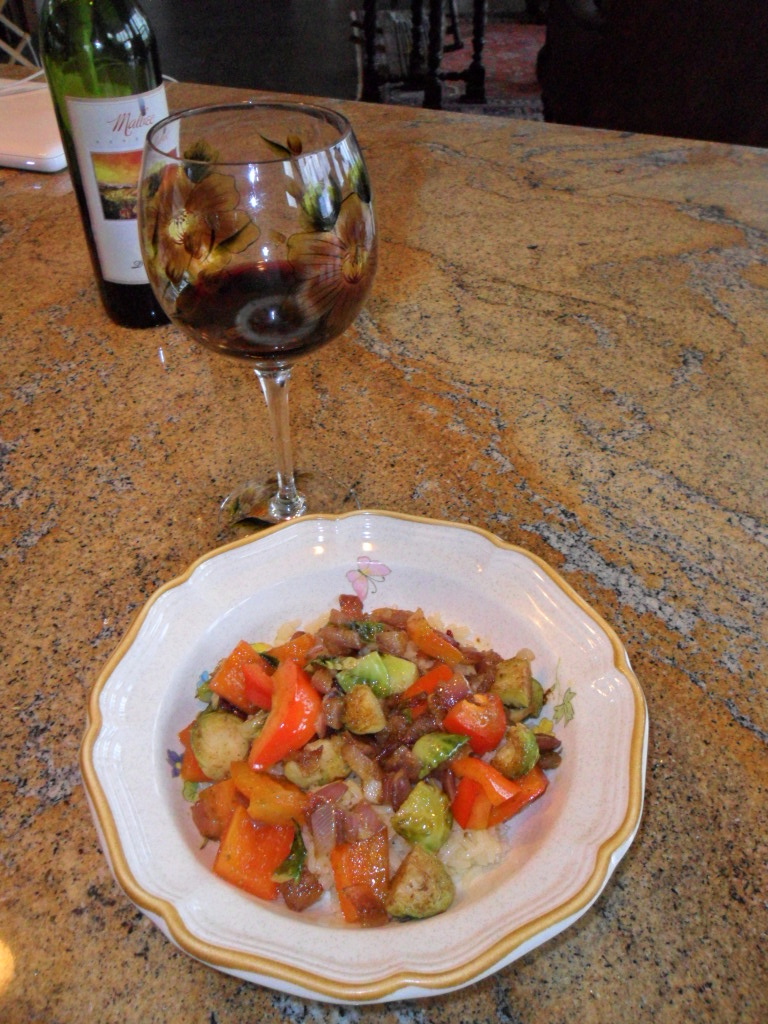
Pour enough olive oil in 8-10 inch skillet to cover the bottom.  Saute the onions in the oil until translucent.  Add the brussels sprouts and spices.  Stir and cook until the brussels sprouts are cooked but still crisp.  Add the red pepper and sauté.  Do not over cook.  Serve over Jasmine rice.

SAM_1567

Not quite ready but almost.


SAM_1568


Berbere on left sent from Ethiopia by my friend’s mother.

SAM_1569


Jasmine rice ready to serve.  Here is how I cook the rice:

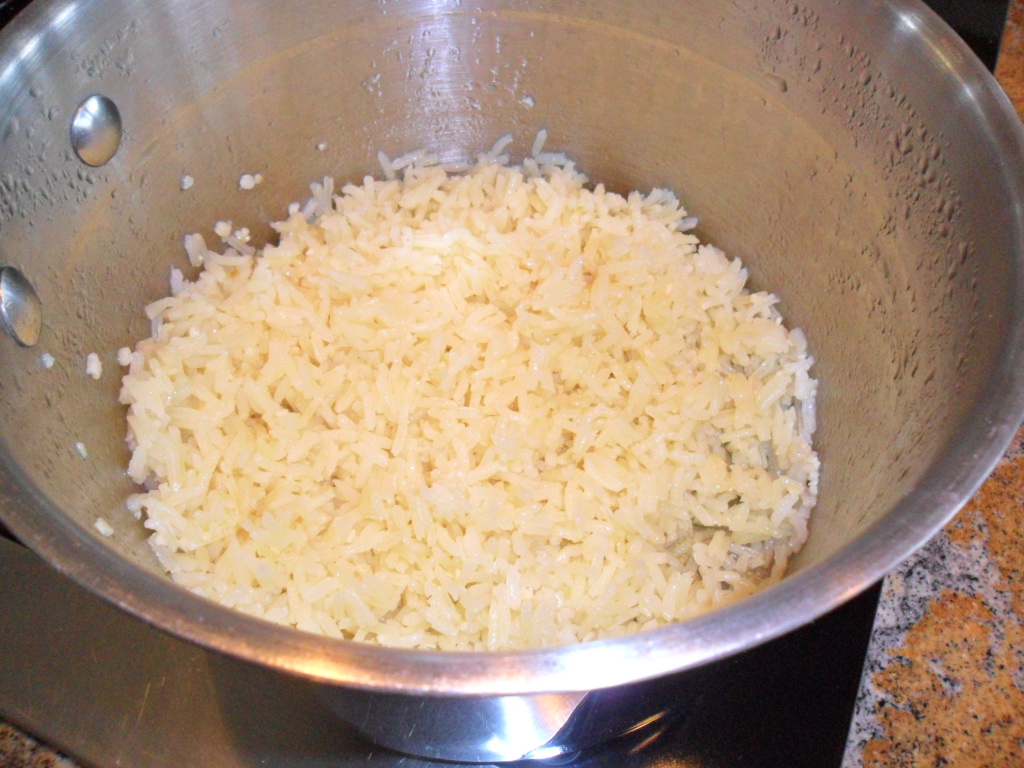
Pour enough olive oil in the bottom of the saucepan to barely cover it.  Add 1 heaping tsp. finely chopped garlic and briefly sauté.  Add one cup rice (here I used white but sometimes I mix red, black and white evenly) and sauté a little bit more.  Add two cups water and 1 tsp. vegetarian bouillon (I prefer Better Than Bouillon).  Stir and cover with several paper towels or one thick tea towel.  Place lid on top and turn down to low.  Cook 1/2 hour if using only white rice.  Other rice requires double the time.

SAM_1570


The finished product ready to eat.


Now I am going back to reading while awaiting the lightning and thunder.  About 1/3 way through a light but entertaining read:  “Coyote Cowgirl” by Kim Antieau.


Commitments, Hosting Benefits, and What We Take for Granted


Shortness of post is necessitated by the time.  Why bother?  Nearly three weeks ago, I committed to writing daily.  Blogging seemed like a logical means to accomplish this.  I expect others and myself to follow through on commitments.  So here I am writing in the middle of the night.

Tonight I hosted a fund raiser for the Hilltop Senior Center here in Amarillo.  We tried to sell tickets in advance but not all that many sold.  The Director of the Center and I became a bit worried, but continued with planning, hoping some would show up even if at the last minute.  They did.  We had great Mexican food donated by Braceros on Sixth Avenue, wine, my wonderful well water, cheeses, fruit, and cakes.  Even the silent auction proved to be a great success.  However, nature became the real star of the event, nature and my dog Isabella.  Unlike earlier in the week when the wind shrieked to 6o miles an hour creating several days of endless dust, today the wind laid low, the sun shone, and it was hot.  This morning the heat went on and this afternoon the air conditioning as it rose to past 90.  Thirty degrees difference between night and day is rather typical here and some days, like to day, this difference increases to nearly forty.

At dark the stars seem so much brighter out here in the country.  Many of the guests walked back and forth on the patio, looking for different constellations.  People came inside for a while only to go back out and look at the stars and the crescent moon.  What I take for granted daily, became a wonder for my company.  As I write this, I think about all the things each of us take for granted, things we eat, experience, feel daily.  How often do we really take the time to appreciate these things, to realize that although they may be ordinary for us, for others they would be incomparable blessings.  So now as I finish this, get ready for bed, and snuggle into my cool sheets, I will meditate and give thanks to the universe for the wonder of the stars.