This novel surprised me by being a page turner. Once I read through the first couple of chapters, I had to keep going. In Southern California the Salton Sea, once much larger and the home of a thriving resort, now has shrunk and only a few people live there. Not far away lies the Imperial Valley, one of the largest agricultural regions in the US which is close to the Mexican border. This is the setting of the story of the little town of El Valle, the surrounding areas, and the tale of two families, one rich, white landowners, the other Mexican-indigenous. Mal, one of the main characters, has always lived on El Valle, worked hard, tried to forget the disappearance of her sister, and raised two daughters alone. Another local girl goes missing, then a week later her youngest daughter also goes missing. Frantic, she searches for answers, wonders if there is a link, and keeps dreaming of the local, indigenous legend of the horse headed woman, El Siguanaba. Meanwhile readers learn about the long friendship and affair between Mal’s oldest daughter, Griselda, and the son of the valley’s largest, white landowner, Mal’s difficult, disabled mother, her father, and brother’s, one of whom is running for office after going to Stanford, and the youngest brother, Benny, who is now a detective. Not only does this work of fiction combine Latinx and indigenous cultures, it also addresses environmental collapse, family secrets, and the complex relationships between mothers and daughters.
Although the subtitle says “A Global Food Philosophy”, most of it is an analysis of actually how the world does eat, including some rather remote tribal people, rarities in this contemporary world. This how also includes an analysis of how food affects health in different parts of the world, noting that although contemporary recommendations push vegetables and the Mediterranean diet, some people have no access to vegetables and eat mainly meat and fat and remain healthy. In other cases, like the Masai, cattle provide everything in their diet. The reader gets a broad based view of the best and the worse of diets and food practices worldwide.
A substantial portion of this tome–it is nearly 400 pages long with notes and index of more than 50 pages, looks at industrialized nations and world food supply, including the monopoly large food producing corporations maintain over what is available at grocery stores. Food is big business. The different definitions of food processing is covered as well as the good and bad. He debunks some common beliefs about food and health and notes that while people go hungry in some parts of the world, there is a surplus of food in others.
After all the analyzing and discussions, the last chapter covers “A Global Food Philosophy”. This includes recommendations for what we can do to create a healthier and more equitable worldwide food system while also saving the environment. He lists seven principles one of which is that our food management should be compassionate toward animals if we are going to eat them.
After reading 17 serious books to date this year, I decided it was time to read something lighter and found this latest in the No. 1 Ladies Detective Agency series at the library. If you are looking for lighter reading, sort of mystery stories without murders, and insights into a different culture, Botswana, this series is for you. Start with at least several near the beginning of the series so you get to know all the main characters to fully appreciate what occurs and who’s who.
This novel gets its name from a traditional hotel located way out in the countryside far from city. It is a relaxing place with a lovely veranda and native gardens full of flowers and succulents. Strange things begin to occur–food poisoning, scorpions in rooms, laundry disappearing from the clothes line–too many for it to be by accident. The hotel manager comes to see Mma Ramotswe and Mma Makutsi for help. At the same time Mr. J.L.B. Matekoni has a male client who asks him to find him a fancy, red, Italian sport car without his wife knowing anything about it. With their customary good humor and kindness, these characters set out to solve the problems of the hotel and deal with the sports car issue.
As usual in this series, one learns that quite often people accuse the wrong person, that things are often not as they seem, and that your own prejudices and inclinations can lead you totally astray.
This Omani author has won prizes for his fiction. Only a few of his books have been translated into English. This one takes the reader into the remote villages and mountain regions of the interior of Oman. Azzan, the main character, had received highest honors as a child and teen for his academic excellence but fails to win a coveted scholarship to travel abroad for college. His father, who is mainly absent during his growing up, berates him, and Azzan turns to alcohol and addiction. Eventually, he saves himself by becoming a beekeeper. He finds solace in the more remote, wild regions rather than the narrow confines of village life which is controlled by gossip and tradition.
In these wild areas he meets two other men. Although they do not keep domestic bees, they go camping together in the far mountain areas hunting for the prized honey from wild bees. One of these men is a Bedouin who trains prized racing camels. Through him and his wife and friends, he learns how much freer Bedouin culture is compared to that of the settled villages. He learns to dance and talk more freely with women. While in one remote area, he meets a woman, Thamna, who too has escaped the traditional village life and roams the wadis and mountains with her herd of goats always looking for better pasture. He becomes obsessed with her, always on the outlook as he keeps his bees and roams the interior of Oman hunting bees.
This story is not only about Azzan, but also his friends, traditional Omani village life, bee culture, and Bedouin life. For those interested in bee keeping, the author provides detailed descriptions of bee keeping. The language is poetic and infinitely descriptive. I could feel the wind, smell the different wild flowers and the taste of the honey created from them, see the Bedouin dancing, and feel Azzan’s heartbreak when disaster hits.
Although this novel describes a culture far different from that of the US and Europe, I found some things not all that dissimilar: the strict rules of small town life, the greater freedom found in nature, how people develop and lose interpersonal relationships. The language used makes the reader feel there in the moment being described. Plus I learned that bee keeping is very labor intensive and wrought with many things that can go wrong. I eat honey daily and now will have a greater appreciation of what goes into its production and harvesting.
Can you call yourself a creative writer if you have not written a word in months? I have a friend who promotes 20 minutes of writing per day, telling people to just write, forget quality, just write. Really?! I care about quality. Perhaps too much? I make sure to read quality writing 99.99% of the time. Is this just words I am writing here or is it quality or garbage? You tell me!
One thing I can do is read. I’m good at reading. And singing. And gardening. I talk to plants; that’s why they grow for me. I truly care. They bring me peace and joy.
In the last two months, I’ve read three collections of short stories, two by Anthony Doerr and one by Gayle Jones. Normally, I am not a short story reader, but here I am reading these. Talk about different. It’s almost like these two famous writers inhabit different planets. Doerr’s stories seem intensely emotional, often a bit fantastical and heart wrenching with a lush, descriptive, poetic style even though Doerr is not a published poet. Jones is a published poet, yet her stories are blunt, conversational, often first person and sometimes short–one page short.
In many, a character is telling his or her (most of the stories are her) story about where they are, some experience, somebody they knew, what they did or said. In one story the narrator says she’s an angel, explains where she’s been, whom she’s known, and ends up by asking readers if they’ve seen her near the Seine. I doubt anyone mistakes me for an angel.
Note: Book 13 for 2025 is “Butter”, Gayle Jones. A collection of short stories.
A tiny book by the author of “Braiding Sweetgrass” envisions a totally different economy than the kind we have now. She uses a plant, the serviceberry, as a symbol for what she calls the “gift” economy. Instead of everything being focused on maximizing profit, it focuses on sharing and exchange and the idea that natural resources are gifts from Earth, from nature, rather than commodities to be exploited for profit.
She notes that capitalist economies hinge on the concept of scarcity and personal accumulation of wealth often at the expense of others. Gift economies, which occur in many indigenous cultures, focus on the mutual benefit of all which encourages gratitude and trust. Later in the book, she discusses how gift economies can be implemented and flourish alongside the current capitalist economy.
There must be considerable appeal for her concepts because this book has been on the non-fiction best seller list for weeks.
This book contains 20 fantastical and dystopian short stories. I found them fascinating with topics ranging from selkies to ogres to ghouls to jinns to witches (in this case positive ones). The settings range from US to Africa to a settlement in outer space (the story “Fallow”). Divided into two sections, Tender Bodies, Tender Landscapes, these stories address human frailty, anger, greed, extreme religions and how humans treat each other (both good and bad) and what might occur in the future if people do not behave better. “Fallow” is a sort of handmaid’s tale where instead of being on Earth–which has been basically destroyed–a group of extreme religious folks have made a place for themselves on another planet after escaping Earth. If anyone from Earth accidentally shows up, they are in big trouble unless they become just like the people already there. Otherwise, they do not kill them–that is wrong–but just sort of let them slowly die. These stories, both brutal and lovely, display an incredible imagination.
While I found her first book, “The Tiger’s Wife” fascinating, I remain uncertain regarding this one. First it is long, 374 pages (I do read long books); second, it tells two different stories which do not interconnect at all until the end of the book. I kept wondering, asking myself, “What?” For me at least, the story picked up about half way through and my interest greatly increased.
One storyline is the life of one homesteading family in rural Arizona in the 1850s told mostly from the viewpoint of the wife. Her husband tends to wander off for long periods of time leaving her on her own with their children. His latest adventure is not only their homestead but also owning and running the local newspaper in the nearest town. The reader also meets some rather powerful but unsavory characters who want to own all the cattle and all the land.
The second storyline deals with the men who were hired by the government to bring camels to the West and manage them, one of whose story–a real historical person–is told. His name was Ali, a Syrian cameleer, who died in 1902. He was called Hi Jolly because people in US seemed unable or unwilling to pronounce his real name correctly. This part is told from the viewpoint of another cameleer, Hi Jolly’s friend, who has a criminal history and is trying to elude the law. Camels were brought to the US by the United States Camel Corps in the 1850s. At that time few roads existed in the Southwest, water was scarce, and camels were known to be able to go long periods without water. The experiment failed so camels were left either in the hands of the individuals who rode and cared for them or left to roam wild. Some of the men, including Hi Jolly, were able to open businesses transporting goods to remote areas via camel. This book details part of that history.
In both storylines one recurring theme is the lack of water. At one point the homesteading family have no water at all. In the other storyline people hire the cameleers to take them to places not realizing that even camels need water occasionally. I find it telling that 175 years later we continue to struggle with water issues in exactly the same part of the country.
This past weekend I headed to Mexicali in Northern Baja to visit the town of San Felipe and see a new development about an hour south of there. San Felipe is a small fishing town of approximately 20,000 people where there are no fast food restaurants and no Starbucks. Excellent restaurants and good coffee can be found but not at the places mentioned above. They do not exist there. The town of San Felipe has a long boardwalk right along the Sea of Cortez with restaurants across the street. This past weekend they were holding a ceviche contest and fiesta on a cross street. This is shrimp season and the city is known for its shrimp. Unlike the Pacific side of Baja, there is no large commercial fishing allowed in this part of the Sea of Cortez because it contains many endangered fish and the place where whales come to mate. Locals can fish and you see smaller fishing and shrimp boats in the sea. Not only is the Sea of Cortez protected but so are the plants and animals in the desert. Certain plants, like ironwood trees, are ancient and rare. If you want to build a road, it has to be around them. Many other species are also protected.
Unlike the Pacific side of Baja, the water in San Felipe is safe to drink from the tap. It comes from an aquifer up in the mountains to the west.
We spent most of Sunday at the new green development (it is totally off grid) called Rancho Costa Verde. Solar is used for power and each house has a large underground water tank where water comes from an aquifer up in the mountains. This is a newer development so although many of the lots are already sold, except for beachfront, many houses are just now under construction.
This is a very modern beachfront property with marble floors and a glass wall facing the Sea of Cortez.
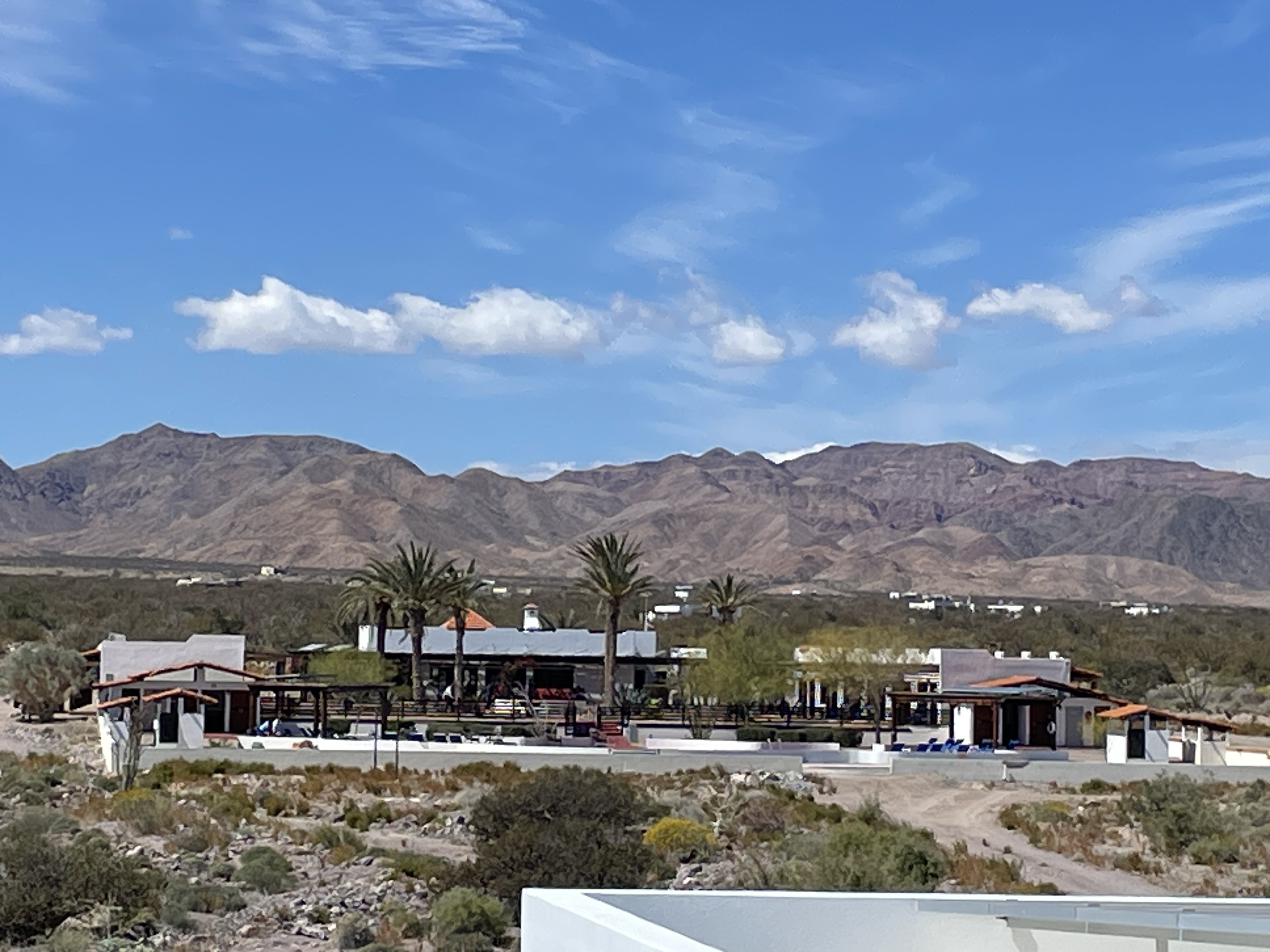
This photo is of the clubhouse and looking the opposite direction toward the mountains. Here I am standing on the roof of the house in the previous photo.
Here I am in front of the pool in front of the clubhouse facing the Sea of Cortez. The house in the first picture is on the left in the distance.
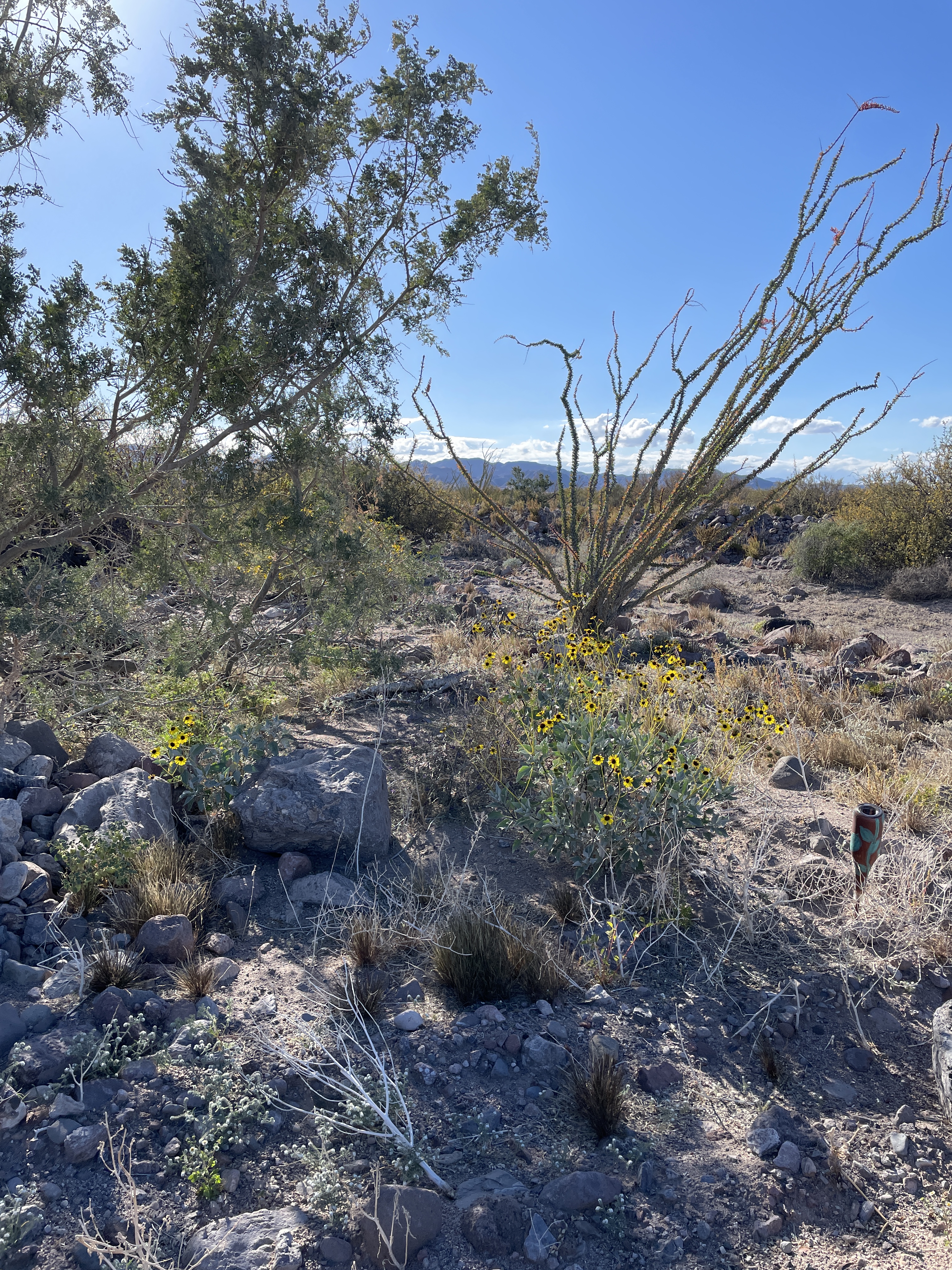
This is desert land where even though it can get hot in summer, the sea breeze keeps it relatively cool.
The plant on the right is ocotillo which is protected. If you are building a house and it is in the way, you have to move it elsewhere. You cannot just get rid of it.
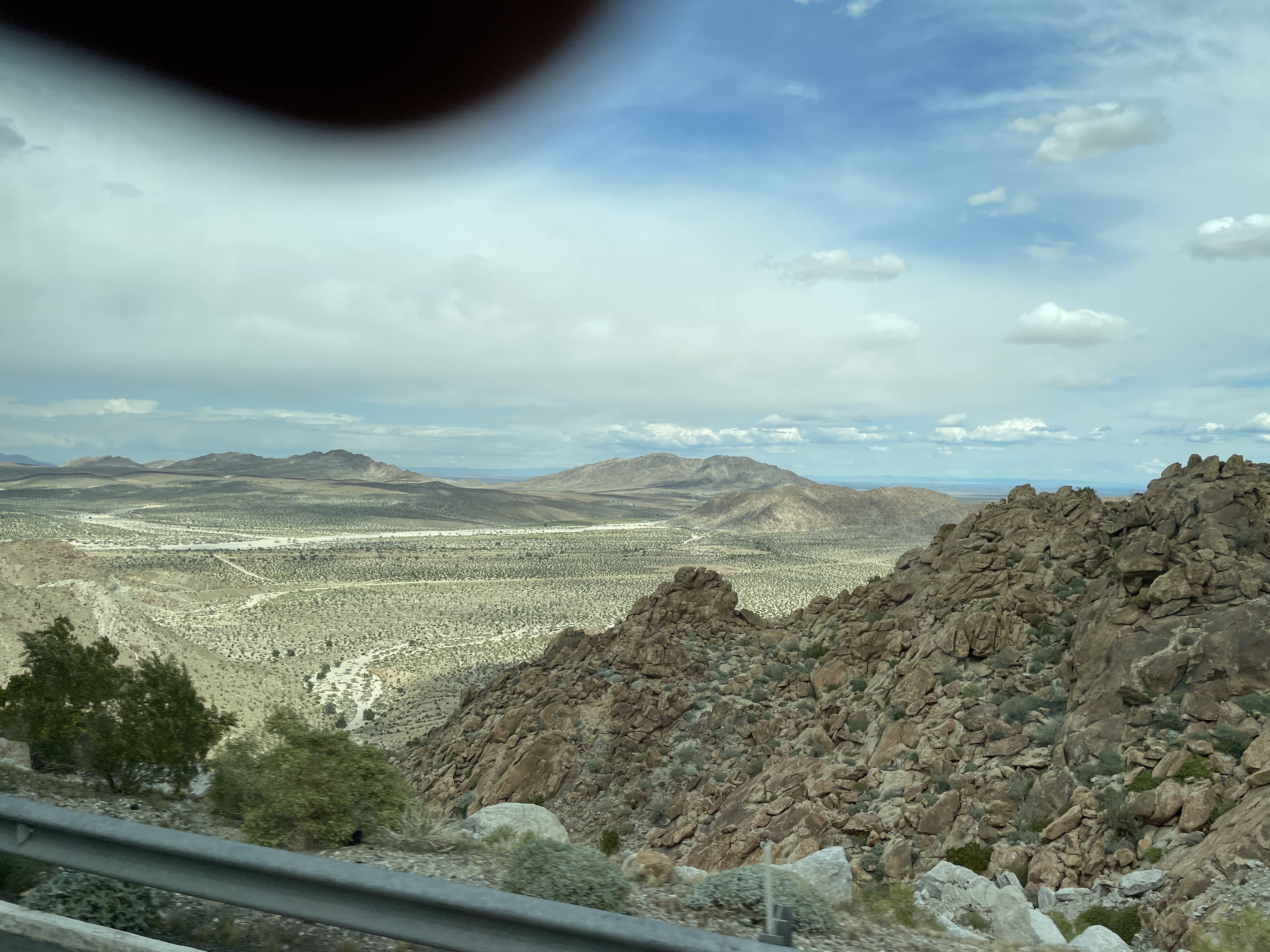
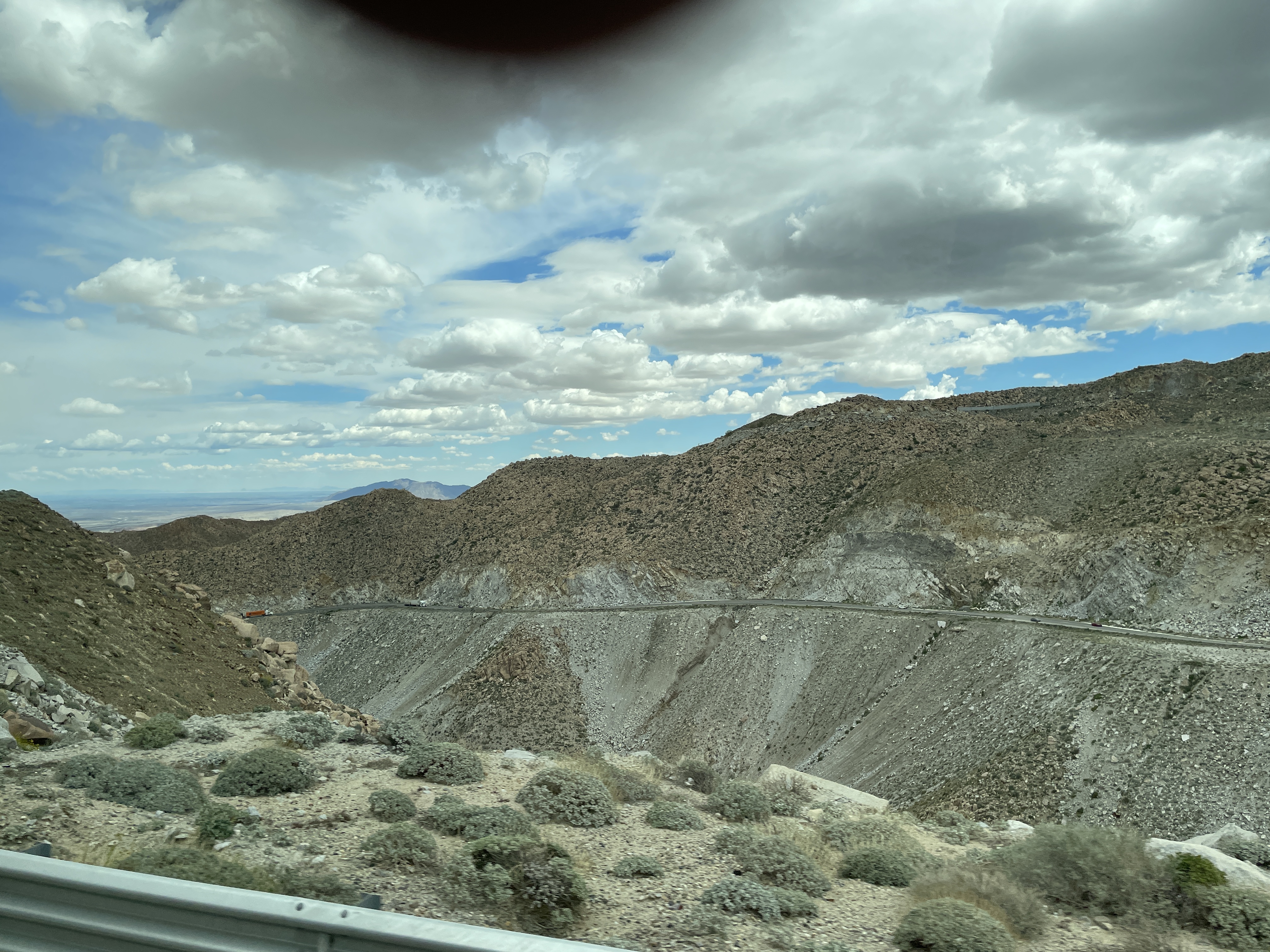
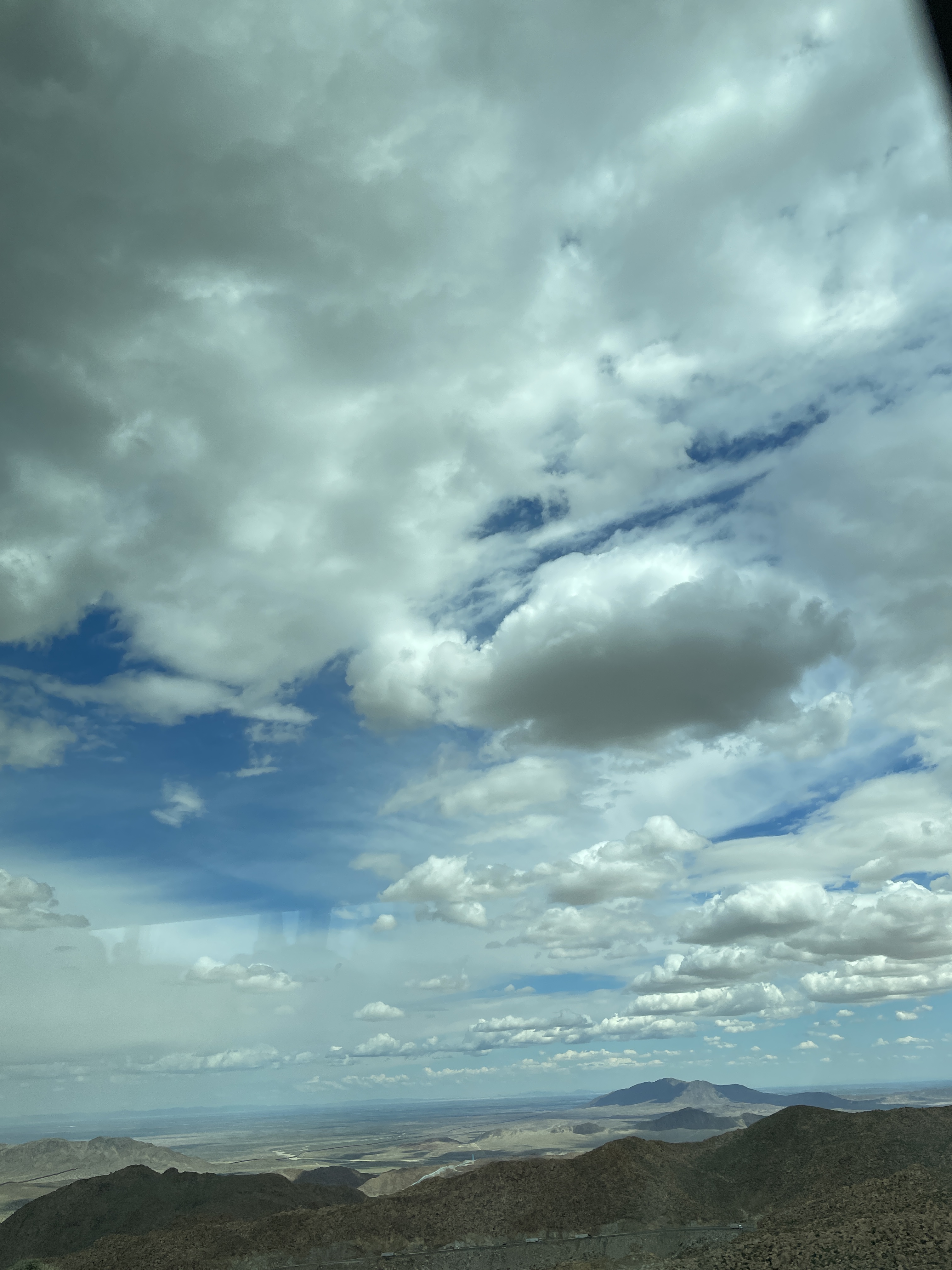
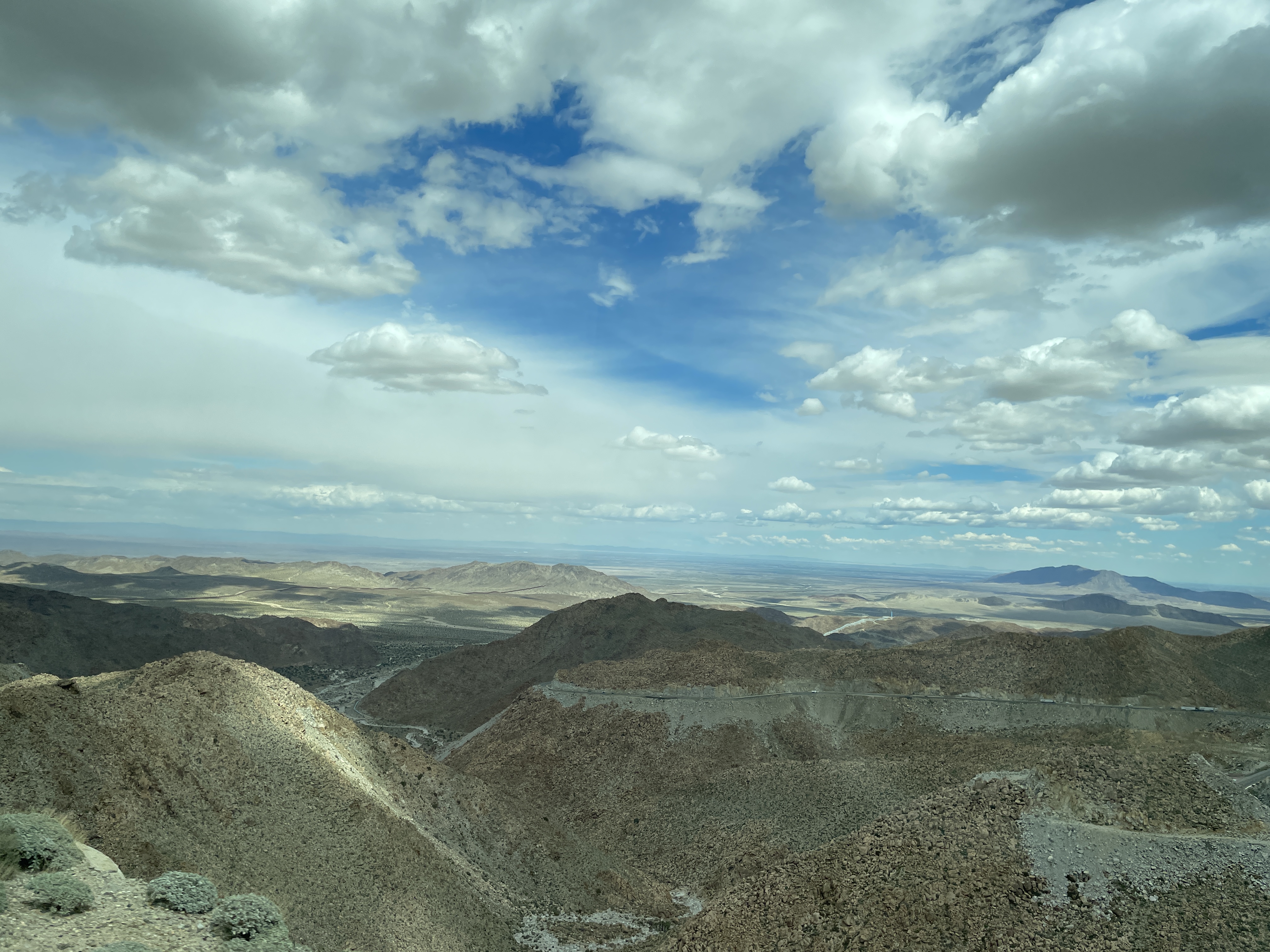
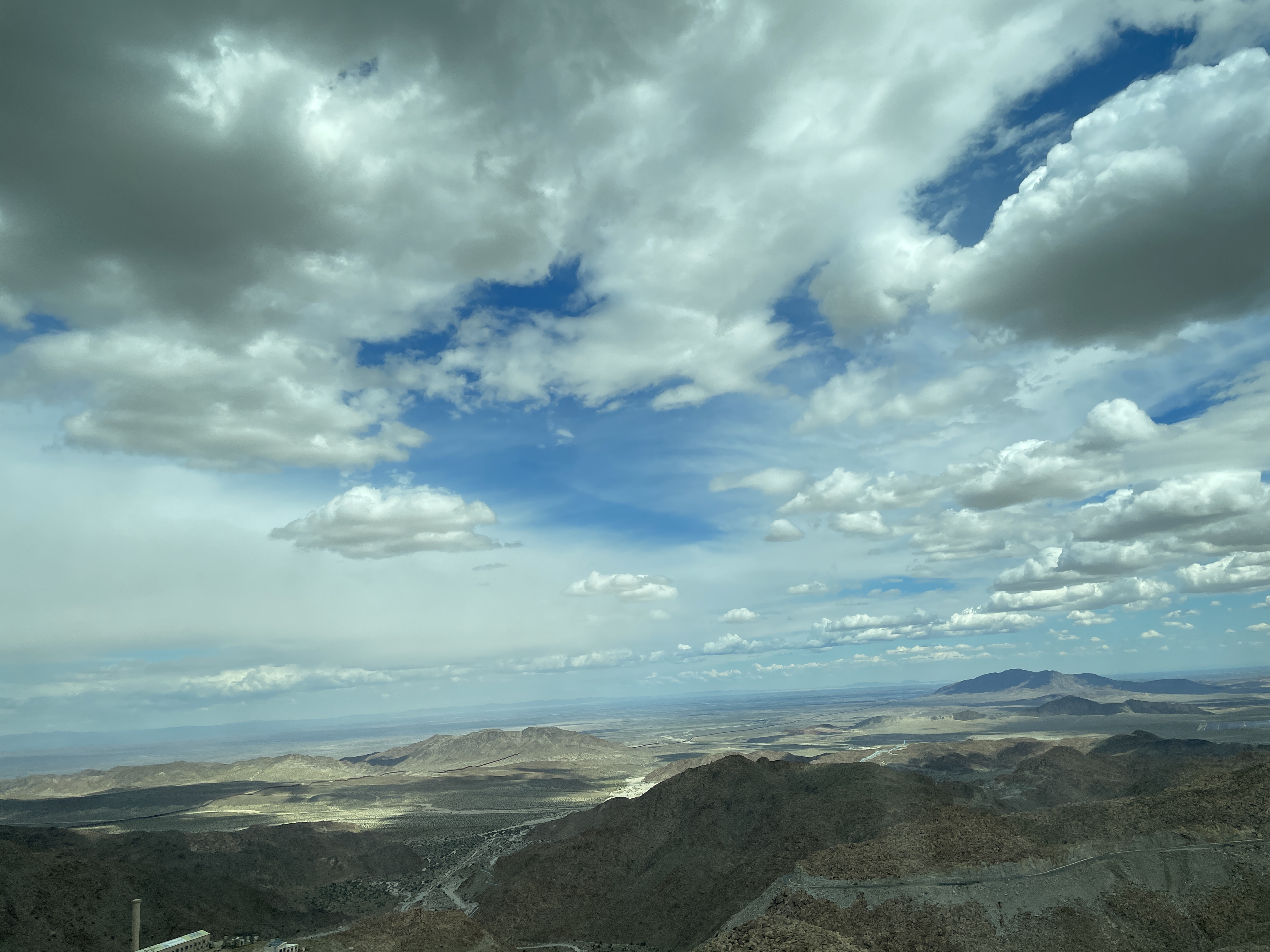
Monday was a big adventure trying to cross the border. We arrived in Mexicali only to discover no busses could cross the border there so we had to take the highway to Tijuana and cross there. To do this you must cross a mountain pass. What a feat of engineering building this road must have been. It is quite incredible and as you climb higher and higher the views go on forever into the far distance. The following are photos I took from the bus window as we drove higher and higher.
These mountains are made of rocks of all sizes that are just stacked on top of each other. Here only these small blue-green plants seem to thrive.
In this photo you can see the highway where we had just traversed.
Here you can see how at this height the mountains are nothing but stacked rocks of all sizes.
After the summit as we went down toward the town of Tecate, it started to rain and it rained most of the way to Tijuana. The Pacific side of this part of Baja gets rain and it was lush green this time of year while the Sea of Cortex side is desert.
I do not recommend crossing at Tijuana in a large bus. Even though we had sent all our passport information in advance, they made the bus sit there for nearly an hour and wait. Meanwhile those on foot and in cars were just zooming along at a rather rapid pace. Then we had to get out of the bus with all our luggage and everything and wait more. I crossed the border (not in a bus) last April and it did not take long at all. I have heard that Tijuana is the busiest port of entry from one country to another in the world but have not verified that. It certainly was busy yesterday.







 writingontherim