Book a Week-20: “Sankofa”, Chibundu Onuzo


After her mother dies, Anna searches through her mother’s belongings and discovers a hidden diary written by the African father she never knew and about whom her white mother, who never married, told her nearly nothing. She travels to Scotland to have the diary authenticated by an expert, researches, and discovers her father had to return to Africa, became a revolutionary, and then president (or dictator, depending on the source) of a small African nation. She also learns that he is still alive.

Leaving behind a daughter and white husband from whom she is separated, Anna decides to travel to Africa to find her father. Treated unequally as a biracial child in England, in Africa she is seen as “obroni”, white. Thus, the book addresses issues of racial identity, family acceptance (she does find her father) and belonging, and tells a tale of the adventures of a middle-aged woman in search of self.

One Book a Week-15: “Oh, William”, Elizabeth Strout


Told from the point of view of the main character, Lucy, in first person, the simple language the author uses as Lucy tells her story, reflections, and anecdotes belies the deep knowledge of marriage, parenthood, the entire human condition underlying this novel. Two once married individuals go on a trip to Maine to learn about a relative one did not even know he had until he received the results of a casual DNA test, a gift he did not originally take all that seriously. They’ve been married and then divorced for years and have two daughters together. In spite of their best efforts to the contrary, they remain connected even when they find each other a mystery.

A rather simple story, written in plain language, holds the following piece of wisdom–Lucy’s words which end the novel:

“Everybody in this whole wide world, we do not know anybody, not even ourselves!

Except a little tiny bit we do. But we are all mythologies, mysterious. We are all mysteries, is what I mean.

This may be the only thing in the world I know to be true.”

National Poetry Month-2: Butter Love


Is it inherited?

Six year old me watched Grandmother

look around, take silver knife, cut into pale

yellow rectangular prism, plop a chunk into

her mouth, close her eyes,

smile.

In Aunt Julia’s presence, this never occurred,

Was it our shared secret,

Grandmother and me?

Yesterday, I told the cafeteria lady,

“Please bring me biscuits, extra butter.”

Less courageous than Grandmother,

I use blue corn pancakes, homemade bread, pasta,

excuses to eat butter, lots of golden, melted

butter.

Who eats butter on conchiglie?

I do, scooping out a tablespoon

from the butter bowl, watch it melt

in hot, drained Italian pasta from a

six-hundred-year-old monastery,

sprinkle on some sea salt, plop

a spoonful in my mouth, close my eyes,

smile.

Note: This poem is published in my book “You’re Gonna Eat That? Adventures with Food, Family, and Friends”. My grandmother, Mom’s mom, rarely smiled. When Mom went to the hospital to have my sister, the family story is that Grandmother fed me so many bread, butter, and sugar sandwiches, I became fat. I was two. I remember a mint patch in her backyard. She’d gather mint, boil water, and make mint tea with cream and sugar. I liked it. When Aunt Julia traveled out of town, I remember seeing Grandmother eat butter and smile. This is Grandmother’s wedding photo.

One Book a Week-7: “Memorial Drive, A Daughter’s Memoir” by Natasha Trethewey


Published in 2020, and a must read for anyone who cares about abused women, their rights, and how law enforcement often fails them, this book by Trethewey, 2007 Pulitzer Poetry Price winner for “Native Guard”, voices her struggle to deal with her mother’s untimely death. When Trethewey was nineteen and in college, her mother was shot and killed by her step-father after the police officer assigned to protect her mother left his post early. Additionally, the memoir details the effects of the racism she experienced as the child of a white father and black mother (married when it was illegal where they lived) in Mississippi and later in Atlanta in the 1970s and 80s before her mother’s murder in 1985. The book gets its title from the street on which her mother lived when she was murdered. Through this memoir Trethewey discusses how her parent’s divorce, her mother’s remarriage to an angry, abusive man, and her mother’s murder has informed her life and affected the enduring love she holds for her mother.

One Book a Week-5: The Importance of Paris by Cynthia F. Davidson


This memoir take place when the author decides to move to Paris in order to address certain “issues” related to her childhood and young adult years. She grew up in Saudi Arabia before the oil boom and went to high school and lived in Beirut when it was considered one of the best cities in the world. She had to leave when Lebanon became war torn, her dad was kidnapped, and her sister shot. Her return to the US proved traumatizing even though she is not genetically of Middle Eastern descent. Paris was filled with Lebanese refugees so she moves there in an attempt to understand what happened to her beloved Lebanon and why.

This is not an ordinary memoir. I could not stop reading it; I wanted to know what happens next and why. It includes a graphic honesty not found in most memoirs I’ve read. In addition, it contains political and historical explanations for the events that transpired during the time period of the book.

Want to learn more about the background to current events in the Middle East? Want to read about a remarkable life? Then read this memoir.

Another Day at The Huntington


Decades ago three of us attended the same two room elementary school, Clay Center, located at the corner of the intersection of two gravel, country roads, surrounded by rolling farmland in Northwest Missouri.

On Wednesday morning, we strolled though part of The Huntington Gardens and one of the art galleries there.

Ramona, the youngest one of us, is visiting her brother, Craig, who lives in Palm Springs. She loves succulents so we headed to that part of the gardens first.

Ramona and my daughter strolling along one of the wider pathways.

I have been here at least six times in the last six months. I see something new and fascinating every time.

After the succulent and cactus area, we headed to one of the art galleries. When I was here before Blue Boy was on loan. Yes, this is the genuine Blue Boy. Craig was so excited to see him and loved this gallery, all of it.
Ramona wanted to see the Chinese Gardens so we passed by this portion of the Japanese Gardens on the way.
A little water fall.

A tiny bit of the Chinese Garden.

The lake in the Chinese Garden was full of water lillies in bloom. Most were flat on the water but not these.
The three of us together for the first time in decades.

Road Trip to Palm Springs


Life brought me to the San Gabriel Valley in Southern California late last summer. A few months later, my childhood friend from elementary school in the farmlands of Northwestern Missouri moved back to Palm Springs. Today I drove out to the desert to see him, Craig Prater. I arrived a little early so drove around, took a walk downtown, and took some photos. We were so intent on catching up and visiting, I forgot to take a photo of Craig and me together. Here are photos I took as I walked and drove around.

Palm Springs shopping area.

Desert mountains surround Palm Springs. It is hot compared to where I live. When I returned to my car after lunch, the thermometer said 121. It really was not quite that hot, only 103. 1.25 hours later when I arrived back home, it was 87 at my house.

I took this to include parts of the palo verde tree and the mountains. Palm trees are everywhere as you can see from the photos.

This is one of the largest palo verde trees I have ever seen. I want one for my backyard. You see them everywhere in the desert. Now that LA County has water restrictions, it would seem to be a good choice.

Palm Springs is Mid-Century Modern architecture country. This photo and the following photos are some examples of the types of houses I saw as I drove around.

While some houses still have grass, the trend is desert landscaping to save water.

There is a house behind all this desert vegetation.

Ponies


Mom loved Shetland ponies.

not so much the stocky, chubby ones,

the fancy show ponies.

We had so many, I’ve lost count–

black, pinto, dappled grey with silver

mane and tail–the fanciest one.

Midget, a pinto, was the first one.

They bought her so I could learn to ride.

I was six.

At the country fair, I rode her.

She zigged; I zagged, fell off.

Utter humiliation.

On rainy days my sister and I would

put a few in the barn, dress them up,

play games with them,

living toys.

We even rode them when in high school

along the cornfields, across the terraces.

My last memory–riding, ambling along, not paying attention,

suddenly lots of noise in the cornfield,

an animal running through the cornstalks.

Pony bolted; I jumped, landed wrong,

limped for days at school, climbing

up and down the steps.

Did I ride again?

I don’t think so, not for years and

then I rode horses.

Easy Vegetarian Chili Dinner


I had some Soyrizo in the refrigerator–chorizo made from soybeans–and decided to try making chili with it. I sautéed one finely chopped onion in olive oil and added the Soyrizo after removing it from the casing and breaking it up into small pieces. After the onion was translucent, I added one deseeded and chopped red bell pepper and a deseeded and chopped poblano pepper. To this mixture I added one can undrained black beans and 1 small can chopped tomatoes. I let this mixture cook on low for several hours before serving. The Soyrizo makes it a little bit spicy, but if you want more spice add berbere, chili powder, etc. to your taste. I like thick chili but if you want it more like the consistency of soup, just add some broth or water.

The salad was made with a mixture of greens, chopped red bell peppers, dried bing cherries, and sliced leeks broken up so you can see the circles. These bowls have been in my family for decades. They were the everyday dishes my mom used when I was growing up.

Note: For those out there who question, and rightfully, some of the ingredients in meat substitutes, I do get it. However, once in a while I like to jazz up the food a bit.

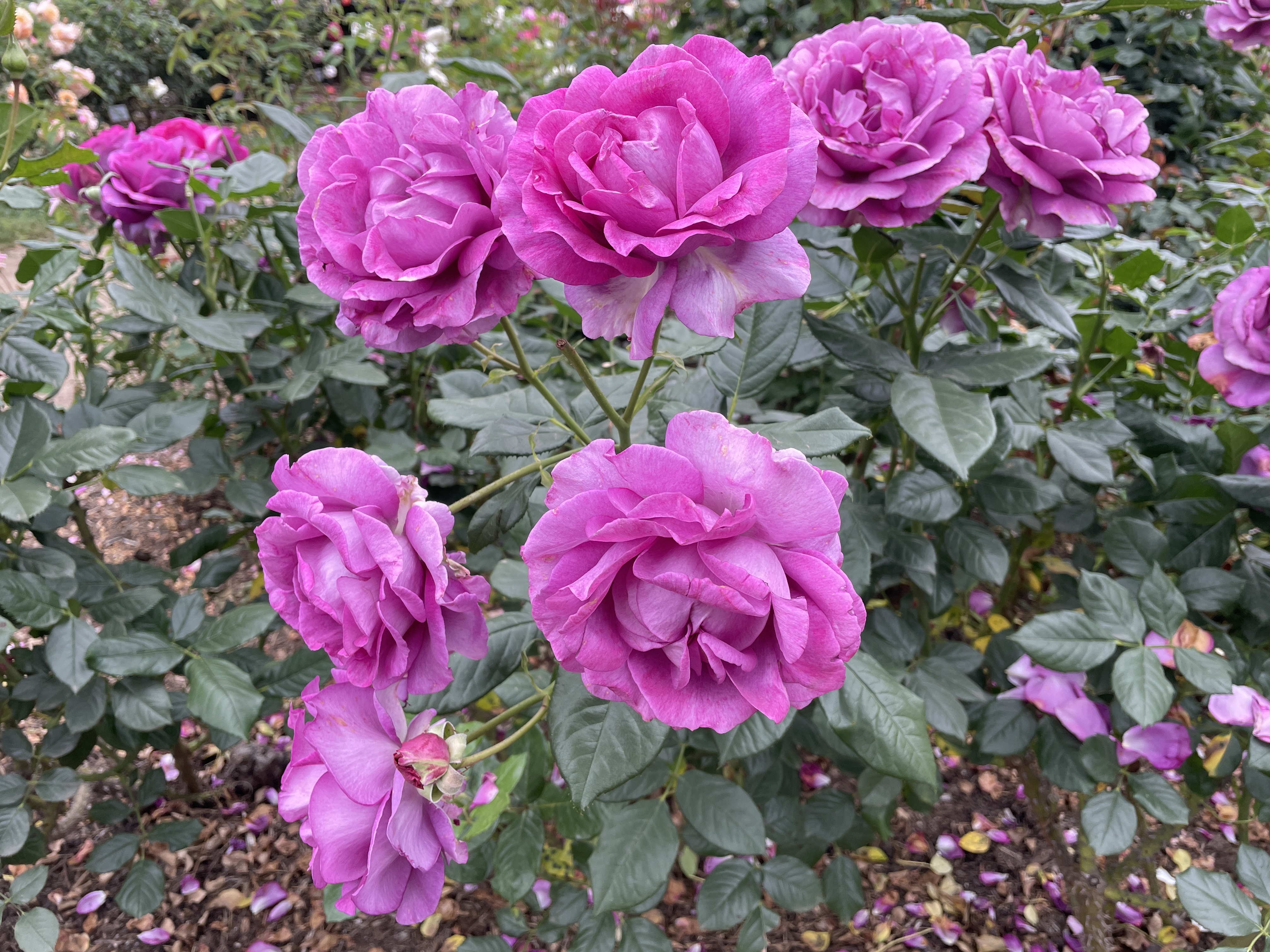
In Memory of Mother’s Roses


Mother’s rose garden

flowers for the family table

all my childhood summers.

Red, pinks, snowy.

No roses for decades

except those given, bouquets,

mostly red.

Now, I look out every window, roses

Pinks, reds, orange, lavender, yellow, snowy.

I love them, cut them,

And remember my mother.