Gratitude and Dust


Initially, I planned to continue my Apocalyptic Planet series, but today’s events caused me to choose otherwise.  As I sit here writing this, I can see the endless blowing dust through the spotted window.  Sometime today, while I was at work, it sprinkled while the dust blew.  Now every window on the east and north side of my house appears as if someone had thrown handfuls of nearly dry mud at it.  My black car looks the same.  The wind whistles in the flue of the wood burning stove in my bedroom.  This storm  blows harder and longer than the one we experienced last week.  Tomorrow they forecast more of the same.

Saturday I stopped by two greenhouses to purchase some hanging baskets and native flowers.  The mesquite trees kept telling me, “Wait, wait.  Cold will come again. Wait!”  Normally, I obey what the mesquite trees tell me.  They never come out until they know without a doubt the cold is over and they feel safe.  I bought the flowers anyway.  This coming Saturday, Hilltop Senior Citizen Center in Amarillo has their Gala at my house to raise money–complete with a silent auction, food, and drink to raise some much needed money.  I want everything to look springlike and pretty.  I heard the weather forecast on the radio coming home from work.  I just looked again on the Internet.  Frost predicted tonight and even colder tomorrow night.  After I fed Rosie, placing the alfalfa as much out of the wind as I could, I brought the hanging baskets inside and poured a bunch of water on the other new plants. The native plants, tough, worry be little.  The others will not survive 33 degree weather.  Later, I will go out and cover them with old towels, hoping the wind relents and does not blow them off.

Everyone here posts photos of the dust on the Internet and gripes about this horrid weather.  Although I certainly dislike it, I refuse to complain.  This, too, is tornado country.  I listened to the news this morning and again coming home from work.  Thirty four dead, whole towns destroyed, a new school flattened.  Here I see no devastation, only the endless, depressing, annoying dust and wind.  My friends, family, and I are alive, our houses intact.  Rosie huddles behind the barn, still healthy, neighs when she hears me coming.  Gratitude engulfs me.


Rosie


Rosie


SAM_0461


The iris I was hoping for.
Myanmar Then and Now-Part One


More than twenty years ago, I went to Myanmar when it was still called Burma.  I flew there from Katmandu.  Compared to the cool, crystalline mountain air of Nepal, the hot, moist, Burmese air felt stifling, thick.  Day one, we left the Inya Lake Hotel and traveled to downtown Yangon to purchase tickets to Pagan.  We never left Yangon because the first of many revolts against the military government started.  Everyone strongly opposed going there by the night train and the last plane headed that way had been shot down.  Personally, I was willing to take the risk but could find no one else willing to go with me.  Everyone was under a 6 pm to 6 am curfew.  Unexpectedly, hundreds of hotel guests were confined to the hotel and its grounds, thankfully rather expansive.  This unusual circumstances provided unexpected opportunities.   To accommodate feeding everyone dinner, the hotel staff asked guests to share tables.  I shared a table with a man from South Korea there to build a sport shoe factory, two women from Germany headed to a medication retreat, and a gentleman with an English accent.  We shared life stories except the “Englishman”.  His sharing seemed a little “off”.  Later, when the rest of us chatted and put together what little he shared, we decided perhaps he was an arms dealer.  One evening guests experienced the privilege of watching the guests for an elaborate Burmese wedding, complete with traditional wedding clothing.

Although clean and orderly, this “one of the best hotels in Burma” looked more like photos of Russian army barracks than the hotels to which most of the guests were accustomed and absolutely nothing like anything else near Yangon.  Few cars roamed the streets.  The most common vehicles were small pickup trucks in which the bed had been transformed into an open air van complete with seats and a cloth roof.  The populace exuded an air of dejection.  Those who bothered to save money saw it devalued to nearly nothing.  The once elegant, ornate buildings showed signs of disrepair and decay.  A country which was once the world’s largest exporter of rice was rationing it as well as gasoline.

Unless you sleep twelve hours a day, curfews present challenges.  What do you do with yourself for all those evening hours after 6 pm hits besides eat a leisurely dinner.  I walked the glorious hotel gardens repeatedly and became acquainted with the hotel gardener who spoke perfect English and whose father had attended Columbia University.  His roses were as tall as I am.  He asked me repeatedly, ” How does my garden measure up to modern standards?”  When I offered tp send him horticulture magazines, he told me they would be confiscated as evil, foreign influences.  Paddle boats lined the lake’s edges.  Guests could use them free but  guests were told not to go far out because we might get shot at.  The luxurious villas of the ruling military elite lay readily visible on the distant opposite shoreline.

During the day, everyone rushed out to make the most possible out of the 12 free hours.  Mainly, I recall an overwhelming sense of gold, glitter, and glass tiles reflecting the tropical light.  At first, it induced a feeling of slight nausea, so much sensory input I felt slightly sick.  But I adjusted.  As if scattered, glittery golden temples were not enough, there rose the Shwedagon Pagoda, 99 meters covered in gold, real gold.  I spent an entire day there, wandering its environs and still missed some of it. Saffron clad monks, vendors selling “sacred” items and snacks, nearly a city within itself,  old, originally  built in 1372 and 344 feet high, repeatedly rebuilt after earthquakes and foreign raids.  Impressive is an understatement.

If Burmese history and culture interest you, I recommend three fascinating novels:

To Save Fish From Drowning by Amy Tan

The Piano Tuner by Daniel Mason

The Glass Palace by Amitov Ghosh

All three focus on one or more of the ethnic groups that inhabit Myanmar and on their relationships with each other.  The latter two are historical novels and in particular Ghosh’s book provides a fascinating history of that part of Asia.


Intelligent Beings


Tonight the program Nature on PBS asked questions about animal intelligence as compared to humans.  This list portrays some of the things I learned, some new, some I remembered from past readings or other Nature programs:

-A few other animals besides humans recognize themselves in a mirror.  This list includes elephants, dolphins, and chimps.  Actually, humans do not demonstrate this ability until they are about 18 months old.

-Only a few species studied demonstrate a sense of social justice.  If they think they are being treated unfairly, they get mad and sometimes have a little fit.  This includes monkeys and dogs.

-Only one species studied demonstrated overt altruistic behavior and a sense of social justice toward others, the bonobo.  Of course, others may but have not been studied yet. Notably this is the same species that resolves social tension and conflict with sex rather than fighting.

-Humans grieve.  Many other mammals grieve immediately after the deaf of a loved one, e.g. their own young offspring, but few recognize the bones of long deceased members of their species.  The exception is elephants.  Elephants not only recognize the bones of other elephants, they frequently nuzzle them with their trunks and stay with them a while.

-Dolphins may seek out help when they need help.  The program showed a diver who was not looking for dolphins at all.  A dolphin who had a fish line and hook stuck in his side approached the diver and managed to stay very still while the diver removed the hook.  This took nearly ten minutes.  Of course, no one knows whether the dolphin was actually seeking help or simply stayed still when help was available.

-Chimps possess another behavior similar to humans, the ability to purposefully deceive.  A less dominant chimp was shown where a banana was hidden from a window outside an enclosure.  She and a more dominant female chimp were released into the enclosure at the same time.  The first chimp did not rush to the food.  Oh,no.  She waited and watched, played it cool,  and when the other chimp wandered off to the other side,  ran and ate the banana.

It is difficult to get inside of the mind of other animals.  Anyone who has pets thinks they are smart or at least dogs and cats seem to demonstrate considerable intelligence.  Horses do as well.  And yes, I have seen horses grieve.  When one of my horses died in a terrible and rather bizarre accident a few years ago, the other horses stood for hours in the place where the deceased horse had died.  They did not even leave to eat their alfalfa, a food they loved and always ran to.

I even think animals, in particular mammals,  know when they are headed to slaughter.  I think those who kill them know this but to admit it would be too painful.  They certainly know the smell of blood.  It incites terror.  Certainly animals can suffer at the hands of cruel humans.  Do animals besides us deliberately hurt others for the sheer, sick pleasure of it?  If there is a study regarding this topic, I have yet to see it.  I wonder.


Sacred Corn


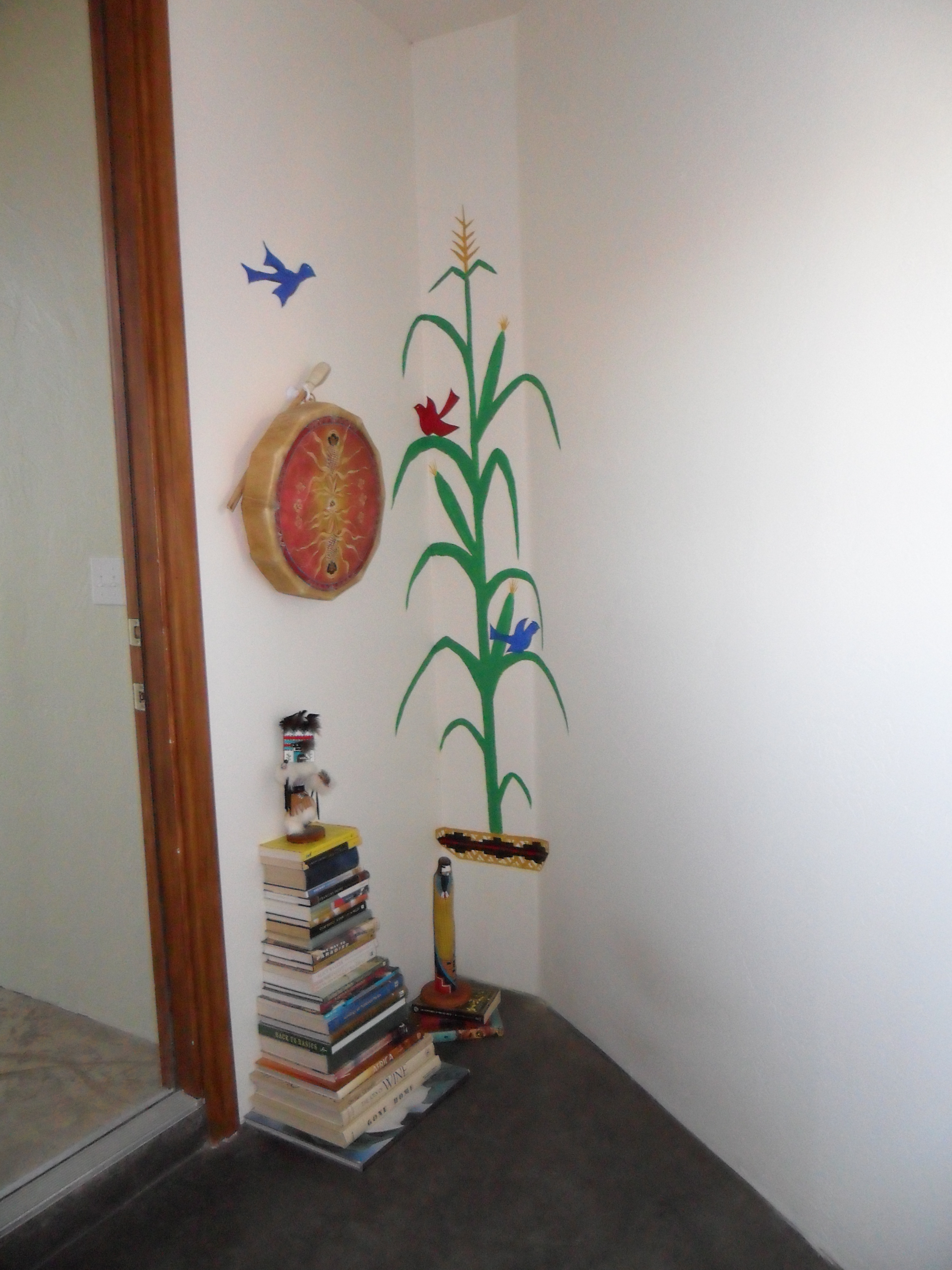
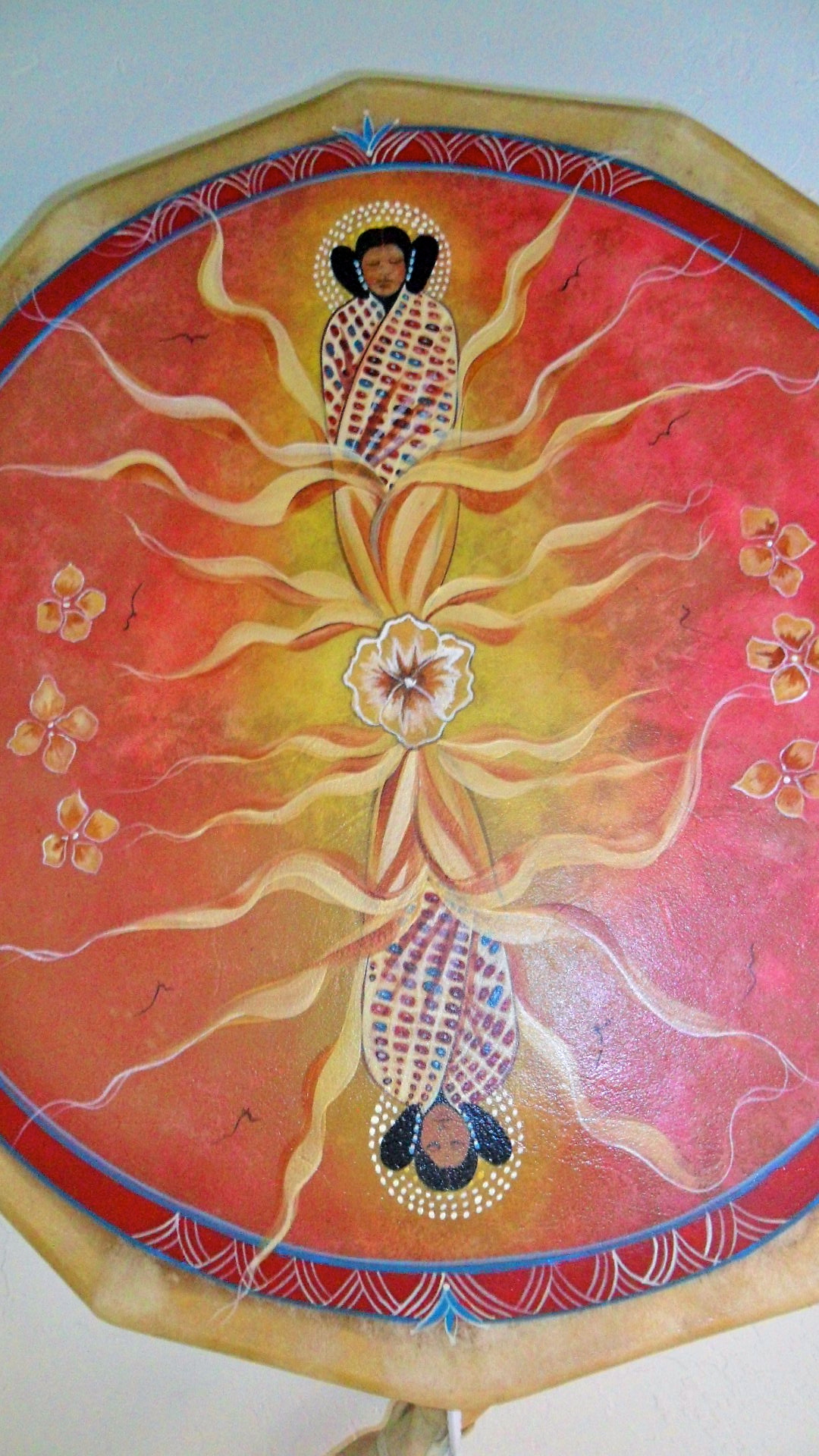
SAM_0035   In the summer on hot, humid nights, you can hear the corn grow.  My great grandfather, my grandfather, and my father grew corn.  I grow corn in that same rich loess soil of Northwestern Missouri.  Soil laid down by Ice Age glaciers thousands of year ago.  Only on a few hill tops, here and there, will you find non glacial soil. Repeatedly, daily, I walk by the sacred corn plant of life painted on my hall corner.  This sacred corn corner houses three corn maiden kachinas and a drum decorated with corn maidens.  I give thanks to corn for my house and the life I lead.

Corn Song

I sing the song of ancients:

pueblo peoples,

Anazazi, Hopi, Zuni.

I sing the song of an America long gone.

Maya, Aztec, Tolmec.

I sing the song of life:  colors of the rainbow

golden, red, white, blue.

I sing the song of now:  thick, endless

identical rows.

Pioneer, Monsanto,

anhydrous ammonia,

atrazine.

I sing the song of hope and joy:

an ancient reclaiming,

a klaidescope of colors,

butterflies and fireflies.

I sing the eternal human song.

SAM_0913

SAM_1489

This is a Navaho kachina.  Kachina are actually Hopi, but Navaho artists now make kachinas as well.  The first corn maiden kachina I bought.

SAM_1490

Spotted corn kachinas, on the left, are unusual.  It took me years to find one.  The kachina on the right was created by R Pino, who is both Hopi and Navaho.

SAM_1491

Every year Pendleton runs an art contest among Native American students.  The winner’s art work is transformed into saddle blankets.  This design, created by Mary Beth Jiron, is the latest in this Student Series. There are three corn  maidens  on each side of the blanket, representing the different varieties of corn grown by native peoples, yellow, red, blue, white, black, and spotted.

The Story Circle Network Conference and My Commitment: This Is What I Know


ad_scnconfWhen I first started blogging more than two years ago, I committed to blogging once a week.  That I managed for a year or so and then since that time, it became more sporadic.  Full time job, writing poems for my book, visitors, mini vacations, all sorts of stuff got in the way.  Really, I let it lapse, but refused to give up.  Last Thursday, I drove to Austin with my daughter and grandson for the biannual Story Circle Network Conference.  The plan:  while I conferred, they played.  The Story Circle Network is an organization for women which encourages women to write, to tell their stories, to share these stories, and when possible and desired, publish those stories in various forms from memoir to poetry.  This was my second time to attend and my first time to attend as a new board member.  A former mentor/teacher of mine, Len Leatherwood, facilitated  a workshop entitled “Transforming Your Writing Life in Just 20 Minutes a Day”, the last workshop I attended.  She blogs everyday.  I follow her blog.  No matter what, she sits down and writes 20 minutes minimum a day separate from the writing she does with her students–she teaches writing privately in southern CA.  One of her recent blogs has been accepted for publication–a piece of flash fiction.  She nearly begged us to commit to this kind of writing practice.  Previously, I had refused, flat out refused, partly thinking that if I tried it, more than half the resulting writing would be crap.  Nevertheless, she and her workshop convinced me that at least for one month I must try this.  Now all of you following my blog will be inundated with daily blog posts.  I am filled with curiosity as to how people will respond.  Maybe it will be like my Facebook posts–yes, I am an almost addict–the posts I consider most meaningful for the universe at large are the ones people ignore and the ones I consider personal trivia receive the most response.  Maybe I will track what appeals to my readers.  Some I won’t know because with blogging I share to Facebook and to a couple of professional networks, I have no clue who read what.  Once I received an email regarding a poem I posted. Although it never showed up as a like, the lady actually told me she read my poem in church!  Who would have guessed. I forgot to time myself so have no idea how long I have been here writing.

Here I am writing about why I am writing.  On the stove I smell Jasmine rice cooking.  I love Jasmine rice from Thailand.  I am a very picky rice eater and prefer to mix equally white Jasmine rice with black and red.  For one thing, it looks lovely when done–a sort of dark reddish purple.  Since I sautéd chopped garlic in olive oil, then added the rice and sautéd for about 15 more seconds, then added water and some broth just before I started writing this, the smell of Jasmine rice fills the house.  I piled a bunch of paper towels on the top before I put on the lid or you can use some cloth towel–a habit I picked up from my Iranian ex-husband.  Iranians really know how to cook rice.  I am also drinking a glass of Cupcake Shiraz which I bought on the way home from work.  And yes, Shiraz is also the name of a city in Iran where they actually grow grapes or at least used to. But of course, drinking wine is no longer acceptable in Iran or at least not publicly.  Good Muslims do not drink at all.

I did write something worthwhile while in this workshop and will share–doing this last because it won’t count as my daily writing since I wrote it yesterday.


This Is What I Know


My parents loved me, really loved me.

My mom was proud of my accomplishments.

Dad gave me a love of books, intellectual curiosity, and a

sense of wonder.

Mom gave me a love of music, beauty, and cooking.

Happiness is a choice.

I do not believe in luck.  You make your own luck.

Life is an exciting adventure.

Horses give me joy.

Singing gives me joy.

Dancing gives me joy even if I rarely have the opportunity.

Family relationships can be distressingly complicated.

I am proud of my children and their accomplishments.

Religion matters much less to me than 99 per cent of the people I know.

Ethnic and religious prejudice distress me and I do not

understand those kinds of attitudes.

I am a good writer.

I want to make a real difference in the world.

I am happy 99 percent of the time.

Blessings flood my life.

My close friends and children and grandson are more

important to me than they know.

Writing has enriched my life.

I have few regrets:

One I have rectified;

the other I cannot–

my dad is dead.

From The Guardian: Ten Rules on Writing Fiction from 14 Authors


The best list of rules for writing almost anything. If you are an English teacher these are musts to teach writing.

lenleatherwood's avatar20 Minutes a Day

Get an accountant, abstain from sex and similes, cut, rewrite, then cut and rewrite again – if all else fails, pray. Inspired by Elmore Leonard’s 10 Rules of Writing, we asked authors for their personal dos and don’ts

Elmore Leonard, Diana Athill, Margaret Atwood, Roddy Doyle, Helen Dunmore, Geoff Dyer, Anne Enright, Richard Ford, Jonathan Franzen, Esther Freud, Neil Gaiman, David Hare, PD James, AL Kennedy

Elmore Leonard: Using adverbs is a mortal sin

1 Never open a book with weather. If it’s only to create atmosphere, and not a charac­ter’s reaction to the weather, you don’t want to go on too long. The reader is apt to leaf ahead look­ing for people. There are exceptions. If you happen to be Barry Lopez, who has more ways than an Eskimo to describe ice and snow in his book Arctic Dreams, you can do all the weather reporting you want.

2…

View original post 3,420 more words

Publication!


A writing colleague posted this on her blog today. It expresses so much of what I feel about so many things that I just had to reblog it. As soon as I finish this reblog, I am going to look for one of these statues for myself. Here’s to a fabulous today and a creative, adventurous future.

lenleatherwood's avatar20 Minutes a Day

I am pleased to report that my flash fiction piece, “A Brother’s Gift” has been accepted for publication at the Provo Canyon Review, a print literary journal. I am especially pleased about this because I rather impulsively submitted it when I saw the Provo Canyon Review’s Call for Submissions. This is a very short piece, but the editors said they liked the tone and also thought it was “A refreshing and moving look at grief and the true emotional impact of such a loss.”

I am happy. Here it is in case you missed it first time round.

A Brother’s Gift

Mary Lou Holder sank down next to her brother, the one who was dying of cancer, and started pulling on the bright red bow of the gift he had just handed her. “This is sweet, Jake, that you’ve gotten me a present. You know you didn’t have to…”

Jacob…

View original post 491 more words

Much as Love and Murder, Freedom is a Many-Splendored Thing


danielwalldammit's avatarnorthierthanthou

17711-series-header Yapto Soerjosoemarno is a middle-aged man. He is the leader of Pankasila, an Indonesian youth group three million strong. The camera follows him out onto a golf course where he explains; “Gangsters are free men. They want to live life in their style. Relax and Rolex.” A moment later he tells his young caddy she has a mole on her pussy.

And she smiles.

Of course all of this comes after Yapto explains that Pankasila had killed all the communists in Indonesia. It comes after he has spoken at a Pankasila rally, one in which he calls himself the biggest gangster of all.

What else could the young girl do but smile?

KillingAs he and his friends try on colorful gangster outfits, Anwar Kongo waxes on about his inspirations; Al Pacino, John Wayne, and others like them. He goes on to relate the story of how he once placed the…

View original post 1,449 more words

On a cold winter evening


This post displays my occasional propensity for pensiveness and reflection.  The highest temperature today was 8 degrees.  The weather forecaster predicted a low of zero, very cold for here with more snow.  In  a few months, it is likely we will hit 100.  Who would want to live in such a place?  Yet people do, worldwide.  Some in places much colder and hotter.  How and why did they all get to wherever they are?  Millennia ago we all migrated from Africa and look at us now.  We think we are smarter, better, but are we?  Perhaps technologically, but psychologically??  War rages over differences in ethnicity and religion.  Clashes for thousands of years change little, just the nature of the weapons, the use of advanced technology.  The intent remains the same.

Sunday, I finished a book by the Turkish writer, Elif Shafak.  I have read all her books translated into English.  This, her latest, Honor, details the effects of the belief in honor of above all else.  To paraphrase one of the main characters, a poor man:  rich men possess money, fancy cars, lavish houses, travel, but poor men have nothing but their honor.  Acting on this belief leaves one family devastated.  For those who desire to learn about other cultures and to understand the behavior of the individuals in them, I highly recommend this novel.

Earlier, I donned two pairs of gloves and socks, four layers of clothes, and ventured out.  If you own horses, you have to feed them regardless of the weather.  Unlike me, my dog, Isabella, fares well in this weather.  Her part wolf blood gives her an undercoat perfect for winter extremes.  Inside, I viewed my larder–what to cook on a frigid winter night?  A simple chicken curry with onions, brussels spouts, jalapeño peppers, and chicken with Jasmine rice, red, white, and black.  And a glass of red wine, cabernet franc, from a local winery, the only wine I have ever seen from only this one grape.  It is usually added to blends.  Definitely haram–still thinking about that book.

SAM_1428

As the temperature drops, building a fire in the wood stove seems like a reasonable endeavor.  I love fires but hate to build them.  Nevertheless, sitting in front of the fire reading brings a silent joy, a paradise.  I feel at peace:  chores done, warm house on a frigid winter night, satisfying dinner homemade, and the knowledge that my book of poetry lays in its final stages with the editors and photoshoppers who will make it publication ready.  I feel extremely grateful, looking forward to dazzling dreams on the rim of wonder.

sam_0303.jpg

The Girl and The Woman


The Girl

She stands alone by the train tracks.

Watching and waiting and dreaming.

Hobos no longer exist.

She remembers reading stories of life

when her great grandmother lived:

hobos begging for food, gypsies stealing

children and telling fortunes, long days

working in the corn fields, chopping weeds.

Her own family praises:

tractors, riding lawn mowers, herbicides, pesticides,

electricity, TVs, dishwashers, muscle cars, MacDonalds,

diet Coke, cell phones, computers, DVDs, iPADs.

Now the only excitement lays in Grand Theft Auto,

guns, and sex.  She watches and waits and dreams.

Canyon photo 1 anabel

The Woman

She stands alone on the rim,

watching the moon rise,

wondering.

Life flies by on wings

outstretched.

She remembers rich years

filled with long joys, living,

loving,

and temporary sadness, divorces,

moving here and there,

Narrangansett Bay, Utah mountains,

Veracruz,

babies held to breast,  blond

and chubby, cafe con leche.

She remembers girlhood longings

for far horizons, traveling

around the world, lovers,

husbands, shades of brown

beauty.

She’s learned to make

her own excitement,

singing Goddess songs,

dancing on the rim of wonder.

SAM_0901

Photograph by Anabel McMillen and Painting by Lahib Jaddo