Book 28 for 2024: “Gun Island”, Amitav Ghosh


A tale based on a Bengali legend about a merchant called the Gun Merchant, Bonduki Sadagar, this novel not only takes place in the mangrove swamps of the Sundarbans but also in Venice. It has nothing to do with guns but demonstrates how differences in language use among languages and translations can lead to total mistranslation. The narrator is an older, male, Bengali, rare book dealer who grew up in Kolkata but now lives in Brooklyn most of the year and goes back “home” occasionally. When he meets a distant relative by chance at a party, he finds himself enmeshed in the Gun Merchant tale and finds himself in search of a remote shrine where a king cobra lives. His adventure leads him to meet two young men and reconnect with an old friend, an Italian woman who is a famous historian.

What fascinated me most about this novel was learning all about the immense number of historical connections between the Bengali part of India and Venice especially related to trade and persons of Jewish descent. It is also filled with lessons in relationships among languages and history. For example, I learned the origin of the word ghetto. During the 17th century a part of Venice, Getto, was where their large and prosperous Jewish population was forced to live, Venice being one of few European cities where Jews were safe. Thus the word designating a part of the city became the word ghetto.

It is also a story about the risks and dangers of immigrants trying to get to Europe. I learned many Bengalis, mostly from Bangladesh, live in Venice and the numerous historical connections between the Bengali speaking areas of the world and Venice.

Book 27 for 2024: “The New Naturals”, Gabriel Bump


Rio, a young Black woman, and her husband, Gibraltar, academics living in Boston, become concerned and disillusioned with their current lives. She finds an abandoned restaurant on top of a hill in western Massachusetts. Heartbroken after the death of her newborn, she is determined to create a safe, new, underground society beneath the restaurant. She finds a benefactor and her dream begins to take place. Via word of mouth, others hear about this safe place for the “lost” and disillusioned and head there. These include two homeless men from Chicago, a successful, young journalist, and a former soccer player.

Can such a society work? What happens if they run out of money? Regardless, can the care individuals have for each other save them?

Note: Depending on what kind of novels you prefer, this may or may not be a book for you. Several of the characters have serious mental issues, some think it is ok to resort to violence to save what they believe in and find ways to justify their actions, some seem very, very “lost”.

An Abecedarian Poem for the Fourth of July


As many celebrate this day

because they see it as a joyous

cry in praise of the

day the United States declared

emancipation from English tyranny,

free to be its own country, self

governed, no longer ruled by kings,

humans, Black, enslaved,

indigenous, find celebration difficult.

Jefferson, in The Declaration of Independence,

knowingly called Native People

lacking in worth,

“merciless Indian Savages,”

never considering the contradictions, the

overt irony when compared to his view that

people are created equal.

Qualified, white male landowners, the

rich, voted, prospered.

Slaves, counted as only 2/3 a person, were

told to obey, work til death, be Christian.

Until all, regardless of race, gender, religion, are

valued as worthy humans, are free to prosper, can

walk proud throughout the United States,

xenophobia will destroy our founding ideals.

Yearn for, work toward, equity, kindness, be

zealous in our quest for a better country.

Book 26 for 2024: “The Burgess Boys”, Elizabeth Strout


After winning the Pulitzer for her previous book, “Olive Kitteridge”, Strout continues her stories about people and families from a small town in Maine, the town of Shirley Falls. “The Burgess Boys” focuses on one family, the Burgesses. A freak accident which occurred when the children were under the age of ten has affected all their lives in one form or another. The boys, Jim and Bob–both lawyers, escaped to NYC as quickly as they could. Only their sister remained behind in Shirley Falls in the old family home which has become a rather dark and dismal place. Jim, a hyper successful, high powered attorney, has demeaned his younger brother Bob, a Legal Aid attorney, all their lives. The lifelong family dynamic is totally upended when the sister, Susan, calls them back for a family emergency after her teenage son commits a stupid, heinous act and gets himself in serious legal trouble.

Strout possesses a simple, straight forward, unique style of writing that seems perfect for telling family stories, illuminating human personal struggles, and illustrating the good and bad of modern life. If you have not read any of her work before, I suggest looking at the publication dates and reading them in order. The same characters keep reappearing and you learn about their lives as you go from book to book.

Book 25 for 2024: “The Spoiled Heart”, Sanjeev Shasta


The main character, Nayan Olak, is a Sikh whose parents immigrated to England. He has worked decades first on a factory floor and then later risen through the ranks of his union. Encouraged by others, he decides to run for head of the union when suddenly a young woman of the same ethnicity decides to run against him. She will do anything to beat him including using an unfortunate argument between them to accuse him of all sorts of misdeeds.

In the meantime, a woman, Helen, who left town under mysterious circumstances years ago shows up with her young adult son who is recovering from the aftermath of another unfortunate misunderstanding. Helen works for home health but refuses to take care of Nayan’s dementia ridden father. He cannot figure out why since she willingly takes care of others. He becomes obsessed with her, helps her son who becomes a sort of substitute for Nayan’s son who was killed along with Nayan’s mother in a fire many years previously. The police never determined who started the fire even though they knew it was arson.

Tragedies ensue as this story about race, misunderstandings, secrets, and relationships progresses. It also demonstrates the power, for better or worse, of misunderstood words and actions.

An Abecedarian Poem for Juneteenth


All slaves did not know freedom

because the powers in Texas

could not, or more likely,

did not want them to know.

Eventually, three years after Emancipation,

freedom came to Texas, June 19,1865, in

Galveston when General Grange proclaimed

henceforth enslaved people could not be

illegally held as property so Texas

joined the nation acknowledging that

keeping slaves was illegal.

Long held in bondage in Texas

many formerly enslaved rejoiced,

now looking forward to a better future.

Opposition arose almost immediately.

People did not want non-whites to hold power,

quickly responded by making new laws

requiring the formerly enslaved to

stay quietly in their homes.

They were informed no public gatherings allowed

under threat of arrest.

Void of the choices, they were forced to

work for low wages.

Xenophobia continues to reign,

youth taught Emancipation but not this.

Zany as it seems, 159 years later, prejudice continues.

Book 24 for 2024: “Inland”, Téa Obreht


While I found her first book, “The Tiger’s Wife” fascinating, I remain uncertain regarding this one. First it is long, 374 pages (I do read long books); second, it tells two different stories which do not interconnect at all until the end of the book. I kept wondering, asking myself, “What?” For me at least, the story picked up about half way through and my interest greatly increased.

One storyline is the life of one homesteading family in rural Arizona in the 1850s told mostly from the viewpoint of the wife. Her husband tends to wander off for long periods of time leaving her on her own with their children. His latest adventure is not only their homestead but also owning and running the local newspaper in the nearest town. The reader also meets some rather powerful but unsavory characters who want to own all the cattle and all the land.

The second storyline deals with the men who were hired by the government to bring camels to the West and manage them, one of whose story–a real historical person–is told. His name was Ali, a Syrian cameleer, who died in 1902. He was called Hi Jolly because people in US seemed unable or unwilling to pronounce his real name correctly. This part is told from the viewpoint of another cameleer, Hi Jolly’s friend, who has a criminal history and is trying to elude the law. Camels were brought to the US by the United States Camel Corps in the 1850s. At that time few roads existed in the Southwest, water was scarce, and camels were known to be able to go long periods without water. The experiment failed so camels were left either in the hands of the individuals who rode and cared for them or left to roam wild. Some of the men, including Hi Jolly, were able to open businesses transporting goods to remote areas via camel. This book details part of that history.

In both storylines one recurring theme is the lack of water. At one point the homesteading family have no water at all. In the other storyline people hire the cameleers to take them to places not realizing that even camels need water occasionally. I find it telling that 175 years later we continue to struggle with water issues in exactly the same part of the country.

Book 23 for 2024: “Off With Her Head: Three Thousand Years of Demonizing Women In Power”, Eleanor Herman


Starting with ancient Egypt and later with the ancient Greeks and Romans and ending in current times, this highly researched book (there are 15 pages of Bibliography) details millennia of lies told about and attacks against women in power. Ridiculous things have been attributed to women, powers that no human has, in order to control them. Here is an example: Pliny the Elder (23-79 CE) wrote that menstruating women caused hailstorms, lightning, and whirlwinds. And worse yet, demons come from this blood (various medieval medical authorities) and it can shrivel the penis.

Then there is the whole thing about raging hormones. The word hysteria, which supposedly is an ailment of women, comes from the Greek word for uterus. During the 2020 presidential campaign, Marco Rubio, currently a possible candidate for vice president, tweeted a photo of ten missiles exploding and asked if you want a woman a heartbeat away from the presidency.

During the Middle Ages millions of women were put to death in various horrible manners after being accused of witchcraft. Even in current times various male political candidates and media announcers (a Newsmax journalist, Zinke of Montana, Ben Carson, Chris Matthews–list is almost endless) have called powerful political women witches. The victims of these pejorative rantings even include Margaret Thatcher when she held office.

Marie Antoinette never said, “Let them eat cake”. Various forms of this phrase had been around for over one hundred years. Ann Boleyn originally wanted to marry the love of her life who also wanted to marry her but the powers at the time, including Henry VIII, forbade this. Many of the ridiculous stories about Cleopatra can be easily disproven, e.g her being so rich she dissolved a giant pearl in vinegar to prove her wealth. Unless powered, pearls do not dissolve in vinegar. Catherine de Medici was attacked as some sort of sex pervert when she was 42, obese, and anything but a sexy seductress.

The documented lives of many powerful women for the last three thousand years contains endless abuse of all sorts. How is this possible? Because there is an informal Misogynist Handbook that has been used for millennia to control women. The above is only a smattering of what you will learn about this Handbook if you read this book. In the last chapter, the author does provide recommendations for overcoming this abuse of women. However, she also notes currently there is a “furious backlash against this long-delayed crawl toward justice, resulting in the increasing viciousness of sexist tweets and memes, more violent threats, more savage abuse.”

Visiting Chaco Canyon


Several weeks ago, I spent a day wandering around the ancient sites where native peoples gathered over a thousand years ago.

This explains the extensive influence this place, located in the northwestern New Mexico desert, held for people from as far away as Central America. To reach this park, you have to drive on a dirt/gravel, rough road for more than 25 miles north of Crownpoint, NM. It is definitely worth the effort. However, it is impassable in rainy or snowy weather. The rangers who care for the park live there.

One of the first things you see as you get closer to the park is this rock tower, Fajada Butte.

Archeologists climbed to the top and discovered petroglyphs, “Sun Daggers”. Created between rock slabs, they align with each solstice and equinox and at these events the light projects to other sites, e.g. Pueblo Bonito. Other petroglyphs on a section of the canyon wall represent a supernova that occurred in 1054 CE.

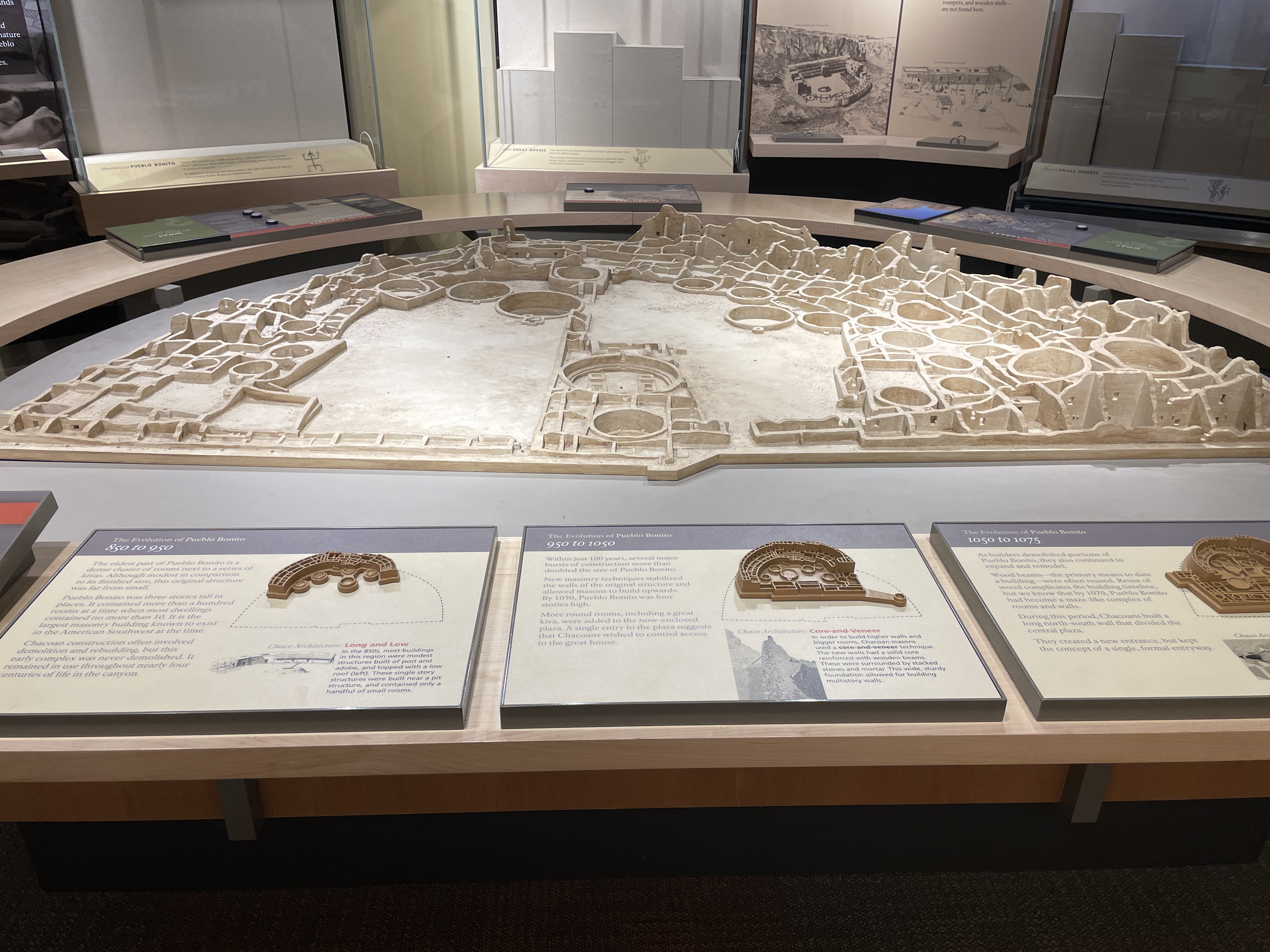
The following depicts an overview of the site as it would have been in the past. In the 1940s part of the wall of rock behind the site collapsed onto it and destroyed some of the buildings.

Here is how it looks today. Many of the doors and windows align with astronomical events, e.g. solstices, the two equinox, and astronomical events that occur only every 17 years.

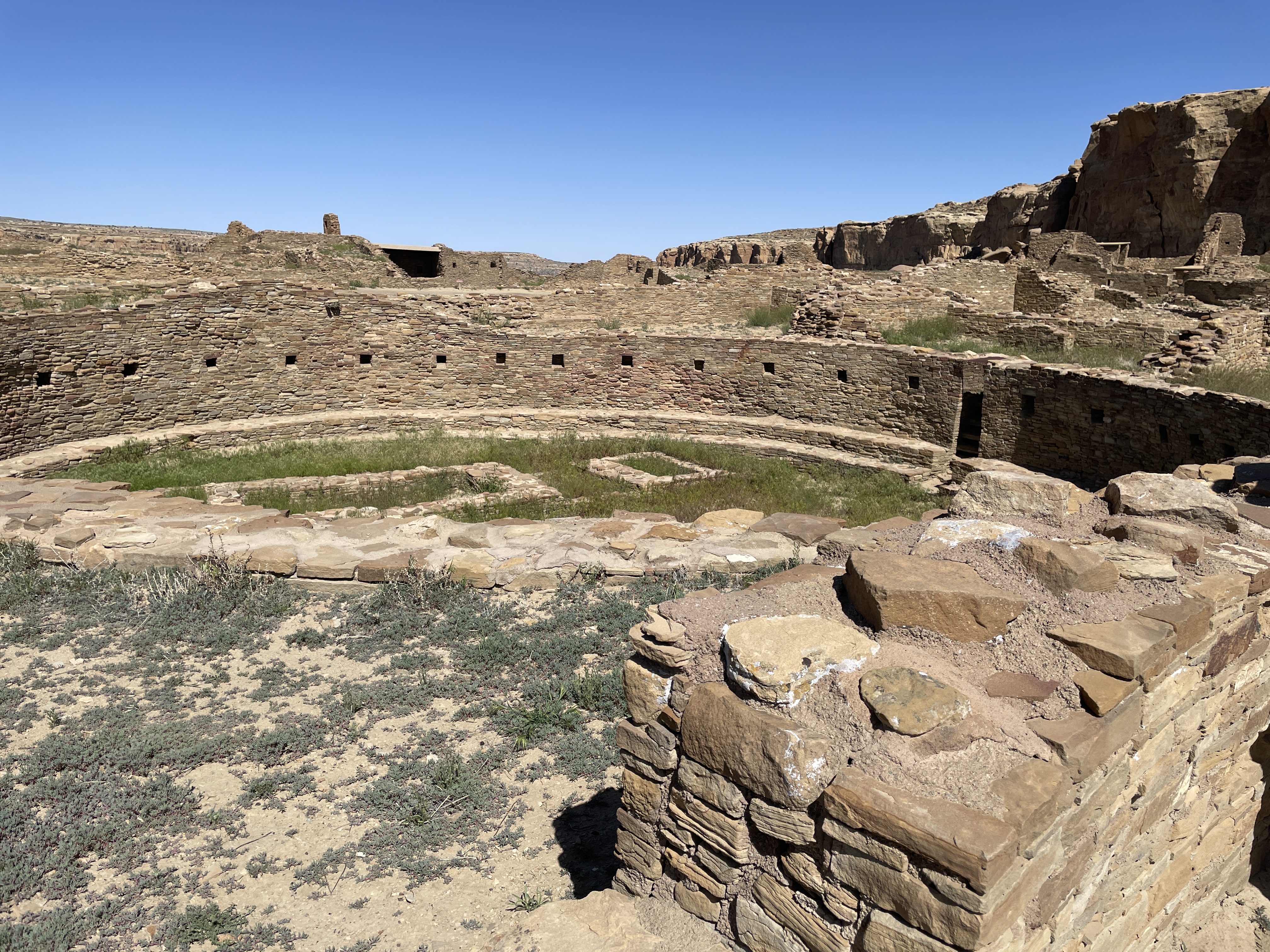
All sites here contain many kivas, many of which are very large. It is speculated that these were used for various sorts of ceremonies, including religious events.

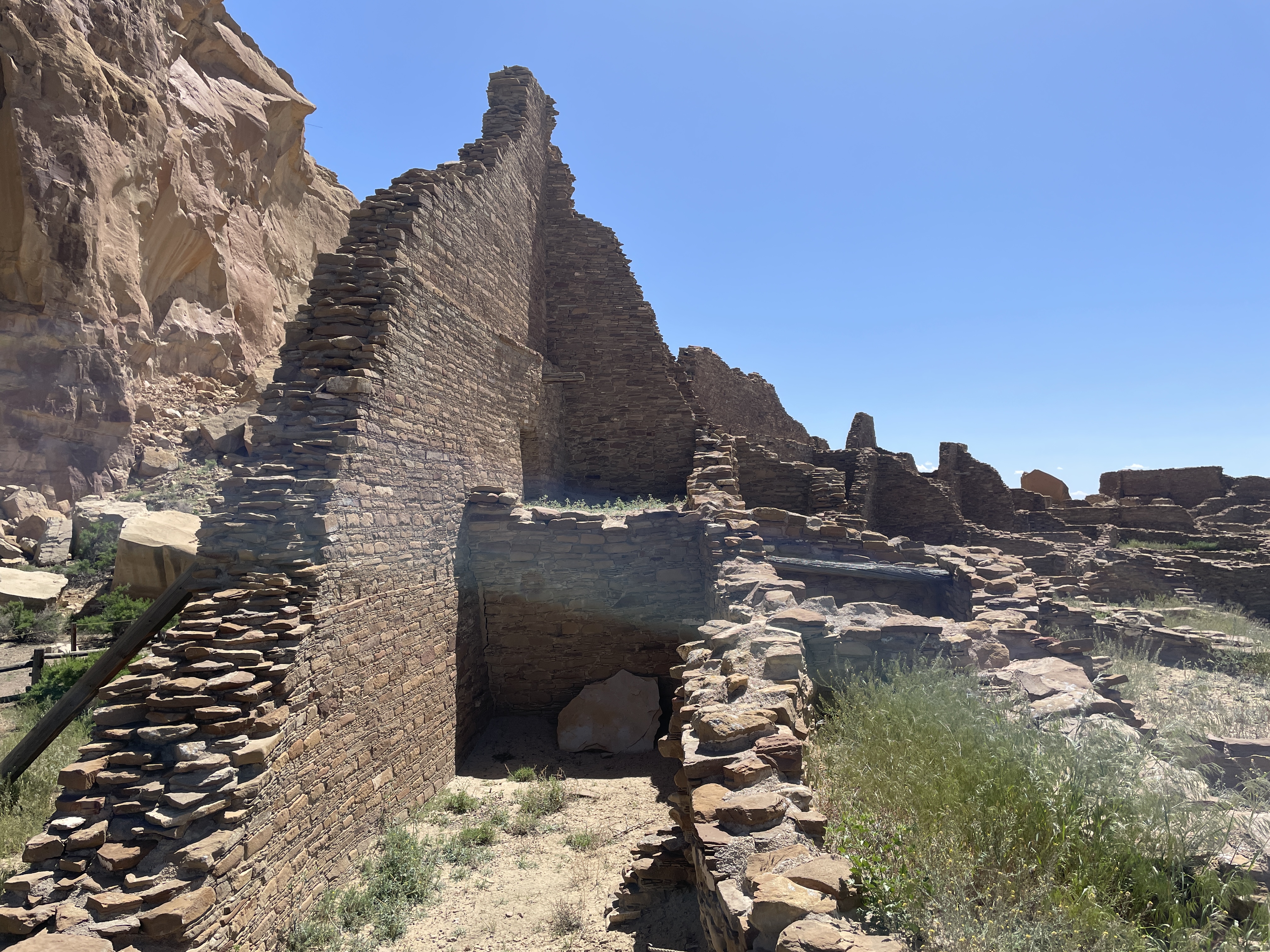
In this view you can see how the rocks that fell from the cliff have destroyed parts of the structures.

Many of the buildings were several stories high. In their heyday, they did not look like this. They were covered with something like stucco and painted white. What an impressive site they must have been–large white structures in the middle of the brown desert. Archeologists think few people lived here. It was a place for gathering, for ceremonies, for trade, for people from long distances to meet.

Across from Pueblo Bonito is the largest kiva found in the area.

Behind the bars on the far side of the photo is an area that was used for ceremonial dancers to don their costumes. At the bottom you can see a depression with a small door. Before centuries of sand filled it in, this place would have be large enough for the ceremonial dancers to enter through it.

If you follow a trail along the cliff from Pueblo Bonito, you will find another area built at different times hundreds of years ago.

Another large kiva and many smaller ones are located at this site, including this famous long wall built at two different times.

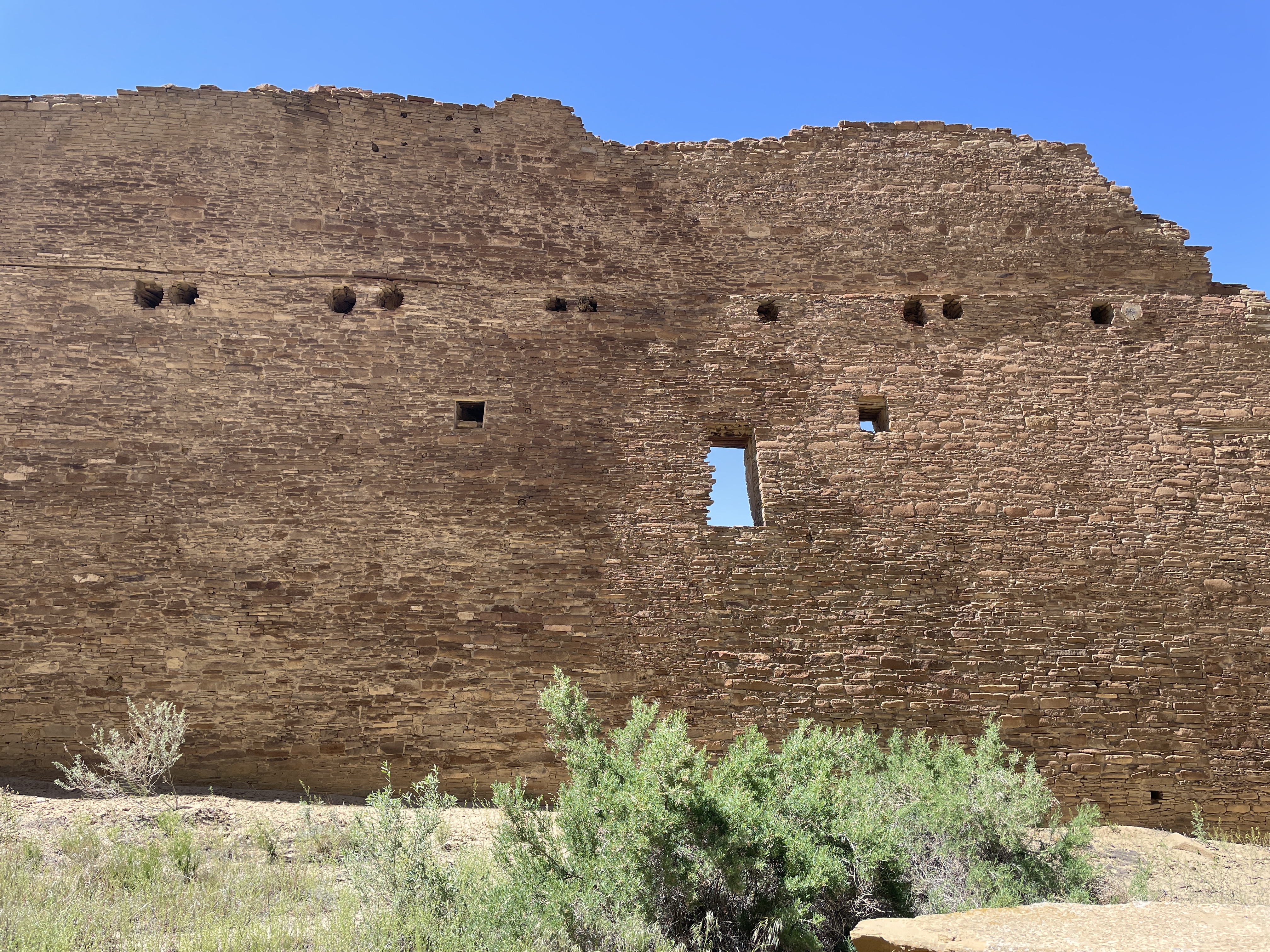
The following shows where at some point the wall stopped, then later it was continued using somewhat different building material and techniques.

The top photo is considered the newer part of the wall.

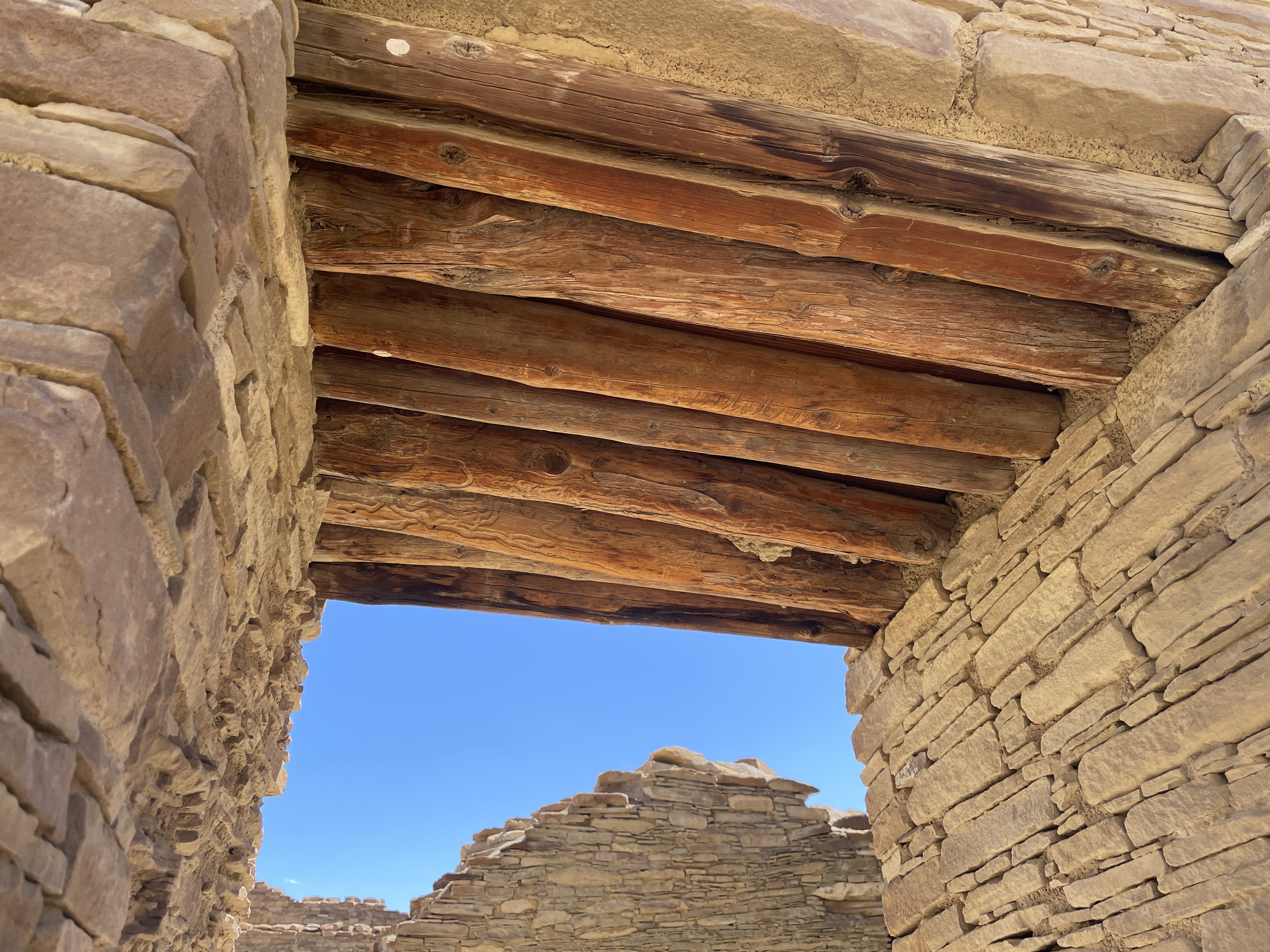
The wood used for tops of windows and doors was brought from forests hundreds of miles away. The desert air has enable it to be preserved.

When you walk the trails, you see wild flowers and native plants. This is desert rhubarb and it is edible.

While these are photos of the more impressive structures at Chaco Canyon, more than two hundred ceremonial and meeting sites can be found in this area of NM and AZ.

Book 22 for 2024: “The Reluctant Fundamentalist”, Mohsin Hamid


Written in an unusual style, the narrator, the main character, tells his story to an American visiting Pakistan. While they are sitting eating dinner and later walk to a hotel, the narrator relates his life as an immigrant who found US life too shallow, too focused on profit. The narrator, a young, Pakistani man with an Ivy League degree, attains the heights of success in the US, working in a highly desirable career position where he is the star. After 9/11 occurs, he questions who he is, what working in this sought after career means, whether it is even ethical to work in a position for a firm whose job it is to investigate companies, their profits, and ruin the lives of the people who work there. He is sent to Chile to investigate a literary firm, meets the manager who takes him under his wing and helps him look at what he is doing in a totally different light. Is money everything? Do the lives of ordinary workers matter? In addition, it is a love story. He meets a beautiful, young, wealthy, US woman, they develop a close friendship, and he discovers she is not mentally stable and does everything he can to help her.

While on the surface this appears to be a story of a young immigrant who does not ultimately fit in with US life, it is much more. It raises the questions of the definition of success, of what love is, of profit over humanity.