Trip to Honey Island Swamp


On our third day in New Orleans, we headed to Slidell, LA, to visit the swamp.  Many swamp tours exist in the area and some in Lafayette as well.  After reading extensively online about the various tours, I decided to take Dr. Wagner’s Honey Island tour early in the morning.  Depending on traffic, it is about a 3/4 to one hour drive from downtown New Orleans.  For at least half this time, you are driving on a bridge across Lake Pontchartrain.

IMG_2773

This little swampy area is right next to the small cabin where they sell alligator souvenirs and you pick up your ticket.  This place requires cash.

IMG_2747

After boarding the boat which holds about 20 passengers, we headed down the Pearl River.  This view looks upriver.

IMG_2748

Many expensive houses rise above the river banks.  You can see the for sale sign.  According to the boat captain, the fancier ones cost about one million.  However, for all the elegant houses, there are more just the opposite and close by.

IMG_2750

Like this one which appears boarded up.  Some appeared abandoned, some in decent repair, some recently used.  When we asked how high the water rose during Katrina, we were told that it would be above the roof of a house like this.  The tours were abandoned for over a year after the hurricane except for the occasional hurricane cleanup crew who wanted a tour.

IMG_2749

This is one of the nice houses along the river, modern, large, well kept.

IMG_2751

We saw a large blue heron, wings outstretched, sunning itself on a large tree stump.  When the captain tried to get closer, it slowly lifted off and flew away before I could get a photo.

IMG_2757

We turned to the right off the river and began to see alligators of all sizes.  Because of harvesting for skins, meat, etc., few really large ones remain.  More common is 8-10 footers.

IMG_2762

Even the boat captain was astonished at the number of alligators we saw.  They seemed to be everywhere and one exceedingly large male followed us deeper into the swamp.

IMG_2764

Although the water flows rather rapidly on the river, once in the swamp, the water is very quiet.  Many different types of trees live here including cypress.  Most of the trees are deciduous and lose their leaves in the winter.  I was extremely surprised to learn how cold it can get here, below freezing, sometimes even down in the teens.  However, the captain said it always rises above freezing during the day.

IMG_2765

IMG_2766

Most of the really large cypress have been cut down in the past for lumber.  Now this is a reserve.  The tree on the left is really large and a lot of moss hangs from it.

IMG_2767

Hogs, like these, are not native anywhere in the Western Hemisphere.  It seems feral hogs can live anywhere.  We also saw raccoons.  The trees and other vegetation are so dense during the summer, wildlife could be a few feet away and remain unseen.

IMG_2769

IMG_2772

The swamp possesses a wild, magical beauty.


Rita Blanca National Grassland


Today, three of us drove up into the northwest corner of the Panhandle of Texas to visit this national grassland which adjoins the Kiowa National Grassland in New Mexico.  The two grasslands together equal more than 200,000 acres.  Originally, created after the Dust Bowl in an attempt by the government to mediate the destruction caused by the giant Dust Bowl storms, the grasslands are now managed by the US Forest Service.  The US acquired much of the land when its owners gave up and left the land owing money to banks.  As a consequence these national grasslands are interspersed with privately owned grassland.  Ranchers, some of whom refer to themselves as grass farmers, can lease this land and graze it along with their adjoining property.  Moderately grazed land often supports a more diverse wildlife and plant population than overgrazed or ungrazed land.

To reach the Rita Blanca we drove past Dalhart, Texas, and turned on a Farm to Market road which led to an area with camping and picnic tables plus restrooms.  Campers and picnickers must bring their own water.  The only trees are those deliberately planted in days long past.  We saw or heard many birds there, including orioles.  Below is the entrance to the Thompson Grove camping and picnic area.

IMG_2719

After a comprehensive briefing from the park ranger, a wildlife biologist, and a range specialist, we took a hike across the grassland.

IMG_2721

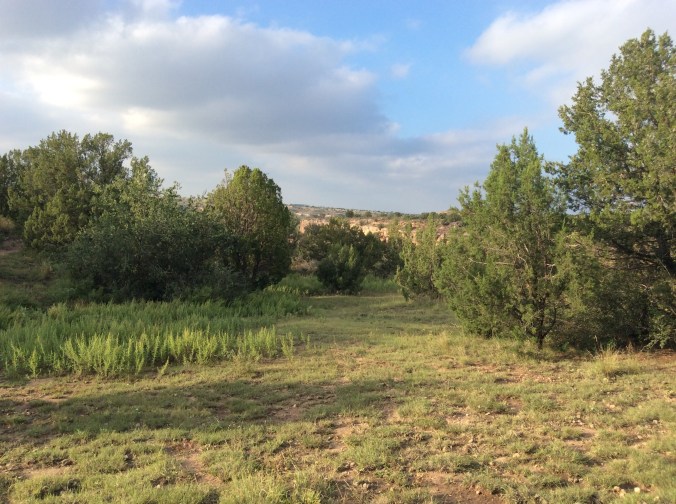
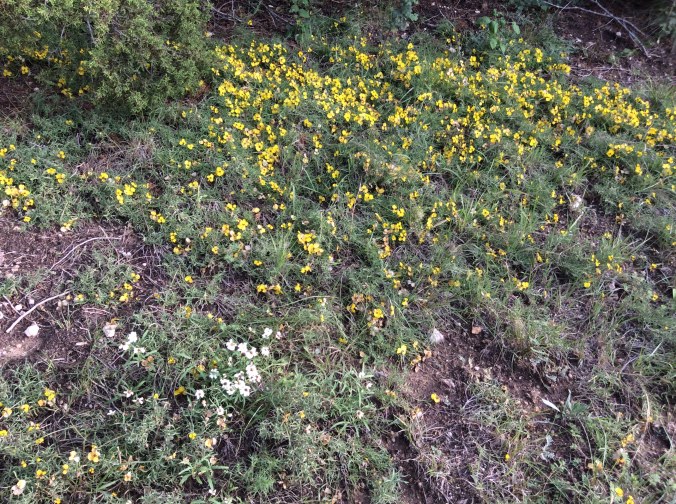
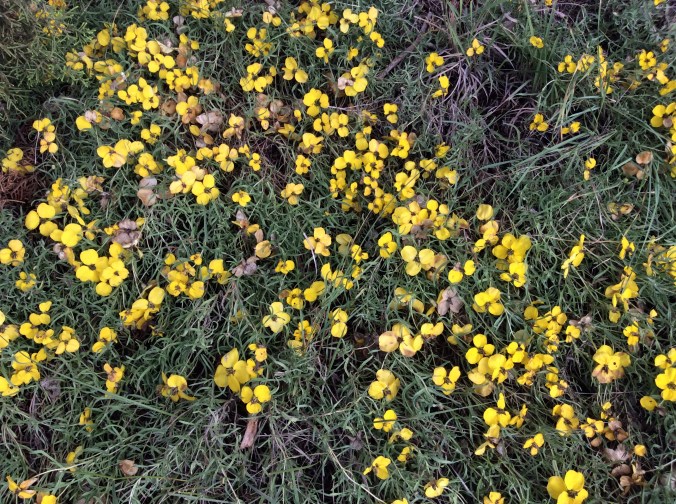
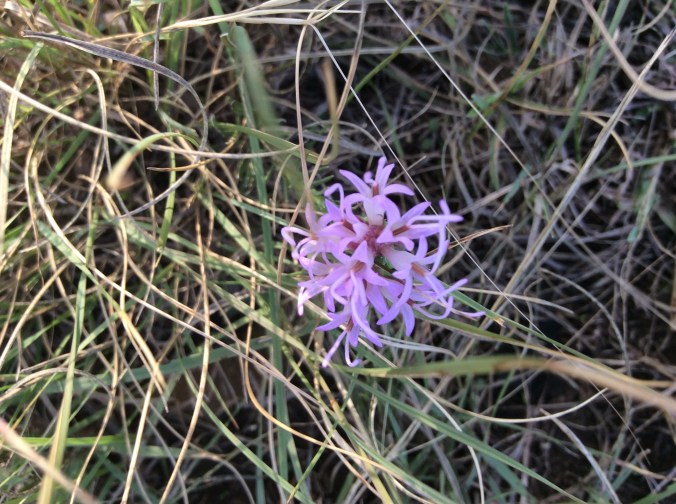
While this may look like a boring green sea to some, upon close inspection, this land teams with many species of grasses and flowers.  Flowers I saw today include Fineleaf Woolly-White, which is not white but bright yellow, Prairie Zinnia, Broomweed, Sundrops, Engelmann Daisy, Mexican Hat, Winecup, Tansey Aster, all of which I have at my own place an hour and 1/2 away.  However, I saw two flowers I have never seen before, White Pricklepoppy and a native Morning Glory which has huge hot pink flowers. While the Pricklepoppy has spectacular, large white flowers with gold centers, the plant looks like a very prickly grayish thistle.

Although I knew some of the species of grasses there, I could not identify the others.  However, the park ranger knew them all.  I might remember some with the help of a book.  Many I have around my land but still cannot identify all of them.  I do know blue grama, side oats grama, buffalo grass, and a few others.

Many grassland and wildlife research projects done there produce useful information.  One current project deals with seismic activity.

If you are driving cross country anywhere near Dalhart, Texas, or Clayton, New Mexico, take a short break and head to these grasslands.

IMG_2720


A Tribute to My Dad, Doyle Lightle


Dad lived his entire life, 90 years, on the farm which my great grandfather, Gottlieb Werth, homesteaded in the middle 1800s.  Gottlieb Werth came to the United States from Switzerland when he was 18.  Even though Dad lived in the same place all his life, he liked road trips.  The first occurred when I was three.  He drove us all the way from Northwest Missouri to Monterey, Mexico.  I still have photos of us wading in the Gulf in Texas before we crossed into Mexico.  Thereafter, we almost never missed at least one road trip a year between wheat harvest and the start of school.  Sometimes instead of a summer trip we took one around Christmas, like the year we went to Florida when I was in elementary school.  I skipped school a couple of weeks, took my work along, and came home ahead because the flu, which I missed, put everything behind.

By the time I was six, I had probably covered half the continental United States and, of course, been to Mexico.  I do not remember some of those first trips but the later ones I remember well, like the summer we spent in Crested Butte, Colorado, when it was still a mining town, and another in Placerville, Colorado, down the road from Telluride.  Then it was just a nowhere place, filled with the Victorian houses of its mining heyday.  Dad joked later that he should have bought one of those houses when it was cheap.

One year, the year between my junior and senior year in high school, we took a one month trip and drove 6,000 miles, from home to the Black Hills, where we had relatives, to Vancouver, to Vancouver Island and then to Victoria.  We visited every national park along the way,  Grand Tetons, Yellowstone, Glacier, Olympic, then drove up the Columbia and cut back across Rocky Mountain National Park and through Colorado. On an earlier trip we went to every park in Utah and Northern Arizona and Mesa Verde.

Dad’s interest in and curiosity about everything seemed endless.  He tried the latest agricultural methods in his farming, was an avid conservationist, wanted to check everything out on these trips, talked to people about what they were doing.  At home he read National Geographic and Scientific American and endless books.

Because of these trips, his sense of wonder, his propensity for intellectual activity, my friends in college were always shocked to find out he was a farmer.  They often thought, originally, that he was a college professor.

He moved into this house where I grew up when he was ten.  After Mom died, Dad and I were at her grave on Memorial Day when a man came up and starting talking with Dad.  I learned that the building in the foreground of this photo, before it was used for livestock and storage, was used for dancing during the Depression. The sheriff would send out deputies to make sure no illegal alcohol was consumed. I took this photo four years ago when I took a trip back.

12193406_10204105678156113_6043720938154804167_n

There used to be woods to the right of this photo but someone bought the land and bulldozed down all the huge oak trees.  The tall douglas fir tree in the middle was tiny when we brought it home on one of our trips out West.

I will forever be thankful to Dad for instilling in me a love of exploration, wonder, and curiosity.


Weekend Adventure


This past weekend my family had to return to Tulsa, Oklahoma, to finish some family business.  While there, we decided to explore as well.  After completing what we needed to accomplish on Friday, we decided to check out the Tulsa Zoo located in Mohawk Park.  Tulsa Zoo contains lots of green, open spaces, and some extremely interesting architecture.  For example the Malayan tigers live in an area made to look like ancient, abandoned temples.

IMG_2682

Then there are animals I have never even heard of before like the siamangs.

IMG_2686

I was surprised to see komodo dragons.

IMG_2681

The intensity of the colors in the American flamingoes never cease to amaze.

IMG_2690

IMG_2691

Apparently, the rest of my family liked them as well.

IMG_2689

The next day, Saturday, we decided to head east through the Cheyenne Nation to visit Natural Falls State Park. If we had known what it is really like, we would have taken a picnic.

IMG_2693

The area above where the falls drop off.

IMG_2697

IMG_2698

Dripping Springs

IMG_2700

Just below the falls another stream enters and then flows down to a lake.

IMG_2709

The lake becomes larger as it flows farther.  It is a moderate to difficult hike getting to the lake.  Fishing is permitted here.  This park is also a good place to camp.

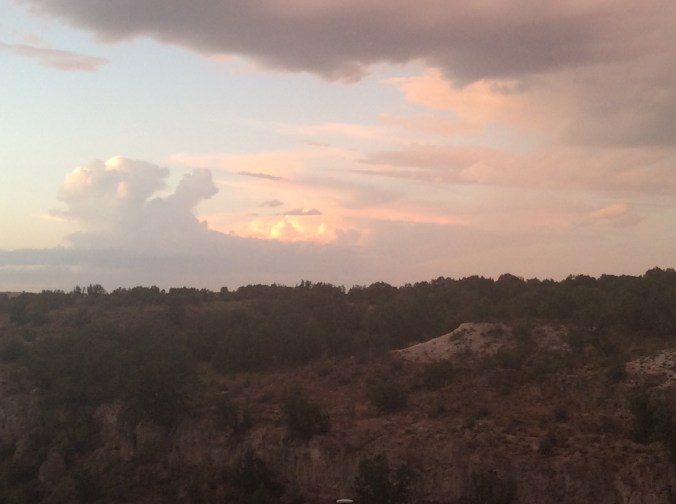
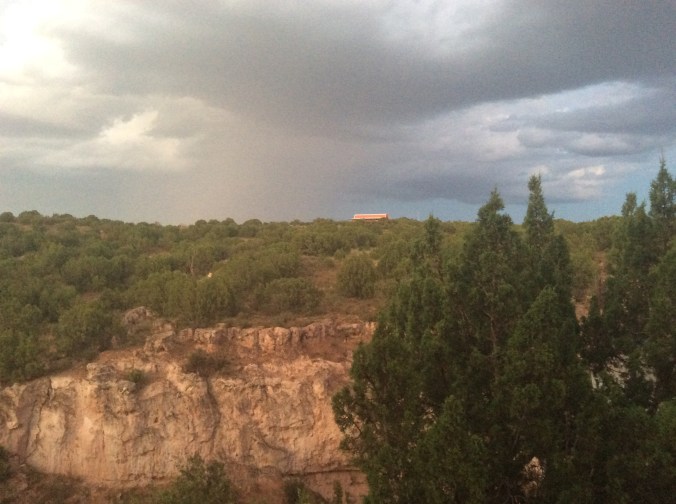
While gone, a giant thunderstorm arrived at my house with 8 inches of hail and three inches of rain in a short period.  Although the juniper trees look close to normal, most of the deciduous plants were denuded.  I have no idea whether they will recover.  A few of the small native flowers appear normal.  Luckily, my house was not damaged. However, this evening with my grandson’s help I will tackle the drive which is full of about 8 inches, in some places, of dirt, rocks, and gravel.  Luckily, after removing the larger rocks, I will get most of it with the tractor bucket and move it back to where it belongs.

Hazy, Lazy Days


The words and tune to this old song float through my brain.  Summer.  Early morning yoga, coffee, horses fed, flowers watered, a lazy lunch:  salad with feta, black beans with caramelized onions.  Slouched, reading a book (The Return, Hasham Matar) on the sofa, feet crossed on edge of coffee table, patio doors open, I hear birdsong, the whir of black fans in the ceiling sea of white.  Summer. Nap time.  Awaken slowly, eyes watching cotton candy clouds barely move across an azure sky.  Summer.

IMG_2671

Unconditional Love


IMG_2222

IMG_2300

IMG_2238

IMG_2180

IMG_1548

img_2385

IMG_2318

All the beautiful flowers I see today, Mother’s Day 2017, make me think of my mother.  She loved flowers, especially roses, horses, music, beauty.  When I think of her, I also think of unconditional love.  Even when young and I sometimes thought she expected too much of me, I still knew she loved me no matter what the circumstances and always would.  For this I feel unending gratitude.  As a teacher, it has become very clear to me that many children do not experience the kind of love my mother gave me.  She died suddenly many years ago.  Her love will never leave me.  Thank you, Mom, wherever you are!!

Celebrating Earth Day–Photos


I decided the best way I should share my reverence and love for nature and this precious planet on which we live is to share photos from various countries, states, and my own little piece of wonder.

IMG_2641

img_2445

img_2454

The three photos above were taken at Palo Duro Canyon State Park in Texas about ten minutes from where I live.

IMG_2617

Above and below the Rio Grande looking into Mexico.

IMG_2607

image

image

image

image

Four photos above — Big Bend National Park.

IMG_2604

Between Marfa and Alpine, Texas.

IMG_2359

The Rio Grande north of Albuquerque on the Santa Ana Pueblo Nation.

IMG_0577

IMG_0592

IMG_0635IMG_0633

The above four photos taken in Simien Mountain National Park, Ethiopia.  The animals are gelada–the only surviving grass eating primates found solely in Ethiopia.  They actually “talk” to each other.

IMG_0266

Menelik’s Window, Ethiopia

IMG_1144

Awash Falls, Ethiopia

IMG_0849

Where the Blue Nile begins draining from Lake Tana, Ethiopia

IMG_2024

IMG_2052

IMG_2070

IMG_1971

IMG_1927

The photos above were taken at various places in Costa Rica.

IMG_1730

IMG_1711

IMG_1718

Northern New Mexico

SAM_1195

Grand Canyon North Rim

SAM_1139

The Missouri River running full.

SAM_1218

California dropping down from Sequoia National Monument

SAM_1342

Near Lake Marvin, Texas

Sunday Sunrise ©Dawn Wink

IMG_1589

IMG_1419

SAM_0483

IMG_2304

IMG_2337

IMG_2323

The above photos were all taken within the last year on my little rim of wonder.

And finally below, my favorite animal.

CA_Cougar24

Sunday Poem–A Life


IMG_1645

I wrote the first blog post about this in February, a second a few weeks later.  The following poem I wrote a week ago but never posted:  too upset, too sad, too filled with regrets I could have no way fixed because I did not even know all the story.  He remained unconscious for two months from late January until March 22.  It seems strange that the memories of a life I lived so long ago, mostly forgotten, could surge into so many waking moments now years later.  Life:  always filled with wonder, surprises.

yesterday we put his body in the ground

the wind blew through the trees

whispering green spring, beauty

yesterday we put his body in the ground

the man I loved, beautiful mahogany velvet

dazzled the world with his smile

yesterday we put his body in the ground

my daughter’s father, standing with family

some we had never seen before, worldwide

yesterday we put his body in the ground

watched a life flash by, slides from baby

to our life long ago, other lives and children

yesterday we put his body in the ground

family, friends, two of his children

a life struck down, too suddenly, too soon

In honor of the life of Kenneth A. Mowoe

You will not be forgotten, your memory lives on with me, your family, your children and grandchildren, your friends.  Peace.  Love.

IMG_2666