roses
rainbow colors
joy
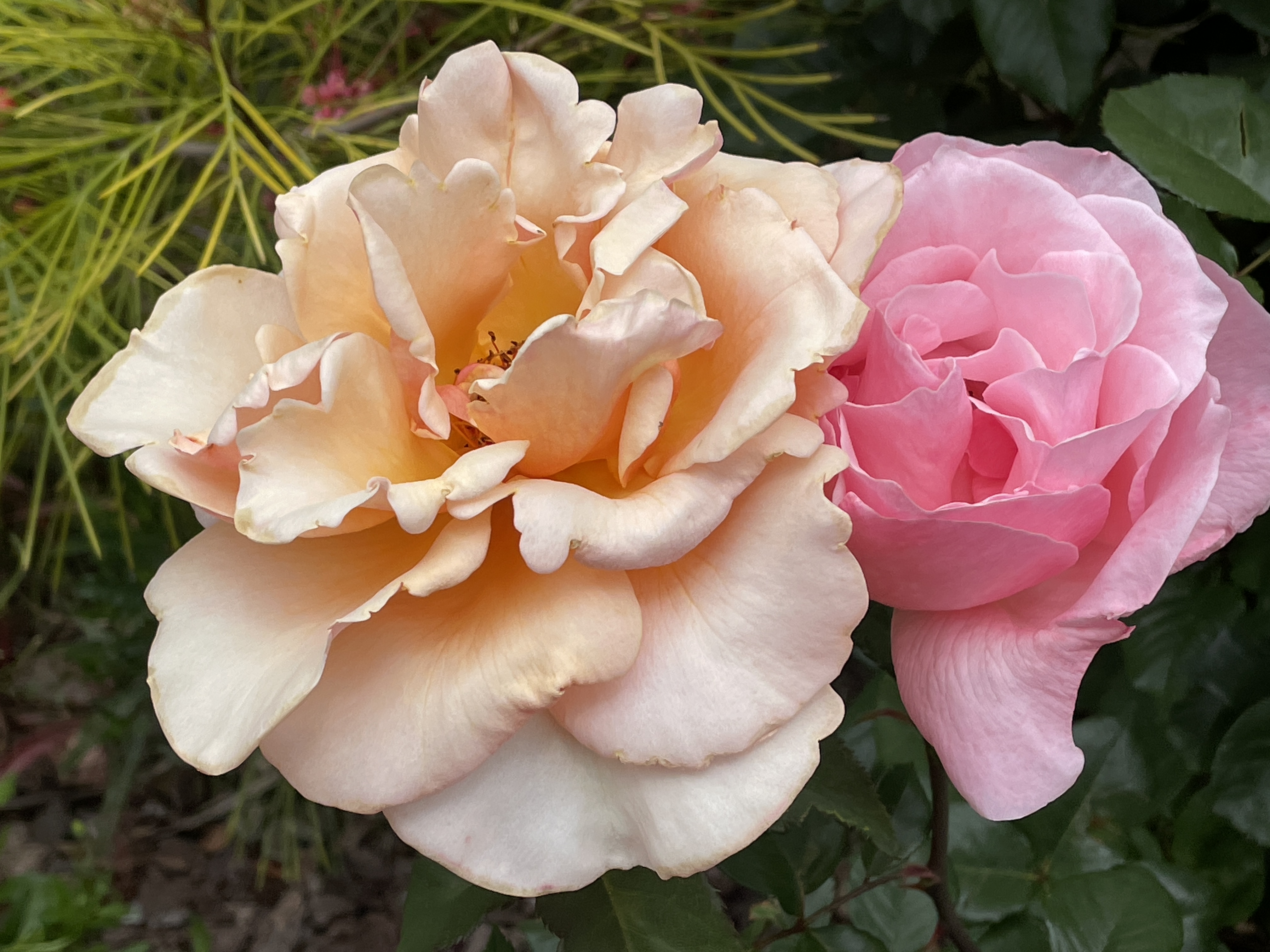


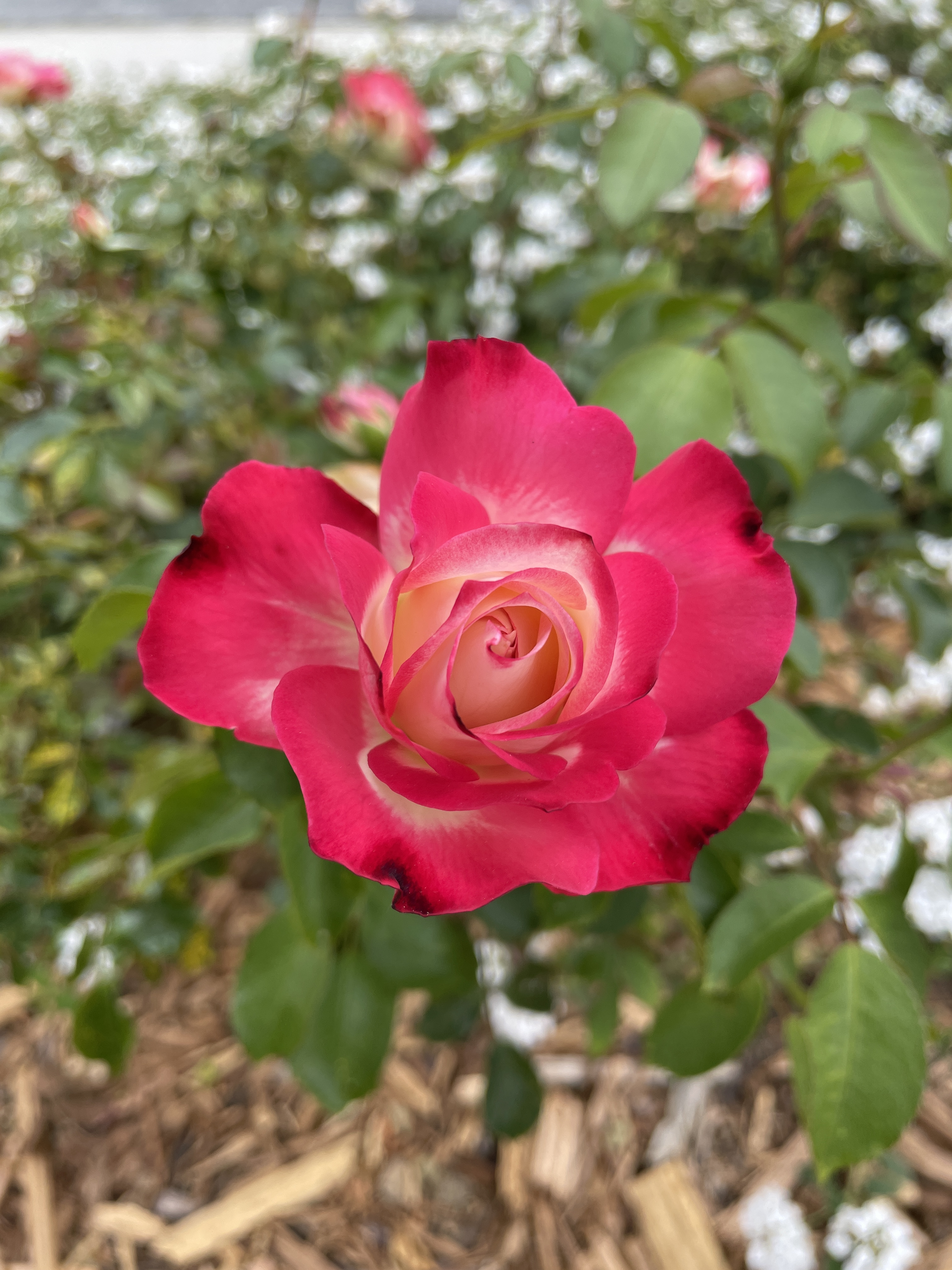

roses
rainbow colors
joy
Rainy Day
sheets of rain against the kitchen window
heavy fog hides mountain peaks
scarlet hibiscus and bougainvillea brighten
a gloomy day
Dusk
The wind died; stillness pervades.
A distant train whistle interrupts.
Tiny brown bird chirps its chitty song.
Mountains display navy blue and purple.
The western sky becomes cantaloupe color.

Fearless little bird with chocolate brown head runs beside me
on the road. At the intersection I circle to the left, following
a familiar route. The heavy tree canopy here always astonishes.
It’s almost like walking in a forest.
The architectural variety amazes: mid-century modern, Spanish,
colonial, ranch, the smallest I am guessing contains 3500 sq. ft. One
house encompasses an entire city block, fronted with heavy, high
fences and metal gates. Privacy obsessed.
I’m watching my time. I don’t want to be late for singing
practice. I take a new route, perhaps a shortcut. It’s
120 degrees of a circle. Not quite a regular street,
not quite an alley, a combination–fronts of a few houses
and the backside of others. At one place it angles more;
I come to a three story stone fortress with intricate
geometrical designs vertically running up and down
the walls. No windows. A sign says, “No trespassing.”
Realization hits me. This is the other side of a house
I saw last year through a gap in a wall on another street.
Three ladies, strangers, asked me about it, told me they’d
heard it was the creation of a famous architect. I researched,
asked others, no one knew. Back then, I tried to find the front,
failed. Now I’m looking at it, wonderstruck. It appears abandoned,
an architectural wonder belonging to another time and place.

Time to rush, a bit lost, I look at my phone map, finish the loop,
find a familiar street, walk faster. Then I see a large, white, colonial house,
weeds knee high, black shutters hanging askew. Here it is abandoned
in the midst of multi-million dollar houses. I wonder what the neighbors
think. Walking on I hear water rushing, peer through the hedges–a stream
runs downhill from the side of this huge brown house at least 100 feet
and gurgles in a pool behind the bushes. Hurrying, I stop in front of one
of my favorite houses, a one-story, tan, Spanish style, small compared
to the others nearby. I take a photo of the tree in front by the sidewalk,
its impressive girth impossible to ignore.

Finally, I’m near my destination, walking in front of The Gamble House,
a tourist destination made famous by the movie, “Back to the Future”,
a structure I see at least twice a week.

I started out thinking I would write a poem per day for National Poetry Month. Well, I’m a bit behind on that, but here are two of several I have written so far.
Spring
The mockingbird awakens me with his song.
A hummingbird, dressed in green with an iridescent
orange collar, flits by my head then sips nectar
from a scarlet bougainvillea blossom.
The neighborhood barn owl hoots at dawn and dusk.
A black and red/orange bird I’ve never seen before
lights on a palo verde limb.
A Western Bluebird dips its beak repeatedly in
the talavera birdbath.

Remember
In this world steeped in senseless violence remember
each day to find a piece of beauty:
-rosebuds opening
-the scent of jasmine
-a friend’s smile
-a bit of birdsong
In this world ravaged by wars remember
each day to find the jewels of joy:
-listen to a child’s laughter
-dance to a favorite song
-walk in the morning sunshine
-tell someone you love them

Before reading this book, I thought of French society as relatively egalitarian. Apparently, it is not if this book mirrors reality. One main character Renee, 54, lives and works as a concierge in a high class building containing eight, large, luxury apartments which the residents own. As she tells her story, she notes that this is her 27th year at this job. She describes herself as “short, ugly, plump”. She rarely says anything nice about herself or any of the residents. She notes she is uneducated, insignificant. She has one friend, Manuela, a cleaning woman originally from Portugal. Renee thinks it is her duty, her lot in life, to pretend to be something she is really not, a person totally lacking in intellectual and artistic acumen. She runs the television to make the residents think she watches mindless melodramas when she is actually reading Tolstoy as well as all sorts of literature and Marx, history, well every genre. After all, her cat is named Leo for a reason. She goes to art galleries, listens to all sorts of classical music, is basically an intellectual in the true meaning of the word, but works very hard to hide this, because she thinks she must stick to her station in life as she sees it. This works until one resident dies and a wealthy Japanese man buys the deceased man’s apartment. Both he, who notes her cat is named Leo, and a young girl, the other main character who lives in one of the apartments and plans to commit suicide and set their apartment on fire, suspect Renee is not as she appears to be. I do not want to give it all away, but this is a book with many life lessons, including that adage about not judging a book by its cover.

The author of this book, Guadelupe Rivera, is the daughter of Diego Rivera by the woman to whom he was married before he married Frida. Diego went on a trip to Russia and his then wife, the author’s mother, became attached to her previous boyfriend, the poet Jorge Cuesta. She and Diego divorced and then he married Frida. Eventually, the two couples became friendly and at one point they all lived in the same house.
Thirteen years after Diego married Frida, the author moved in with them. This book details her life living with Frida and her father, how Frida learned to cook, how she decorated the Blue House in Coyoacan, the fiestas, the food, the adventures. The book includes photos and recipes of Frida and Diego’s favorite foods, photos of the house, and places the author visited with Frida. It is also a story of many of Mexico’s famous people at the time.
I own several books about Frida but this one is the most revealing and intimate in many ways. If you like Mexican food and find the life and art of Frida and Diego of interest, read this book.
Note: It was also written by the journalist Pierre Marie-Colle with photos by Ignacio Urquiza.
Kohl
Kajal
Sormeh
Mebari
Ancient names for eyeliner
still in use today.
Kohl-Arabic
Kajal-South Asian
Ithmid-the purest kohl
made from galena
Surma-powered kohl in Urdu, Bengali
Sormeh-loose power preferred by Persians
Tiro-Nigerian
Mebari-red eyeliner, Japanese
Nefertiti used it.
Today the Worso and Wodaabe
African men use it.
Where women must veil themselves
the eyes are everything.
Bedouins use it for protection
from the desert sun.
In defiance find Cat Eyes
in Chola culture.
In Kerala Kathakali
dancers use it.
Geishas in Kyoto use red.
Find influencers on TikTok
Instragram, they will
teach you how.

Note: The above poem was inspired by my most recent read:
“Eyeliner A Cultural History”, Zahra Hankir. Hankir is a Lebanese journalist whose history of eyeliner throughout the world informs the reader about places and people and customs many never heard of or know about.
Today I traveled a bit south of where I live to the campus of the Tzu Chi school which I have visited numerous times. First we had a vegetarian lunch–they are Taiwanese Buddhists who advocate a vegetarian, plant based diet as better for the environmental future of Earth. Then all the visitors, who were mostly parents of the children, went to the gym for the program. Various ages wore headdresses to represent the various signs. Some of the youngest children wore dragon headdresses. This is the year of the dragon.

The children sang and danced.
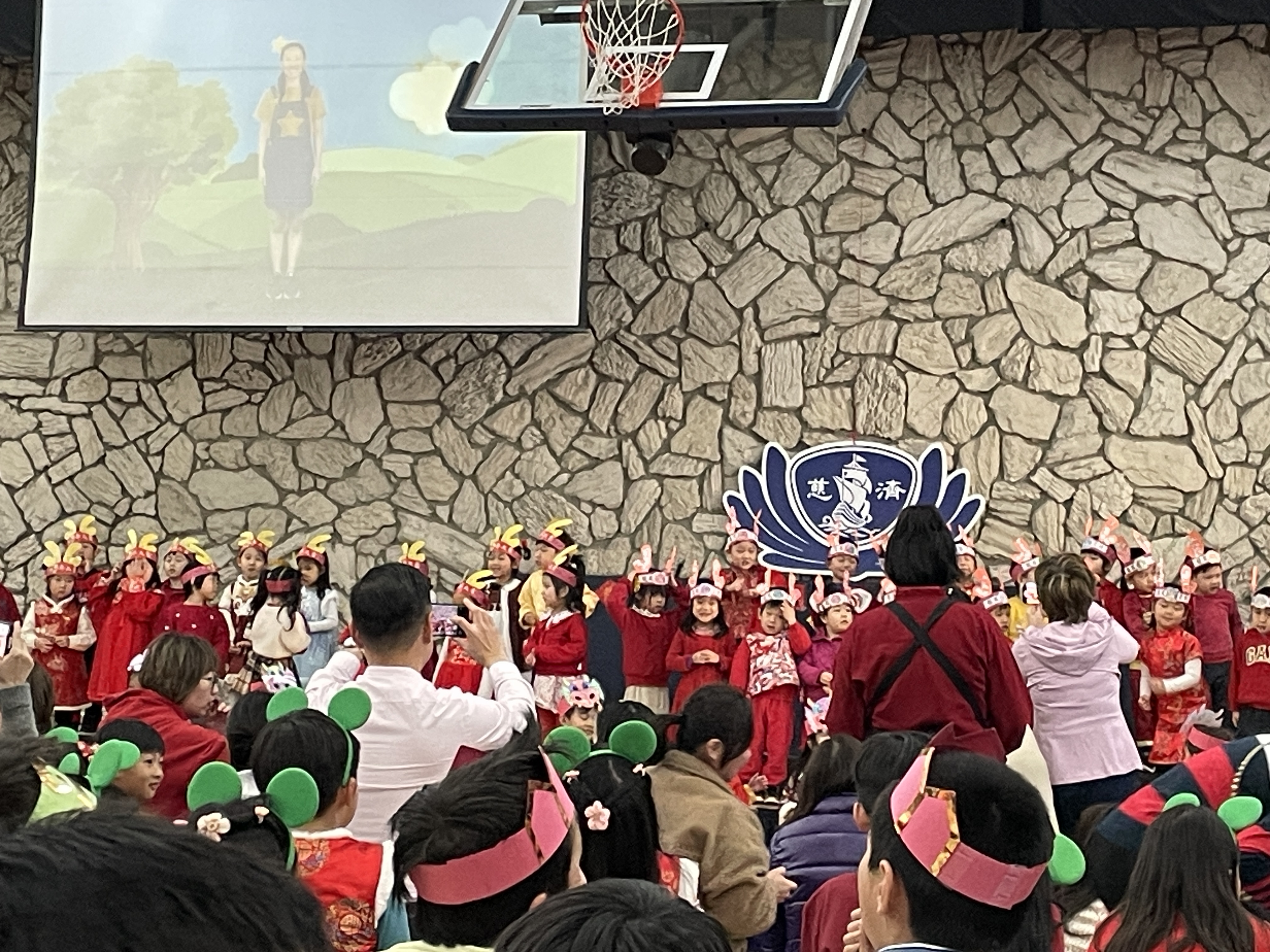
Parents were very enthusiastic about taking photos.

Then after all the students of varying ages finished all their performances, including older students who made a circle around the room and sang plus danced with perfect synchrony, out came the dragon.
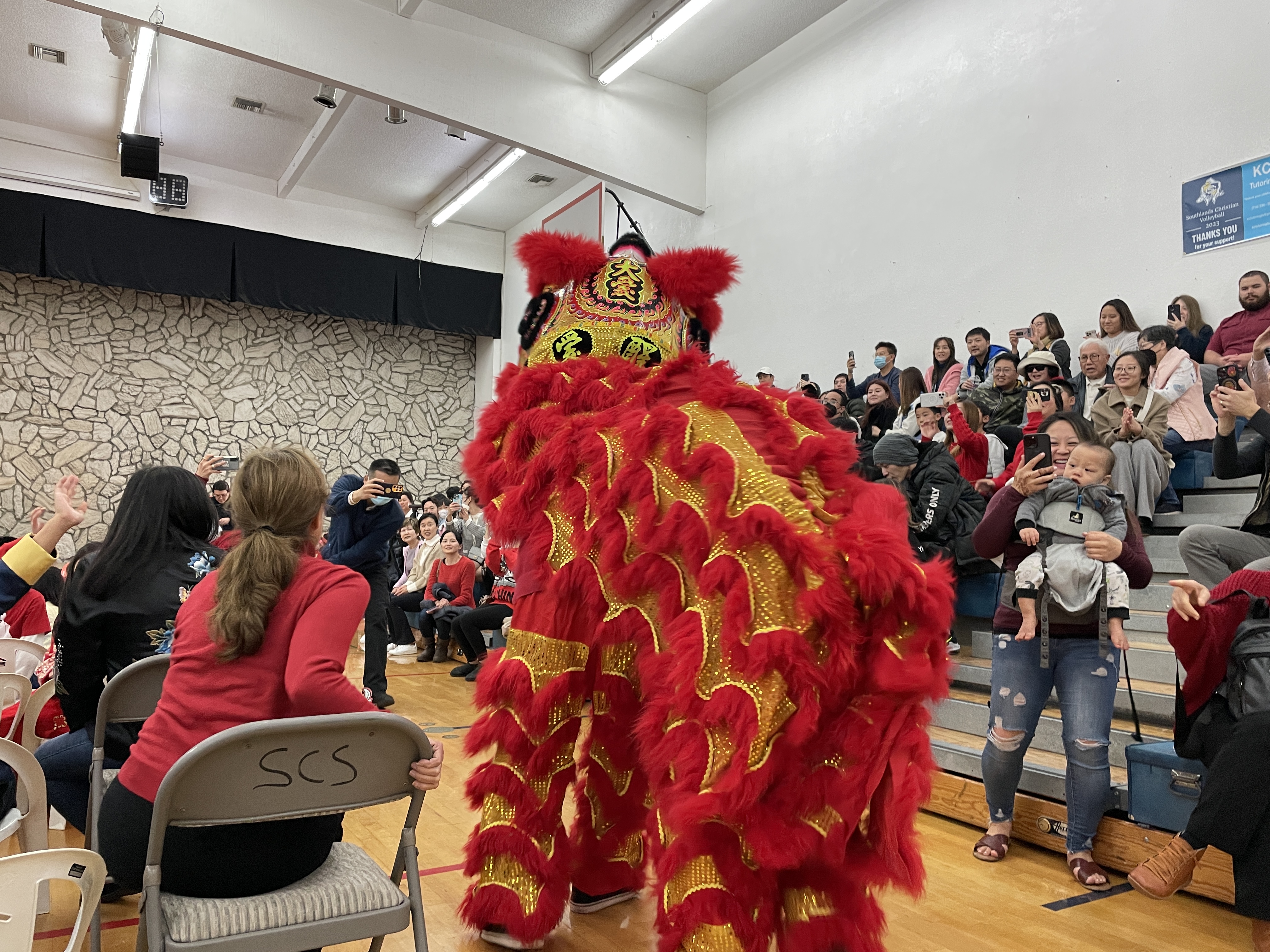

It was so much fun to see all the children performing; it was obvious they had worked very hard to accomplish this. It was also enjoyable to see so many happy, enthusiastic parents.
Note: I work with this Buddhist Center teaching character education at local public schools.
In the last few days, I’ve read three books by Annie Ernaux who won the Nobel Prize for literature in 2022. Although she is a major writer in France, I had never previously heard of her. Since the local library possessed none of her books, I drove to Claremont and checked out all of her books that were available. The publication dates range from 1974 to 2022.
Most of her books defy categorization. The librarian helped me find them because some were in fiction and some nonfiction. From just reading them, it is impossible to determine whether what I’m reading is real or imaginary or a combination. She writes about women’s lives mostly and issues that only women experience.
“The Young Man”, copyright 2022, tells a detailed account of a love affair between a young male student and a 50 something woman, thirty years older than he. They meet on weekends often at his apartment, make fervent love, visit sidewalk cafes, wander. The narrator notes that people sometimes look askance at them in a way they never view an older man and a younger woman. She finds love making helps her write, “Often I have made love to force myself to write.” At the end of the book are photos of Ernaux over the years (she was born in 1940) and a detailed biography.
Next I read “The Happening”, (2001) a detailed account of a young female student seeking an abortion when it was illegal in France. She manages to hide her state from most people including her parents. She finally finds an elderly nurse, but later experiences complications and ends up in the hospital where a young doctor, who thinks she is just some poor woman off the street, treats her badly. When he discovers she is a university student, he finds her and apologizes. It seems mistreating the poor is okay but not someone from his own class status.
Then I read “Simple Passion” (1991), a short (64 pages) detailed account an illicit love affair between a young, married man from Eastern Europe and the narrator. The telling part of this story is the narrator’s (the author?) obsession with this man she calls A. She waits for his calls 24/7. She thinks about him every waking moment and dreams about him at night. I kept thinking of myself and many women I know who have become obsessed with some man to their own detriment.
A a writer, I find her work totally fascinating in its extreme courage. She writes in detail about experiences few would dare to even talk about, but many experience and keep silent. Much of it is autobiographical, an even great demonstration of bravery. Who dares tell the truth of many of our own experiences? Very few of us.

At the beginning of 2023, my main resolution was to read at least one book a week on average. I exceeded the goal. Now I have to decide whether to continue. I discovered a lot of authors I had never read before and learned many new things.
This last book of the year is perfect for those who love Italy, the Italy of today and medieval Italy because it takes place in both time periods–mostly in the Siena of the 14th century but some in modern Siena as well. It begins in current day New York where Beatrice, the main character, works as a neurosurgeon. Years before, her older brother, a medieval scholar, moved to Siena to investigate the ancient rivalry between Florence and Siena. When her brother suddenly dies, Beatrice discovers she has inherited his house in Siena. When she goes there to settle his estate, she not only discovers his wonderful, centuries old house, but also a manuscript from a fresco artist, Gabriele Accorsi, and one of his paintings where there is an image of a woman who looks exactly like Beatrice herself. This magically leads her to 1347 Siena, a conspiracy over the rivalry between Florence and Siena, the Plague, romance, and so much more. This is a page turner sort of book where the reader also learns a lot about the Plague, medieval Italian customs and life, and Tuscan history.
I find it interesting that the author is a professor of neurology, fluent in several languages, and literate in Latin. This novel has also lead me to explore the actual medieval relationship between the cities of Florence and Siena.
Travel the World 4 Less
A Glimpse into My Life & Passions
Ceto-Magoism, the Whale-guided Way of WE in S/HE
Exploring the F-word in religion at the intersection of scholarship, activism, and community.
ANCESTRAL FOOD. HERBAL WISDOM. MAGICAL COOKERY. SEASONAL CELEBRATION.
inesemjphotography
politics, engineering, parenting, relevant things over coffee.
Food is the best expression of every emotion. Explore through my reviews, recipes, events and more.
Smile! A Site for Friends Wherever You Are!
inspiring personal growth through poetry and writing
Combining atheism with whimsy. This is a Fair and Balanced blog based on opinion unencumbered by fact.
Odds and ends ~ My Life
Original poetry, commentary, and fiction. All copyrights reserved.
bripike@gmail.com
A wildlife filmmaker in Africa
A Geeky Feminist's Musings On Pop Culture
"5 minute walks"
 writingontherim