Book 13 for 2024: “The Blueprint”, Rae Giana Rashad


In this dystopian novel white men in Texas run everything and carry guns, have taken over what was the US, eliminated The Constitution, and now use a Blueprint one of the main characters created. There is no choice for much of anything especially if you are a Black woman. An algorithm determines your occupation, spouse, residence, well, everything. Black men have a bit of choice, mainly to be in the military and die young. You can raise to a high rank, have some power, and be honored for your bravery. Sometimes young Black girls around 15 are assigned by this algorithm to be the concubines of powerful white men. This is how the main character, Solenne, ends up living with the most powerful man, becomes his lover. Unlike other circumstances where later she might have a choice, he becomes so obsessed with her that he never wants to let her go. To keep sane she writes about her enslaved ancestor, Henriette, the concubine of a powerful white planter in the 1800s. Women have a tracker implanted in their thumbs so men can see where they are and what they are doing. The only place to escape to is Louisiana, a free state, but even there greed and power can entrap you and force you to return to Texas. The prevailing attitude is this:

“The Councilmen said a nation was only as strong as its hold on its women. They had to squeeze the life out of the women’s liberation movements, give it no air…It begins at home with the wives.”

Book 12 for 2024: “Quiet in Her Bones”, Nalini Singh


If you like murder mysteries, this is a book for you. I do not normally read them, found the blurb intriguing and started it. Once I started, I did want to know what happened. I learned a lot about New Zealand, the diversity of wealthy people who live there, and the lush climate in some places. A wealthy South Indian woman suddenly disappears along with 250,000 in cash. Ten years later no one still knows what happened to her and then suddenly someone finds her Jaguar hidden in dense woods with her skeleton in it. Her devoted son has believed all this time she ran away from a horrible marriage (he cannot stand his mean dad) and is still alive. Now the son is a famous, wealthy writer and determined to find out who killed her. This is the story of her life, a horrible marriage, a wealthy neighborhood where nothing seems as it really is, and the son’s quest to find who killed his mother.

Book Seven for 2024: “After Eden, A Short History of the World”, John Charles Chasteen


Want to learn a lot in less than 400 pages? Read this book. Published this year, it is the most recent book by a prominent Latin American scholar and historian. After humans learned agriculture and built cities, most of the population of the world became increasingly patriarchal and warlike. The divide between rich and poor increased. Egalitarian foragers and wandering hunters existed only in more remote areas. A few still exist in those remote and less modern corners of the world, often places where few others want to even go. This quote says a lot about the current state of affairs:

“Our civilization has thousands of years practice making war. We have almost NO practice making global peace, but without it we are doomed. Today’s pervasive nationalism and rearmament is unlikely to help us make global peace.”

And a page later:

“Only a true unanimous global effort has any chance to preserve our common home.”

He notes that saving Earth will take huge social transformations, including curbing the excessive consumer capitalism that currently pervades plus overcoming a world wide history where half of humanity mistreated the other half, a practice that still continues.

Chinese New Year at the Tzu Chi Campus


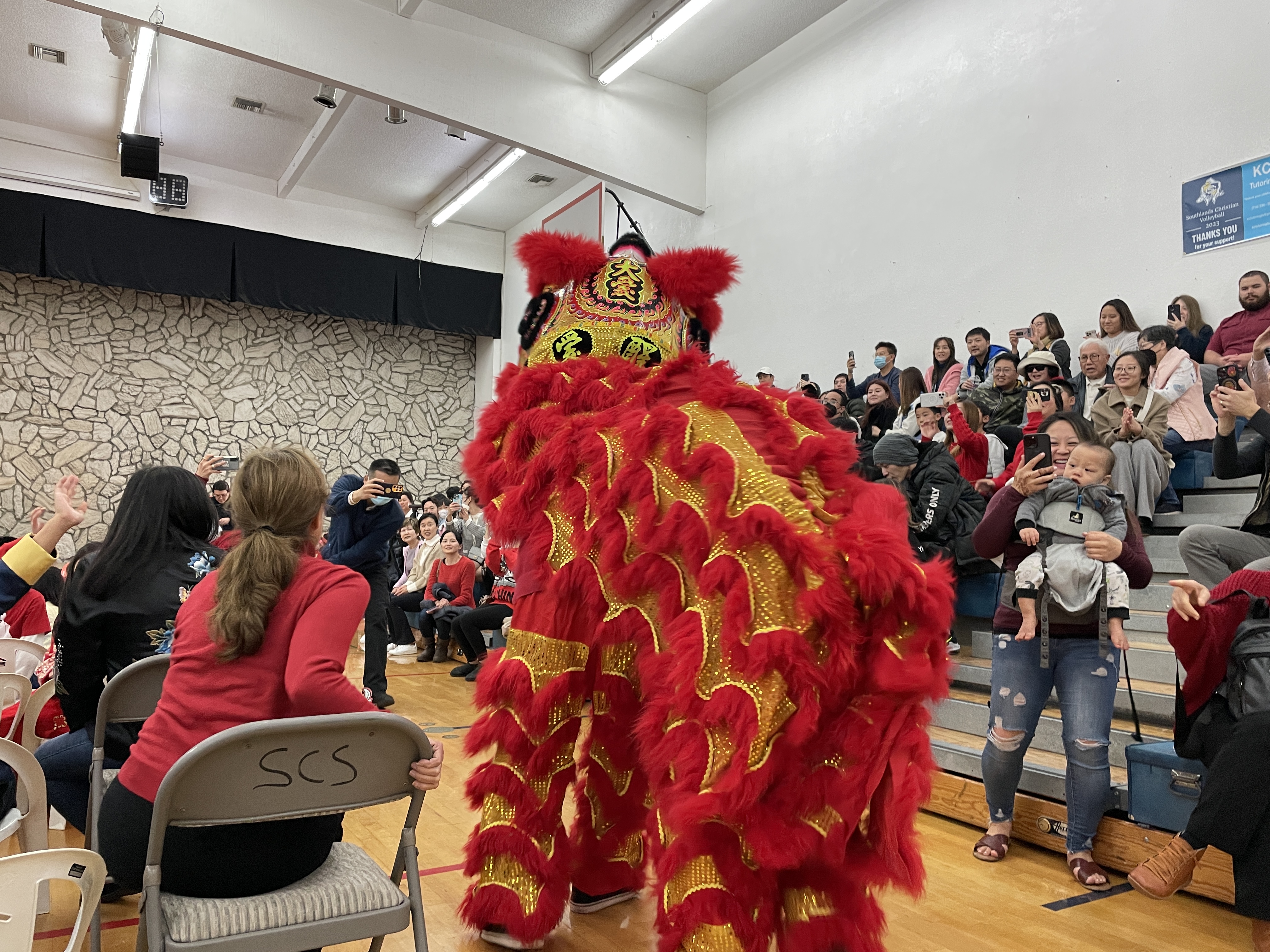
Today I traveled a bit south of where I live to the campus of the Tzu Chi school which I have visited numerous times. First we had a vegetarian lunch–they are Taiwanese Buddhists who advocate a vegetarian, plant based diet as better for the environmental future of Earth. Then all the visitors, who were mostly parents of the children, went to the gym for the program. Various ages wore headdresses to represent the various signs. Some of the youngest children wore dragon headdresses. This is the year of the dragon.

The children sang and danced.

Parents were very enthusiastic about taking photos.

Then after all the students of varying ages finished all their performances, including older students who made a circle around the room and sang plus danced with perfect synchrony, out came the dragon.

It was so much fun to see all the children performing; it was obvious they had worked very hard to accomplish this. It was also enjoyable to see so many happy, enthusiastic parents.

Note: I work with this Buddhist Center teaching character education at local public schools.

Book Two of 2024: “Jezebel”, Megan Barnard


As a woman whose view of most women in the Bible remains nuanced, I could not resist a purchase when I saw this on the shelf at a bookstore. For centuries, she’s been vilified as a harlot, a temptress, both descriptors seen as negative by many societies even in these freer, modern times.

This novel by Megan Barnard is first person Jezebel, beginning with what she has been told about her birth and family. Then she describes her luxurious upbringing in Tyre, her forced marriage to Ahab while Ahab’s father is still alive and king of Israel. She begs her father not to force her to marry Ahab. Her father wants an alliance with Israel, which at that time was considerably less wealthy, quite backward, and more warlike than Tyre. She and Ahab have never even met when she arrives as a teenager to be his wife. To make it more difficult initially Ahab mostly ignores her, preferring other women in the harem. One issue is their differences in religion, she being a follower of Astarte while he and Israel are followers of Yaweh. She is used to religious tolerance, thinks people should be free to follow whatever religion works for them. The Israelis go to war over religion, demand adherence to their god.

Throughout she laments the plight of women, their lack of power and self determination. She notes that only prominent men are remembered, written about, not women regardless of their status, intellect, and influence. She remains steadfast in her determination to be remembered, to be written about even to the point where she engages in devious and sometimes cruel behavior to accomplish her goals. I find it noteworthy how effective this turned out to be; she is remembered, immortal, whereas kinder, gentler women are mostly forgotten.

Book One for 2024: “Rain of Gold”, Victor Villaseñor


The lady in charge of the College Center at Mendez Learning Center told me about this book, one of her favorites. I received it for Christmas from my grandson. It is the first book I read this year.

Although it reads like an epic novel, it is non-fiction, the story of Victor Villaseñor’s family tracing back to his four grandparents in Mexico, one set from Jalisco and the other from the rugged mountains closer to the US border. All left Mexico to escape the violence of the Mexican Revolution and eventually settled in Southern California.

Some of the events in this story are heart wrenching incidents of violence, even death, blatant prejudice, and economic poverty. On the other hand, I often found myself laughing out loud, it was so funny. The author’s parents remain perfect examples of strong people who never give up, whose persistence and determination lead to prosperous lives as successful business owners. The author continues to live on the ranch where he grew up in northern San Diego County. Now 83, he has authored many books including a sequel to this one. His website not only talks about his life and writing, but also struggles with dyslexia.

One Book a Week-55: “The Scribe of Siena”, Melodie Winawer


At the beginning of 2023, my main resolution was to read at least one book a week on average. I exceeded the goal. Now I have to decide whether to continue. I discovered a lot of authors I had never read before and learned many new things.

This last book of the year is perfect for those who love Italy, the Italy of today and medieval Italy because it takes place in both time periods–mostly in the Siena of the 14th century but some in modern Siena as well. It begins in current day New York where Beatrice, the main character, works as a neurosurgeon. Years before, her older brother, a medieval scholar, moved to Siena to investigate the ancient rivalry between Florence and Siena. When her brother suddenly dies, Beatrice discovers she has inherited his house in Siena. When she goes there to settle his estate, she not only discovers his wonderful, centuries old house, but also a manuscript from a fresco artist, Gabriele Accorsi, and one of his paintings where there is an image of a woman who looks exactly like Beatrice herself. This magically leads her to 1347 Siena, a conspiracy over the rivalry between Florence and Siena, the Plague, romance, and so much more. This is a page turner sort of book where the reader also learns a lot about the Plague, medieval Italian customs and life, and Tuscan history.

I find it interesting that the author is a professor of neurology, fluent in several languages, and literate in Latin. This novel has also lead me to explore the actual medieval relationship between the cities of Florence and Siena.

One Book a Week-54: “On A Night Of A Thousand Stars”, Andrea Yaryura Clark


For decades I have been a bit obsessed with Argentina and its history. When the horrible events described in this recent novel occurred during the military dictatorship in the 1970s, I closely watched news and read books about it. Later, I hosted an exchange student from Argentina and visited him and his family. Therefore, when I saw this novel on the new books shelf of the local library, I checked it out.

At a polo match in New York, a wealthy Argentinian diplomat and his wife and daughter meet a woman from his college days. She says things about him and his past that upset him and cause his daughter, Paloma, to wonder about her dad’s past, about which she knows little. When they go to Argentina on a trip related to his diplomatic duties, Paloma decides to investigate. She meets a local university student whose parents had disappeared (as thousands did) during the military dictatorship. He is part of an activist group searching into the disappearance of close family members during the dictatorship. He decides to help her with her research into her dad’s past. This creates a chain of events that upsets everything she knows and endangers her life.

If you want to read a heartbreaking love story, learn more about a brutal period in Argentinian history and some Argentinian customs and lore, this is the book for you. I went back and reread some of it twice.

One Book a Week-49: “Anything Is Possible”, Elizabeth Strout


Her books are deceptively simple with so much to say about people and life. This is the fourth book I have read of hers this year. It interweaves many of the characters in the books I previously read back to the towns where they were born and grew up. One part of the book discusses one family who were so poor the children dug food out of dumpsters and everyone made fun of them at school. Only one truly escapes and finds success. One lives a lonely life at the home place, and the other is filled with anger and resentment. Much of the book is about how even if persons escape a horribly poor and dysfunctional family and find success later in life, the terrible things that happen to them as children are always there lurking in the shadows. This includes a lot of resentment and anger from some family members who do not manage to escape. Other parts of the book detail the lengths to which people will go to find solace often secretly with few or no one having a clue about how their lives really are. How well can we really know another person?

One Book a Week-47: “A Pipe for February”, Charles H. Red Corn


If you have read “Killers of the Flower Moon” and/or seen the movie, this is a must read. Published in 2002, this Osage novel details the daily life of John Grayeagle from his viewpoint. A young, oil wealthy Osage man at the time he tells his story, John was raised by his grandfather because his parents, like many other Osage, were killed under strange circumstances, in his parents’ case an odd car wreck. He is the cousin of Molly, a main character in “Killers of the Flower Moon”. Although he received a college education, spent months traveling in Europe, lives in an elegant house, and drives an expensive car, he still follows many of the Osage traditions, which he details as he talks about his life throughout the novel. The novel describes the murders (which officials usually claimed were accidents or suicides) from the Osage point of view. They knew something was going wrong but were having difficulty determining what they could do about it. They were suspicious of the guardians assigned them by the US government who thought they were too stupid to manage their oil wealth, yet were often stymied when they tried to gain control of their own affairs. This is their story.

The author, who died in 2017, was a prominent member of the Osage Nation, a member of the Peace Clan as is the novel’s main character. The novel’s Foreward is written by Martin Scorsese, who cowrote the screenplay for “Killers of the Flower Moon” and coproduced and directed the movie.