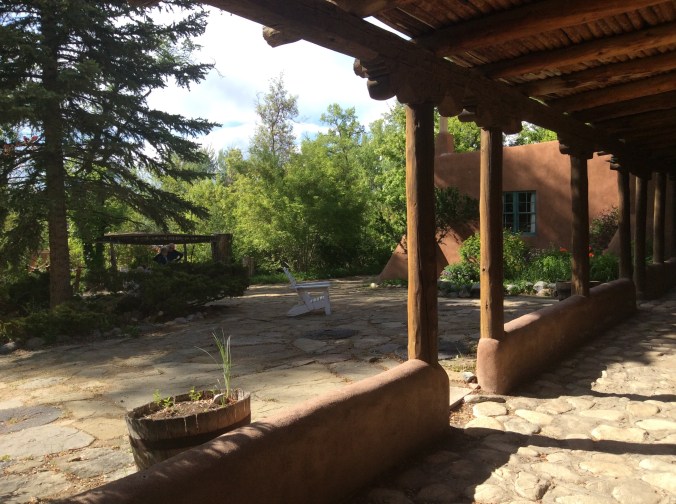
The Mabel Dodge Luhan House in Taos


For years I had read and heard about this place, even attended a lecture by a descendent of one of her frequent guests who actually knew her when he was a child.  This past weekend good friends from Rociada took me there with my best friends from college years, friends from long ago, visiting from California.

I already knew something about Mabel and her friends, famous people who frequented her salon, created the artistic mystique that still hangs over Taos.  When I returned home, I wanted to know more.  Born into Buffalo, NY, high society, she had been married and widowed by the age of 23.  As a young woman she was openly bisexual; her memoir, “Intimate Memories”, provides a frank discussion of this part of her life.  Several years after her first husband’s death, she married the architect Edwin Dodge.  They lived near Florence, Italy, for seven years where she entertained such notables as Gertrude Stein, Alice B. Toklas, and Andre Gide.  After affairs and two suicide attempts, she separated from her husband and moved to Greenich Village.  Eventually, she married her third husband, the painter Maurice Sterne and became a patron of the arts.

In 1917, she and her husband moved to New Mexico.  This changed her life; she lived there until she died 45 years later.  She preferred Taos to Santa Fe, finding the latter “too civilized”.  She found New Mexico “alive” and fell in love with Pueblo culture eventually even cutting her hair to mimic Pueblo style.  Sterne did not find New Mexico to his liking and left.  After their divorce she married her long standing love, Antonio Luhan, a Taos Pueblo man.  They remained married 40 years.

Mabel entertained a nearly endless array of famous artists, writers, and intellectuals:  D.H. Lawrence, Georgia O’Keefe, Willa Cather, Ansel Adams, Carl Jung, Emma Goldberg, Margaret Sanger, the founders of the Taos Society of Artists.  She introduced New York and the east coast to New Mexico through her columns in “The New York Journal”.  Mabel died in 1962.

IMG_2284

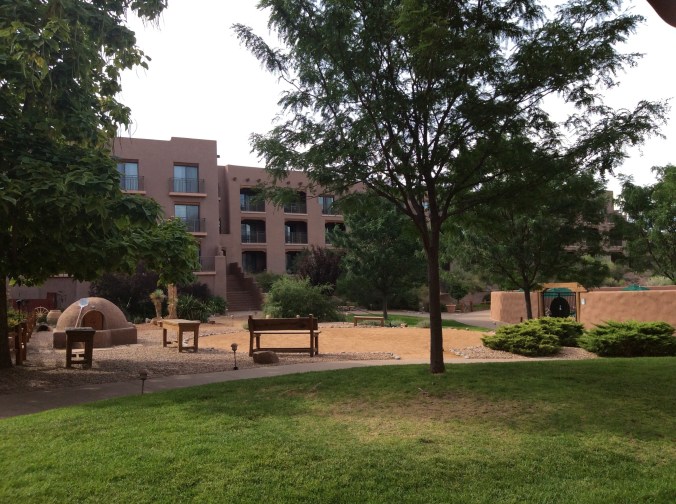
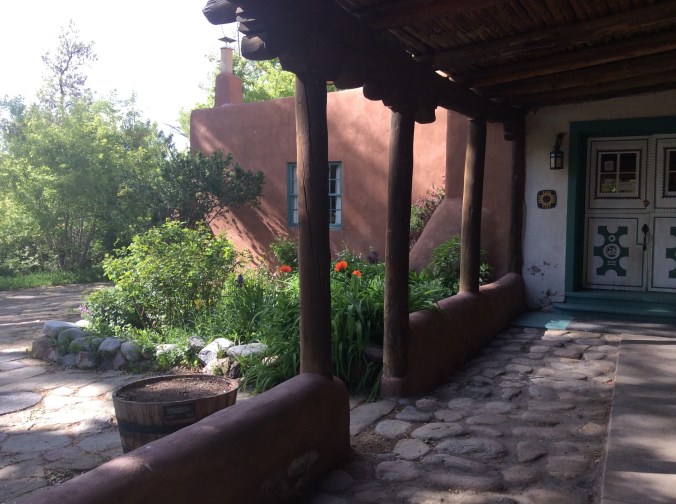
A view of the main entrance and the largest portion of the house and grounds.

IMG_2274

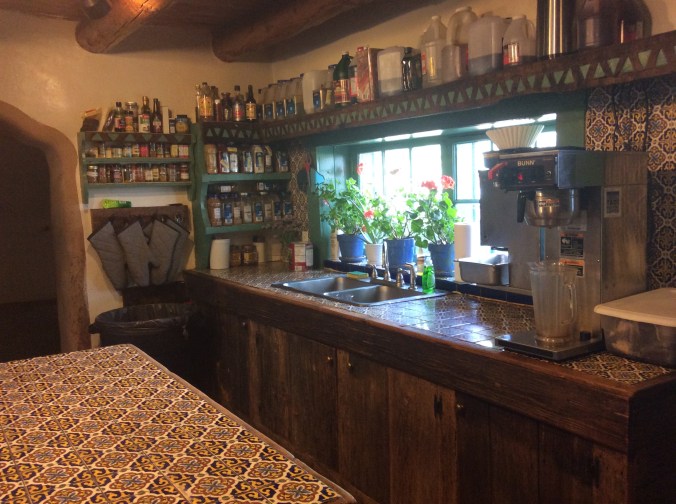
A small portion of the kitchen.  Cookies, coffee, fruit infused water, and tea were available in the dining room for hotel guests. Books with historical photos lay out for visitors to read in an adjoining room.

Dennis Hopper bought the house in 1970 and recreated her “salon” hippie style.  In 1977, he sold it to George Otero.  Because of years of neglect, it required extensive restoration.  The Oteros turned it into a non-profit where they held workshops.  The Attiyeh Foundation, its current owners, purchased it in 1996 and run it as a hotel and conference/retreat center.  It costs nothing to visit and wander around.

IMG_2281

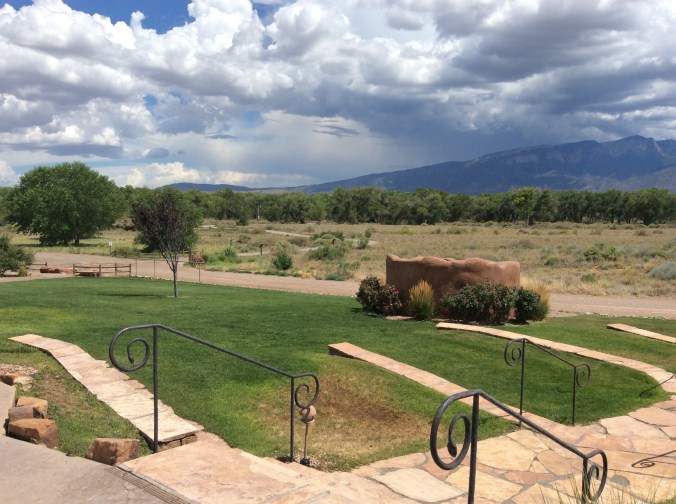
This photo was taken from the same spot as the first one, looking to the right instead of toward the entrance.

IMG_2282

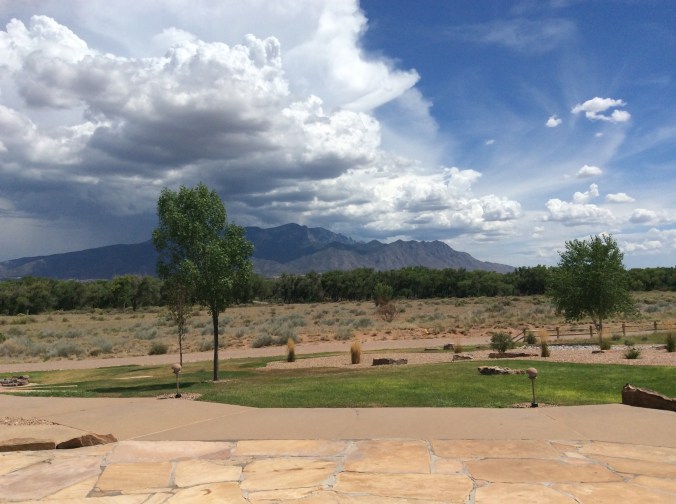
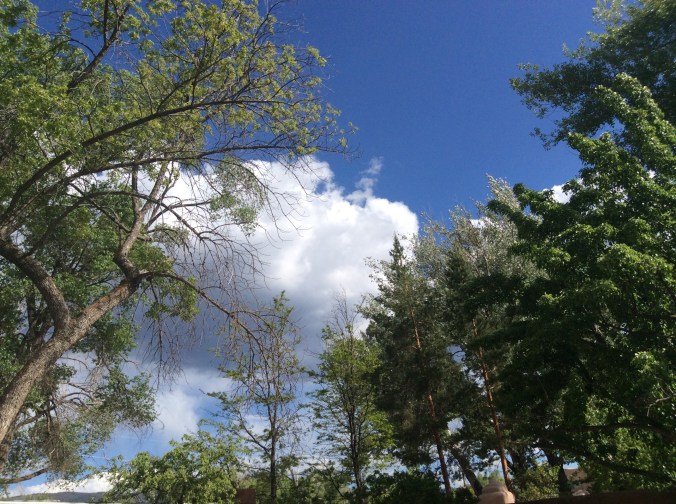
While standing there, I looked up into that incredible New Mexico sky.

IMG_2279

A close up view of the entrance.

IMG_2276

Look at all the bird houses.

IMG_2275

Beside the kitchen, out a side door–patio and horno (traditional clay oven) shaded from the afternoon sun.

IMG_2277

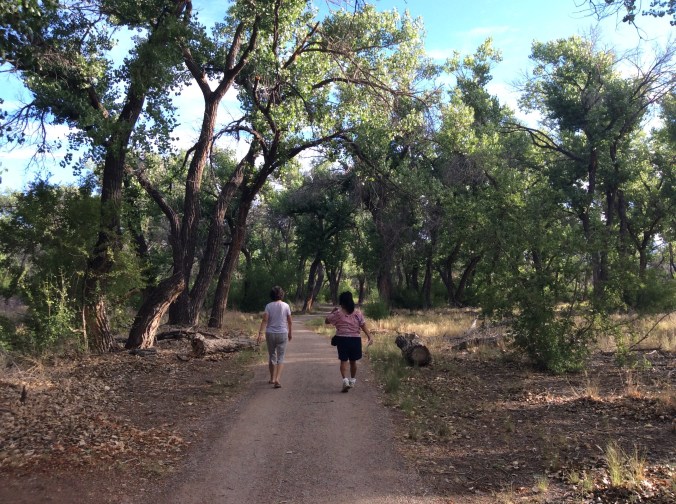
IMG_2280

Friends chit chatting while I wander around taking photos.

For more details, go to:   http://www.mabeldodgeluhan.com.  This includes history, accommodations, workshops, etc.  The accommodations portion even tells the site visitor who slept in each room when visiting Mabel.


79-Year-Old Bird Watcher Takes Down Oregon Militant With Old High School Wrestling Move


For those of you who have been following the illegal occupation of the refuge in Oregon, this is perfect. Whenever I see how they treat those who disagree with them, how they violate the rights of the rest of us who pay taxes that fund those lands, how they violate and destroy American Indian sites and artifacts, I become increasingly dismayed, well, actually angry. Perhaps all the birdwatchers in the country should show up there. Would they shoot them? Oh, I forget, most people, unlike the occupiers, actually have to work.

Unknown's avatarWolves of Douglas County Wisconsin Media

Source: The LapineJANUARY 10, 2016

BURNS, OREGON — Grandfather of four Robert Saunders says he was just out to check on some young burrowing owls at the crack of dawn this morning when he was confronted by a “red-faced pudgy man with a big gun”.
And things got physical when Saunders refused the barked orders to halt and identify himself.
But it wasn’t the retired teacher who ended up on the ground.


Well heck, one second he was warming his hands by this kind of puny little fire and the next second he was running at me and shouting to get down on the ground,” Saunders told reporters gathered nearthe Malheur National Wildlife Refuge.

“Made me mad really. It’s public property and here this guy is acting all big and tough and pushy.”
“I don’t swear much at all but I told him to screw right off and…

View original post 287 more words

Who Is the Best Writer: A Matter of Taste and Viewpoint


Until I was asked to be a judge for a memoir competition, I did not spend a lot of time thinking about this topic.  For years my general awareness about writing preferences included the knowledge that the writers I prefer and usually read rarely hit the best seller list and generally are not white, main stream USA.  What do I read:  Native American (American Indian), Indian as in the country of India, and Latin American writers, and writers from the Middle East, especially Iran.  My favorite writer is Leslie Marmon Silko.  My favorite book of hers is Storyteller.  My favorite story, “Yellow Woman”, is in that book as well as numerous literary anthologies. I estimate I have read that story at least fifty times, maybe more.  Why?  In spite of asking myself that question, I remain somewhat clueless.  Because of my current teaching assignment which includes British literature from Beowulf to now, I try my best to read a bunch of British literature.  For instance, I just read I, Claudius by Robert Graves.  Of course, it has nothing to do with Britain; perhaps it does not count.   Next on my list is The Inheritance of Loss by Kiran Desai.  This book won the Man Booker Prize in 2006.  Although she writes in English, she obviously is not British unless you consider being in a former British colony counts as British.

Back to my contest assignment:  Two of the books I was assigned to read nearly put me to sleep.  One did not; in fact I liked it a lot–enough to mark pages with passages I plan to use when I need writing inspiration/ideas later.  When I read a bunch of reviews recently, it came as quite a shock to find one of those put-me-to-sleep books favorably reviewed.  Could I really have been that far off base?  I consider the possibility that even though I have read some excellent memoirs, I find many of them impossible to read.  Why?  From my viewpoint, many memoirs whine, lament, and carry on about the past in a way I find highly objectionable.  Who wants to read hundreds of pages about how someone overcame addiction or some hideous disease or a divorce? Apparently, a lot of people.  Even though I consider The Glass Castle an excellent book, I even had a difficult time plugging through the last 50 pages of that one.  Some of Storyteller is a memoir–a combination of poetry, vignettes, photos, but it also includes several enlightening short stories.  While writing now and reflecting, I can only think of one other memoir type book, I actually recommend to people, Jimmy Santiago Baca’s A Place to Stand.  While stopping by the library this morning, I did pick up Willie Nelson’s latest, Roll Me Up and Smoke Me When I Die.  It even has a foreword by Kinky Friedman, who in my opinion would make a much better governor than any one we have experienced in Texas lately or will have for the foreseeable future.  With a title like that, about Willie, and Kinky thrown in, surely it won’t be too boring.


Immigrants


Since teaching senior English is my new teaching assignment, I started reading books I have not read that were short listed for the Man Booker Prize.  The first, which I just finished, is We Need New Names by NoViolet Bulawayo.  I marked two quotes that hold special relevance for me for very different reasons.  The first one:  “And besides, I’ve been getting all As in everything, even maths and science, the subjects I hate, because school is so easy in America even a donkey could pass.”  I laughed out loud when I read this.  Talk to many students born here and you would think school is hopelessly challenging.  Last school year and for many before, I taught math, algebra 1 and geometry mostly.  Half do not know their multiplication tables which makes teaching them how to factor polynomials quite a challenge or at least a lot harder.  Ask something truly simple, “What is 1/3 of 3?”  They stare and shrug.

In the past six years, four exchange students have lived with me, two from Thailand, one from Brazil, and one from Argentina.  They all took math, including AP calculus for one.  For all of them, English was a second or third or fourth language.  One commented that except for trying to read Beowulf and Canterbury Tales (they were all seniors and senior English is British literature), it was quite easy compared to school at home.  Two of them took either AP or honors classes.  Parents here complain that school is too hard, there is too much homework.  Really??  I chat with my friends from countries in Asia, the Middle East, Africa, South America.  I listen to my students and I cannot help but wonder what will become of this country if we do not have immigrants.  Yet, many citizens complain about immigrants.  These same complainers often lack the skills to get the best jobs, to rise upward in part because learning these skills is hard work.

The other quote illustrates just how difficult it is to come here from a war torn or violent or economically depressed country you love but must leave and how angry some who feel stuck there may feel.  “Just tell me one thing.  What are you doing not in your own country right now?  Why did you run off to America…Why did you just leave?  If it’s your country, you have to love it to live in it and not leave it.  You have to fight for it no matter what, to make it right.  Tell me, do you abandon your house because it’s burning or do you find water to put out the fire?  And if you leave it burning, do you expect the flames to turn into water and put themselves out?  You left it…you left the house burning…”

I cannot imagine how to respond, how to feel.  I am from here, have always lived here except for one brief stay elsewhere.  Traveling even with friends and family from another country simply is not the same.  Amarillo is a large refuge center with displaced people from Sudan, Myanmar, Somalia, Iraq, Afghanistan, and many other places. Even those with degrees often must work at horrid menial jobs others rarely want, e.g. killing and butchering livestock.  One of my good friends teaches English at a nearby high school.  She has one class in which only one student is a native English speaker.  Although I can read and speak some Spanish, I think just how difficult it would be to learn history and literature in Spanish.  I look at my house and know 100 % that without immigrant labor, I would not have this house.

If you live in the United States and are not 100 per cent Native American, you are either an immigrant yourself or the child of immigrants. Many have forgotten what their immigrant ancestors knew.  Perhaps they need to remember.


Amazon


His milk chocolate, heavy lidded eyes stare at me from the

front of the magazine.

His cheeks display charcoal tattoos, a criss cross

design, tiny Xs on top, stopping where his nostrils flare.

His straight hair barely touches his shoulders.

not the black I expected, but the color of mahogany.

His eyebrows grow thin and wide,

no visible eyelashes.

His skin, color of morning coffee with two teaspoons of milk,

looks clear, smooth.

His full lips only slightly darker than his skin

do not smile.

He, a Kayapo Indian, continues staring.

He lives in Kayapo Territory, Brazil, land the size of

Great Britain and Ireland.

He plans to save it from the rest of us.

He plans to save us from our own worst selves.


SAM_1502


The Kayapo and other indigenous Amerindians have lived in the rainforest for millennia.  They and most environmentalists view their rainforest as a priceless haven for biodiversity.  Their Amazon remains a major defense in the fight against global warming and habitat destruction.  Fifteen per cent of greenhouse emissions, more than all the trucks, cars, buses, and planes combined, come from deforestation.  Although Brazil has slowed the deforestation rate by 70 per cent in the last nine years, last year saw a reversal with an sudden increase of 30 per cent.  Brazil also began construction of a network of canals, dams, and a huge hydroelectric project on the Xingu River in the middle of Kayapo territory.  The Kayapo and other Amerindians defeated a larger project in the 1990s. They intend to defeat this one.

The chief of the Kayapo, Megaron, knows what is at stake, not only for his tribe, but also for the rest of us, long term survival.  One  National Geographic article noted, “It is one of the richest ironies of the Amazon that the supposedly civilized outsiders who spent five centuries evangelizing, exploiting, and exterminating aboriginal people are now turning to them to save ecosystems recognized as critical to the health of the planet–to defend essential tracts of land from the outside world’s insatiable appetite.”

Kayapo success can be attributed to their ability to embrace some of the best of the modern world while retaining a strong sense of identity, culture, and traditions, all of which come from the forest.  As Megaron notes, “Before the white man, we were always fighting other tribes.  Not anymore.  We stopped hitting each other over the head and united against a bigger threat.”  For our own long term health and success, we can support them and hope they succeed.


Water, Water, Where?


Today, I drove about fifty miles to watch a play especially produced by my friend, King Hill, for the Gem Theatre in Claude.  I almost did not go because of high winds and blowing dust.  Between 8 and 10 this morning visibility was so low  it was impossible to see the horizon.  High wind and blowing dust warnings started yesterday.   Now, as I write this, these warnings have continued for more than 24 hours.  Red flag warnings flash across the TV screen. Thankfully, not quite the dust bowl extremes, not yet anyway.

Originally, a green sea of grass covered all the land where I live in the Panhandle of Texas, the Llano Estacado. Immense herds of buffalo roamed free.  This prairie grass protected the land from erosion.  Rivers and an occasional canyon interrupted this endless sea, including the Canadian River, Palo Duro Canyon and the network of canyons running into it.  Once the Spanish brought horses, Kiowa and Comanche ruled this sea for more than a hundred years.  Under a full moon, the Comanche reigned by night raids from Nebraska to Mexico.

What happened?  Plows brought by people from the East dug up the grass.  These people planted the crops they knew, wheat, corn.  They settled in towns and homesteaded the country. They brought cattle and in some areas developed gigantic ranches.  Hunters killed all the buffalo except a few the famous rancher Charlie Goodnight and his wife managed to save.  Remnants of this southern herd now live at Caprock Canyons State Park near the tiny town of Quitaque, Texas.  Those who farmed dry land farmed.  In a normal year crops grew, the people prospered.  In dry years dust blew because there was no grass to hold the dirt.

Today, giant pumps pull water from the aquifers, the Ogallala, the Santa Rosa. My well is 400 feet deep, some are nearly 900.  More and more people move here from other parts of the United States.  They want lawns like the ones they had where it rains forty inches a year.  It does not rain much here, twenty in a good year, ten in a bad year.  These aquifers lose much more water to irrigation in a year than are replenished by rain.  Farmers grow corn,wheat, cotton, and milo, all irrigated.  In some places where  the water became to saline for crops, the pumps sit abandoned.

Today, I drove by miles and miles of dry, thirsty grass, perfect fuel for the wind driven wildfires which sometimes start this time of year.  In other places irrigation pivots rained water on immense emerald fields of wheat.  I could not help but wonder how much of this water evaporated in the sixty mile an hour wind.  As I finish writing this with the TV on  weather watching, I see Fire Weather Watch, High Wind Warning, Red Flag Warning flash across the screen. I hear the wind roar and heavy outdoor furniture slide across the patio.  I’ve seen wildfires, had a half mile of cedar post fence burned down.  All it takes is a tiny piece of cigarette thrown from a truck or car, a flash of dry lightning.  They predict three more days of this.

I love the space, the vermillion sunsets, the intense blue of the sky.  I watch my neighbors water, water, water their new houses in the country.  I think about those pivots irrigating in the wind, and I wonder what will happen when all the water’s gone.


SAM_1369


Apocalyptic Planet-Part Five: Civilizations Fall


Whether it is my innate ambition, something my parents instilled in me, or something else unknown, I try to learn something new every day.  Craig Childs starts this chapter of his book by talking about a Phoenix landmark.  Back when I travelled to Phoenix regularly, I knew this place as Squaw Peak.  Now its name Is Piestewa Peak.  The name change is probably a good thing.  I never knew before reading this how dreadfully pejorative the word squaw is.  Basically, it means Indian bitch as well as other things related to the privates of women.  All languages seem to possess an accumulation of dreadful words geared to putting women down one way or another.  Slang words for the private parts of a man rarely mean anything pejorative, at least not that I know of.  The new name, a Hopi name, a blessing word, is a word that calls water to this place.  Not a bad idea in Phoenix or most of the Southwest for that matter.

The name Phoenix fits.  Underneath modern day Phoenix, an ancient city lays buried, a quite sophisticated city with ball courts, temples, irrigation canals.  This city existed at least a thousand years ago.  Its inhabitants grew corn, cotton, beans, and agave.  Farmers, hunters, carvers, all sorts of artisans and merchants apparently lived there.  Now they are called Hohokam taken from an O’odham word meaning “ancestors”, the “ones who have gone”.  We find forgotten cities all over the world, Palmyra, Machu Picchu, Angkor Wat.  What causes these sophisticated civilizations to fall?  If you read a bit, look further, you find common themes:  environmental decay, resource depletion, conflict, disease, social problems.  Angkor Wat fell because it could not maintain its complex irrigation network.  Ur in Iraq fell because a drought caused its port to dry up.  Usually, the demise of particular civilizations occur over time, e.g.Rome.

Childs notes that human patterns often follow animal patterns, or at least mammalian patterns.  For example, when over population occurs, behavior changes.  Parental care and cooperation become replaced with aggression, violence, competition for resources, dominant behaviors.  These types of behaviors are particularly detrimental to females and the young without whom the society (or animal population) cannot replace itself.  Generally, in animal populations, when this occurs, reproduction slows for several generations and the imbalance corrects itself.  For humans, it is not so simple.  Hohokam bones indicate mass starvation and malnutrition.  Other civilizations, e.g. the Anasazi, seem to have disappeared without a trace.

Today, most of the world’s largest cities have immense infrastructures that keep them going, miles of underground sewage tunnels, water mains, etc.  Here in the US in our oldest cities, much of what we take for granted is very old and deteriorating.  New York City and Chicago have water main systems that some experts claim are near collapse or at the very best badly in need of repair.  Doubtless such conditions exist in old cities throughout the world, most of which are much older and larger than the majority of cities in the US.  Yet, they continue to prosper.  Have we passed a point when civilization cannot fall?

Childs completes this discussion by describing his visit with his wife to Guatemala.  They visited all the best known Mayan sites, visited with natives.  His wife managed to get invited to a Mayan fire ceremony, a renewal ceremony.  History books tell us the Mayan civilization is dead, ended.  But it is not.  The Mayan culture still exists.   At least six million still live in the Central America.  What would have happened to Mayan cities if the Europeans had not brought epidemic diseases and better fire power?  We will never know, of course, but no matter how many civilizations rise and fall, change continues and humans continue to inhabit the earth.

The new question is this:  can this planet we live on sustain the ever increasing numbers of humans who inhabit it??

Sacred Corn


SAM_0035   In the summer on hot, humid nights, you can hear the corn grow.  My great grandfather, my grandfather, and my father grew corn.  I grow corn in that same rich loess soil of Northwestern Missouri.  Soil laid down by Ice Age glaciers thousands of year ago.  Only on a few hill tops, here and there, will you find non glacial soil. Repeatedly, daily, I walk by the sacred corn plant of life painted on my hall corner.  This sacred corn corner houses three corn maiden kachinas and a drum decorated with corn maidens.  I give thanks to corn for my house and the life I lead.

Corn Song

I sing the song of ancients:

pueblo peoples,

Anazazi, Hopi, Zuni.

I sing the song of an America long gone.

Maya, Aztec, Tolmec.

I sing the song of life:  colors of the rainbow

golden, red, white, blue.

I sing the song of now:  thick, endless

identical rows.

Pioneer, Monsanto,

anhydrous ammonia,

atrazine.

I sing the song of hope and joy:

an ancient reclaiming,

a klaidescope of colors,

butterflies and fireflies.

I sing the eternal human song.

SAM_0913

SAM_1489

This is a Navaho kachina.  Kachina are actually Hopi, but Navaho artists now make kachinas as well.  The first corn maiden kachina I bought.

SAM_1490

Spotted corn kachinas, on the left, are unusual.  It took me years to find one.  The kachina on the right was created by R Pino, who is both Hopi and Navaho.

SAM_1491

Every year Pendleton runs an art contest among Native American students.  The winner’s art work is transformed into saddle blankets.  This design, created by Mary Beth Jiron, is the latest in this Student Series. There are three corn  maidens  on each side of the blanket, representing the different varieties of corn grown by native peoples, yellow, red, blue, white, black, and spotted.