One Book a Week-30: “Deacon King Kong”, James McBride


It takes genius to write a novel about serious topics, e.g. racism, poverty, addiction, drug dealing, crime, which is also very funny. This is the first book I’ve read this year where I found myself frequently laughing out loud. In the projects of South Brooklyn in 1969, an elderly church deacon shoots a young drug dealer, who is also a star local baseball pitcher. Thus begins a saga about the Black and Hispanic residents who live there, the cops who patrol the area, the Italian mobsters who control the docks, and the church where the shooter is a deacon. The “New York Times” listed this as one of the ten best books of 2020. Indeed it is. This is the third book I have read by this author, and I will soon progress to another one.

One Book a Week-29: “We Are Not Like Them”, Christine Pride and Jo Piazza


A heart wrenching Prologue begins this contemporary novel about race, family, and friendship. Two children, one white (Jen) and one black (Riley), became best friends in kindergarten. Their close friendship endures to adulthood and through distance. Finally, once again in the same city, their bond is tested when Jen’s husband, a police officer, shoots an unarmed 14 year old black boy. Riley, a TV reporter, is assigned to interview the boy’s mother.

Their story, told from the viewpoints of both women, covers the effects of such a tragedy on family and fellow police officers and the community, illustrates the trauma of current events, and demonstrates how such a disaster tests all involved.

Book a Week-21: “Boy, Snow, Bird”, Helen Oyeyemi


A unique and sometimes frightening story with a surprising ending, this is another tale of the lengths to which people of color will go to pass for white to gain the benefits of whiteness. For one New England family this has succeeded quite well by sending a too dark daughter back South to live with relatives and never allowing her to come to the town where the rest of the family lives. It fails when a too dark child is born and the parents keep her with them. It is also a tale of gender identity and how rape and abuse can destroy and deform and of resilience in the face of endless obstacles. This is not an ordinary novel.

One Book a Week-12: The Sweetness of Water, Nathan Harris


The immeasurable horrors of slavery and the immediate years after come excruciatingly alive in this novel. Decent white people help recently freed brothers but at a terrible price. A “forbidden” romance between two Confederate soldiers highlights the destructiveness of class and hatred. Yet, in spite of the despair and cruelty, resilience, decency, and tenderness prevail in the end. Long listed for the Booker Prize, this detailed and beautifully written novel remains true to some of the most painful parts of US history.

One Book a Week-11: The Vanishing Half, Brit Bennett


This unusual novel features identical twin sisters, inseparable as children, living in a small town in rural Louisiana. The town’s founder, a light skinned Black man, insisted on maintaining a certain character for the town–only light skinned Black people should live there. At sixteen the sisters run away to New Orleans where they ultimately choose diametrically opposed lives, one passing as white, marrying a wealthy white man who knows nothing of her true past. In spite of the deception and lies, years later their lives become intertwined in unexpected ways. The novel not only addresses themes of race but also sexual identity and who we are as individuals and a country.

One Book a Week-7: “Memorial Drive, A Daughter’s Memoir” by Natasha Trethewey


Published in 2020, and a must read for anyone who cares about abused women, their rights, and how law enforcement often fails them, this book by Trethewey, 2007 Pulitzer Poetry Price winner for “Native Guard”, voices her struggle to deal with her mother’s untimely death. When Trethewey was nineteen and in college, her mother was shot and killed by her step-father after the police officer assigned to protect her mother left his post early. Additionally, the memoir details the effects of the racism she experienced as the child of a white father and black mother (married when it was illegal where they lived) in Mississippi and later in Atlanta in the 1970s and 80s before her mother’s murder in 1985. The book gets its title from the street on which her mother lived when she was murdered. Through this memoir Trethewey discusses how her parent’s divorce, her mother’s remarriage to an angry, abusive man, and her mother’s murder has informed her life and affected the enduring love she holds for her mother.

Prophetic Passages from Octavia Butler


In my last blog post about reading, I promised to address the prophecies of Octavia Butler in my next post. The best way is to quote some passages from Parable of the Talents which was published in 1998. This book is the sequel to Parable of the Sowers. In that book the main character creates a new religion with CHANGE as a major focus. In fact, one of the main tenants of that religion forms the words on Octavia Butler’s tombstone which I quoted in an earlier post. Here are some passages from Parable of the Talents:

I couldn’t help wondering, though, whether these people with their crosses, had some connection with my current least favorite presidential candidate, Texas Senator Andrew Steele Jarrett. It sounds like the sort of thing his people might do—a revival of some nasty out of the past….So now we have another group that uses crosses and slaughters people. Jarrett’s people could be behind it. He insists on being a throwback to some earlier ‘simpler’ time. Now does not suit him. Religious tolerance does not suit him. He wants to take us back to some magical time when everyone believed in the same God, worshipped Him in the same way, and understood that their safety in the universe depended on completing the same religious rituals and stomping anyone who is different.

Jarrett’s supporters have been known to burn people at the stake for being witches….a Moslem, a Jew, a Hindu, a Buddhist, or in some parts of the country, a Mormon, a Jehovah’s Witness, or even a Catholic. A witch may also be an atheist or an eccentric…anyone who does not fit into Jarrett’s version of Christianity. He condemns the burnings but in very mild language.

He has a simple answer: ‘Join us! Our doors are open to every nationality, every race.! Leave your sinful past behind, and become one of us. Help us make American great again.”

Note: If you are interested in Octavia Butler books, the stack at the right bottom of the photo are mostly her books. Some are series and need to be read in a certain order.

Reading Octavia Butler-1


In a recent post I mentioned walking in her footsteps. This is the rainy season so we have not been able to go on that walk yet.. However, this morning I finished reading the last novel of hers that I had not read–Parable of the Talents. It is the sequel to Parable of the Sower. Now I have read all of them. She is buried at Mountain View Cemetery in Altadena, CA, Eagles View Lot 4517. The inscription on her gravestone is the theme of both the books above:

All that you touch You Change.

All that you Change Changes you.

The only lasting truth is Change.

God

Is Change.

Octavia Butler’s Pasadena–Part One


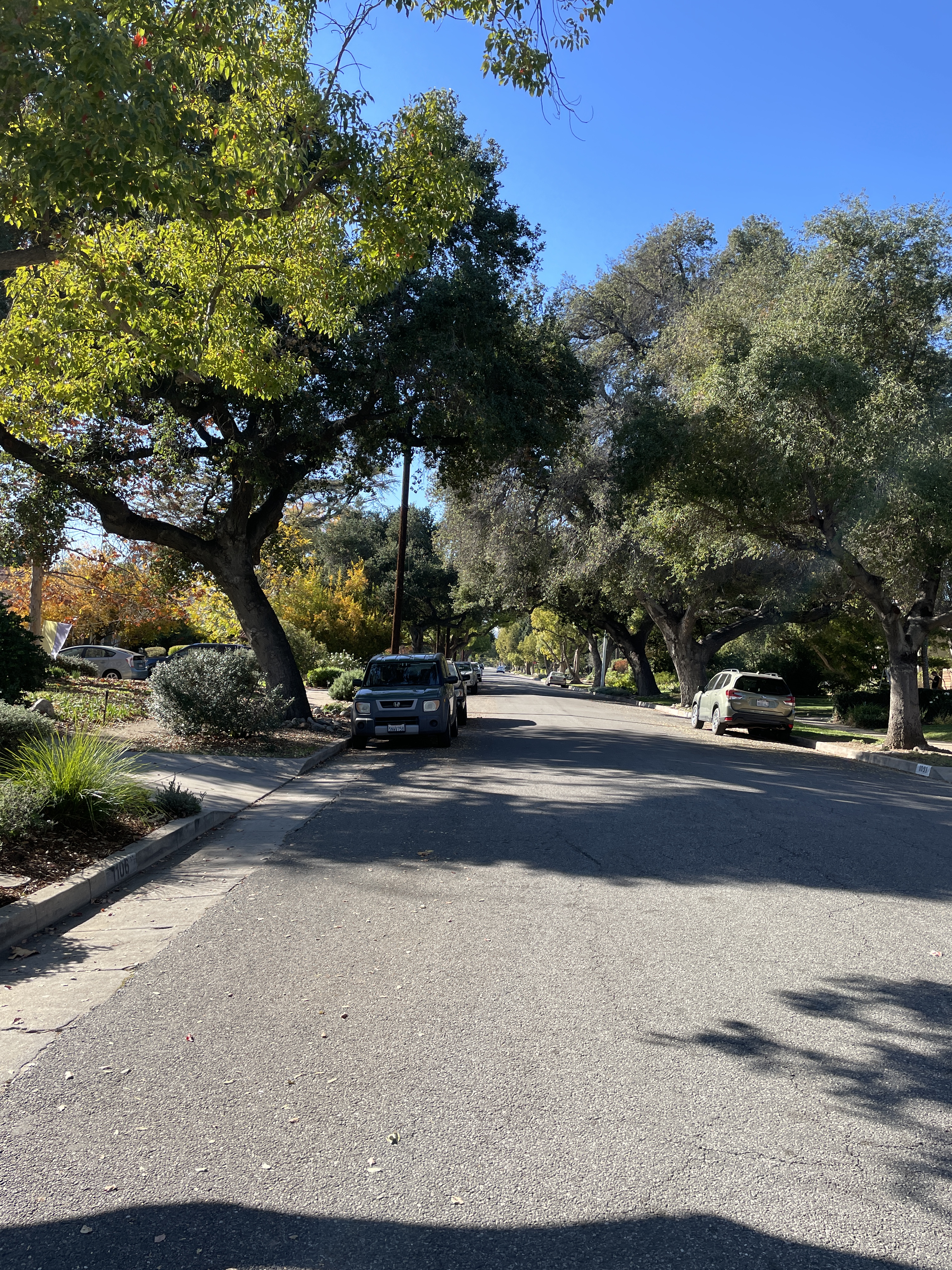
As part of a bookclub I co-host, we read Octavia Butler’s novel Kindred, a science fiction story which takes places in California and in the Old South. Since many of the bookclub members live in or near Pasadena, we decided we would do “Experience Butler’s Pasadena on Foot”, a walking loop of about 2.5 miles. We had planned to take the walk earlier in December but were rained out. We will reschedule early next year. I decided to do a dry run in November and took these photos along one of the streets where she often walked.

Butler lived most of her life in Pasadena but never owned a car. She either walked or took public transportation.

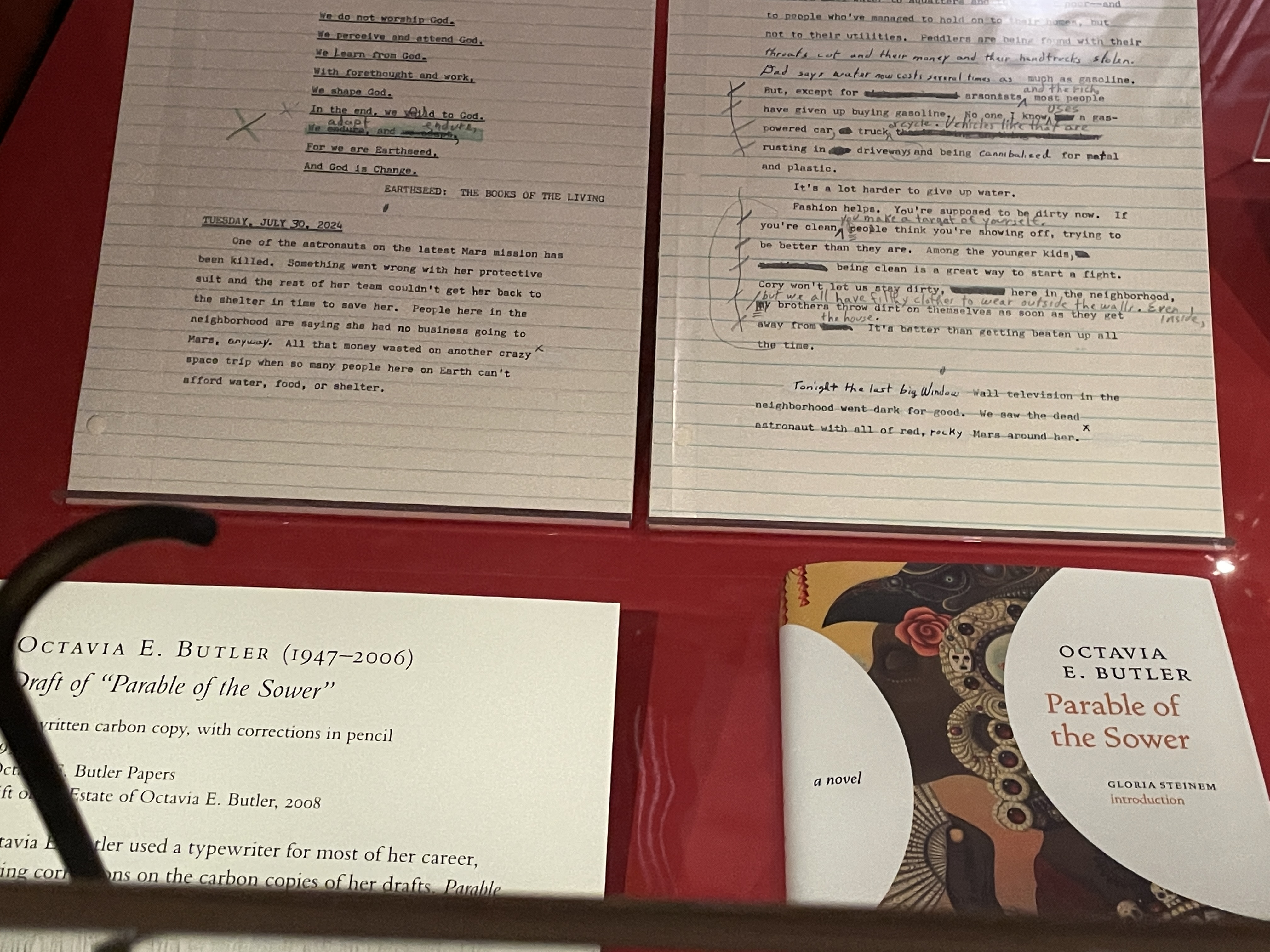
For those unfamiliar with her, she became famous as the first African American to win multiple Hugo and other science fiction awards. Born in 1947, she died in 2006, and is buried in a cemetery in Altadena, CA, just north of Pasadena. Many of her manuscripts are on display at The Huntington Library.

The last Octavia Butler book I read is the one illustrated in this photo taken at The Huntington Library. I am currently reading the sequel, Parable of the Talents. When I finish that one, I will have read all of her novels. She is one of my favorite authors.

Reflections on Independence Day


IMG_3636

When I was a child, we lived on a farm where it rains around 40 inches annually.  On the Fourth of July, Dad always shot off a few Roman candles, and we had small firecrackers and sparklers, nothing fancy, just fun.  Even then I knew about the Declaration of Independence, revered its message.  Still do.

Now I live where it is hot and dry.  The neighbor’s fireworks display rivaled those found in cities–beautiful but dangerous in brown grass country.  I wonder if they give any thought to the history, to why anyone celebrates this day.

For the first time in the decades of my life, I did not celebrate Independence Day.  Why?

Born decades ago, I originally went to college in Virginia where I experienced the shock of real segregation; I had not grown up where it was like that. I was horrified, lasted only one semester, then transferred.  Later I attended a college which shut down in protest over the Viet Nam War, I supported The Civil Rights Movement, I helped create one of the first intercollegiate groups to advocate for abused women, and with an ethnically diverse group I taught diversity classes for teachers.

Now in 2020, I feel that even with all that hard, determined work, progress has been too limited.  It is as if I have been transported back to 40 years ago.  People need to learn from the history most do not even know:

-Cotton Mather, the leading intellectual and Puritan minister in the colonial era, actually helped butcher King Phillip (Metacomet) like an animal.  What did he do to deserve this?  He tried to save his Native people.  Cotton Mather later writes about tearing Metacomet’s jaw from his skull.

-In 1676, when poor whites joined enslaved Africans to rebel for a better life and decent living conditions, fighting for justice against the wealthy planters, those rich planters realized they had to get poor whites to hate Blacks.  They took land owned by Blacks and gave it to poor white people and then paid them to hunt down and abuse, even kill, people of African descent.

-Later, the same Cotton Mather mentioned above, learned from his slave that in Africa, Africans had been taking pus from a smallpox infected person and inoculating others with it to prevent smallpox from spreading.  He refused to believe any African  could be so smart even though he inoculated himself and his family after learning this.  Later, he wrote this about his African slave who had told him the story that may have saved his life: “…brokenly and blunderingly and like Idiots they tell the Story.”

-Of course, we all know that the intellectual giant, Thomas Jefferson, held the deed to the woman who would later bear him numerous children while he proclaimed those famous words that all people are created equal.

The history of racial and ethnic hatred goes back to the inception of this country.  It continues to poison progress and hope.  It never seems to end.  I am tired of it.  Enough is enough.