Ethiopian Journey–Addis Ababa


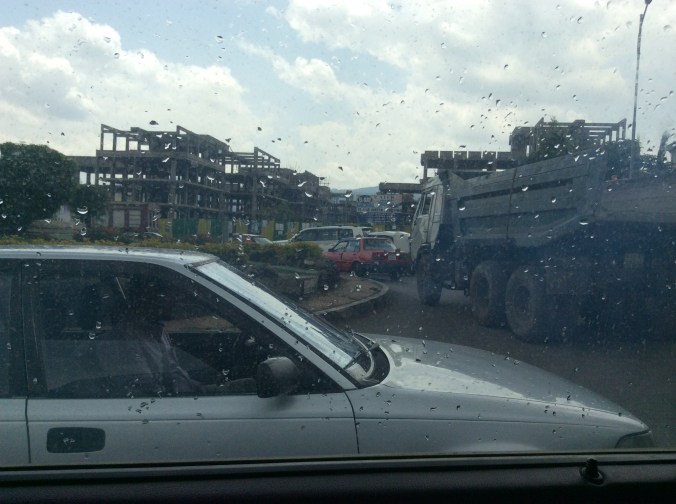
We spent a couple of days in Addis staying with my friend’s sister who lives there.  Addis traffic is incredible.  In a city with millions of people I saw only one traffic light and it was not working.  Most intersections are giant traffic circles and getting through them is a rather daunting task.  On the way to my friend’s brother’s house one day, we sat stuck for nearly one half hour–we could not get through the circle.  Finally, the passenger in the car to the right of us jumped out and stopped the traffic so we and his driver could get through.
IMG_0211

Additionally, it rained often, streets and buildings were under construction, and mud and potholes showed up everywhere.  This is a nice traffic circle.

IMG_0212

A nice day with little traffic.

IMG_0213

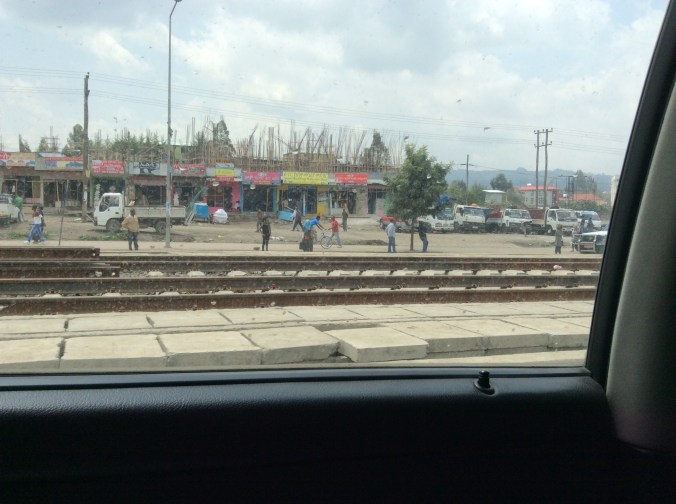
They were building a new rail line across the city hoping people would use the train instead of driving.
IMG_0214

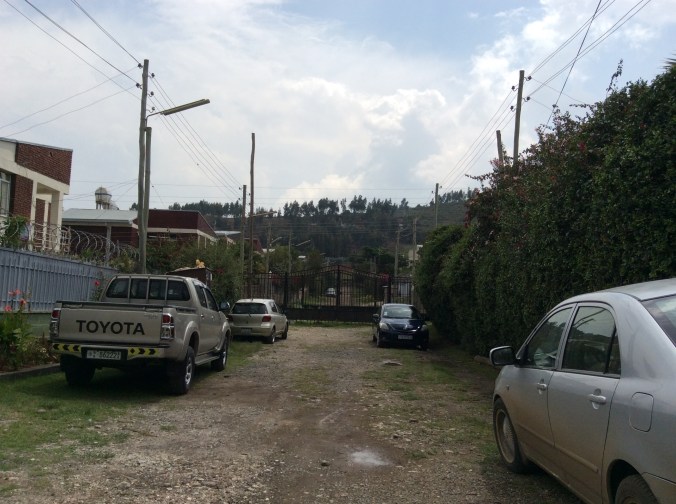
This is a typical residential street in a newer part of the city.  A gate with a guard can be found at each end of the street.

IMG_0215

In other parts of the city, houses have walls around them and you back your vehicle out into a street like this, then go to the main street.
IMG_0207

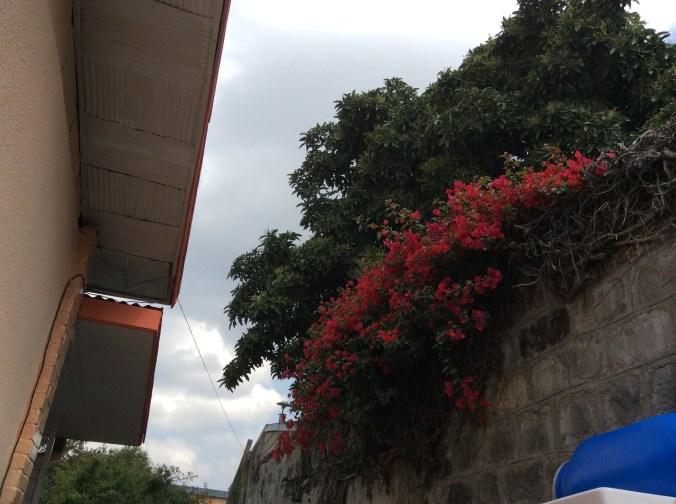
Walls around houses are not bare.  Lush tropical vines and flowers cover many of them.

IMG_0218

Many of the fancier, famous hotels, like the Hilton here, contain fountains and gardens. My friend and I could not resist a photo in front of the pool and fountains.

IMG_0219

After wandering around the Hilton we drove to see the grounds of another famous hotel where foreign diplomats often stay.  The plants in the foreground are papyrus.

IMG_0220

IMG_0222

These extensive gardens take a while to walk around.  Many of the plants and trees are labelled.  From here we could see the Addis skyline.

IMG_0227

We stayed in Addis a couple of days.  Before we left on a ten day road trip, my friend’s sister took us to a traditional restaurant.  I expected it to be filled mostly with tourists–was I ever wrong.

IMG_0240

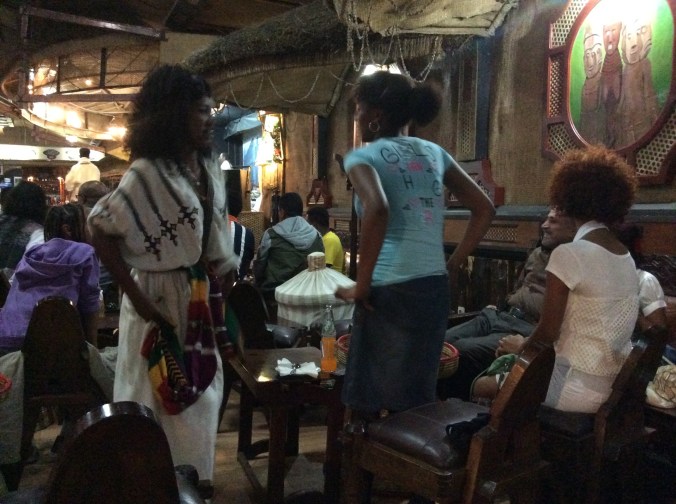
In addition to traditional food, this restaurant features traditional dancing.  Many locals came to compete, to try to out-dance the professional dancers.
IMG_0242

The lady on the left, one of the professional dancers, and the lady on the right having a little competition.  The lady on the left is dressed in traditional dress.

IMG_0243

In the background locals try to out-dance the professionals.


Ethiopian Journey–The Beginning


Two years ago today, two friends and I flew from here to Dallas to Dubai.  The final destination:  Ethiopia, where I spent nearly three weeks with them and my friends’s family plus a road trip through the north.  Ethiopia was nothing like what one sees in the news, in famine photographs, nothing like the image most people in the USA have of it.  My main goal when I returned home was to show people photos and inform them what it really looks like, how incredibly beautiful it is there.  This mission continues two years hence.  For the next several weeks I plan to relive this journey and share it on my blog here.

It is a short trip from Amarillo to Dallas via air.  In order to carry the baggage allowed on Emirate Airlines, we first flew via Southwest to Love Field, then took a taxi to Dallas International.  If you plan to fly long distances, I highly recommend Emirates Airlines.  Compared with all the others I have experienced even coach class is wonderful:  bigger seat room, more than a hundred movies to watch, good food, an area where you can help yourself to fruit and snacks, unlimited wine and beer, and an international group of flight attendants.

From Dallas to Dubai is fifteen hours of flying.

IMG_0155

IMG_0163

People wonder why they fly over Greenland, Iceland, northern Europe to get to Dubai.  Do not look at a flat map.  Get a globe and trace the route.  It is the shortest way to go.  Dubai is not like many think here.  No, I did not see endless lines of Lamborghinis and Ferraris.  In fact, I do not recall seeing any at all.  Tomorrow, photos of Dubai before heading on to Addis.

Making a Difference: Kiva Loans


To honor the death of a best friend’s father, I did as she asked, made a Kiva loan.  After looking through dozens of potential individuals and groups, I loaned 100 dollars to a group of women in the Democratic Republic of Congo to help fund their poultry raising operation.  Even though it has been less than six months, they have paid back more than half, paid on time regularly.

Some loan opportunities require even less money.  People often think their efforts don’t count, they are too small to make a difference.  Everything each person does makes a difference for better or worse.  Make a difference, act, speak out, contribute however you can to make our world a better place for all of us.

Saturday Night


Read two pages,

“Ghana Must Go”.

The wife’s Nigerian,

Yoruba, Igbo.

She sells flowers,

not in Nigeria.

The author’s name

Ethiopian?

Sip zinfandel

flowered glass.

Take a bite

chocolate filled

peppermint,

lick peppermint

fingers.

Read two pages:

“Africans…the indifference of the abundantly blessed…

who can’t accept, even with evidence, that anything native,

occurring in abundance, is exceptional without effort,

has value.”

Does anyone?


IMG_1584


Legalizing Rhino Horn Trade


You ask, really, is this possible?  The South African government is considering it to appease rhino farmers.  Rhinos do not have to be killed to harvest their horns which actually grow back if cut.  As a consequence South African rhino farmers think if they raise rhinos for their horns, they can get a big pay off from the constantly increasing demand for rhino horn.

Rhino horn trade remains illegal and rhino horn demand continually increases.  In Asia the Chinese use it in medicine, mix the powdered form into mixed drinks, and give it as luxury gifts.  Of course, there is no proof it works for anything.  That seems not to matter.  Currently, although it varies from time to time, powdered rhino horn brings about 60,000 dollars per gram, more than cocaine, gold, and heroin combined.

The logic behind farming rhinos is that farmed rhinos, usually white rhinos, will provide enough for the demand and save wild rhinos, especially black rhinos which in some areas are already extinct.  Research indicates otherwise:  that once rhino horn is legalized, the demand will increase far beyond what rhino farmers can supply.  A study by Duke University indicates that many, who do not currently buy rhino horn because it is illegal, would buy if legalized.  Once the demand is greater than farmers can supply, poachers will kill whatever is needed to fill the demand.

If you want to research this and discourage the South African government from legalizing rhino horn trade, go to this website:  nrdc.org/rhinos.

2016 Africa Reading Challenge


Want something new to read, what to expand your knowledge of the wider world, read literature from Africa, Latin America, anywhere that is not your culture.

Kinna's avatarKinna Reads

Welcome to the Africa Reading Challenge.

This will be the fourth time that I’m hosting the Africa Reading Challenge.  Details and requirements are the same this year as for the 2012 Africa Reading Challenge, which started with: “I have absolutely no reason for hosting nor urging you to participate in this challenge save for the joy of discovering and reading African literature!” Here are the details:

Challenge Period

January 1, 2016 to December 31, 2016

Region

The entire African continent, including its island-states, which are often overlooked. Please refer to this Wikipedia “list of sovereign states and dependent territories in Africa”. Pre-colonial empires and regions are also included.

Reading Goal

5 books.  That’s it.  There will be no other levels.  Of course, participants are encouraged to read more than 5 books.  Eligible books include those which are written by African writers, or take place in Africa, or are…

View original post 473 more words

Ethiopian Wolves


When I went to Ethiopia a year and a half ago, I missed seeing these incredibly endangered animals.  Less than 500 remain in and around Bale Mountains National Park.  Unlike other wolves, they do not hunt in packs, perhaps because they do not bring down big game, but rather eat the large, big-headed mole rat.  The wolves use their extremely long noses to get the rats out of their burrows.  Another hunting tactic includes hiding among the herds of gelada baboons, the only remaining grass eating primate in the world.  These baboons, like the wolves, live only in Ethiopia.  The wolves and the baboons live peacefully together while the wolves hide among the grazing baboons, sneaking upon the unsuspecting rats darting from burrow to burrow.  Although the baby gelada are not much bigger than the rats, the wolves refrain from eating them.  Like the situation with many other wild animals, human activity ruins their habitat through subsistence farming and cattle grazing.  Rabies, caught from domestic dogs, further decimates the population.  For more information on these rare wolves and conservation efforts, go to:

http://www.ethiopianwolf.org


IMG_0592

gelada baboons–I took this photo summer of 2014

11779773_10206016828193393_6185251550733171717_o

Image from ethiopianwolf.org.

My Ethiopian Adventure–On the Road to Lalibela, Part Two


My Ethiopian Adventure–On the Road to Lalibela, Part Two.

To continue my revisiting the Ethiopian trip from last July, I am reblogging this section, day two on the road to Lalibela.  This photo shows the interior of a small farmhouse we visited. Click the green title to see the rest of the photos.

A farm house near the road.

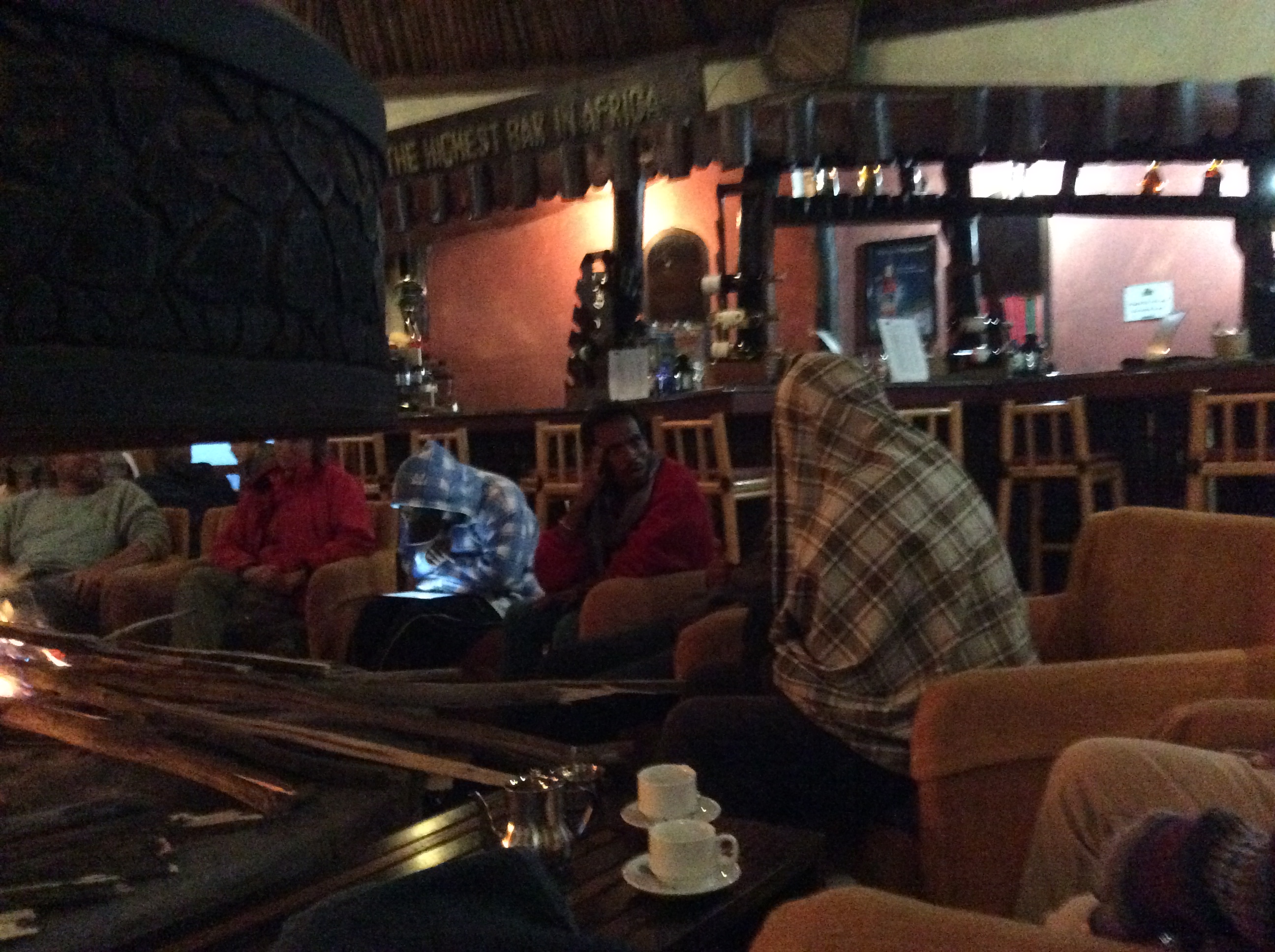
The Highest Bar in Africa


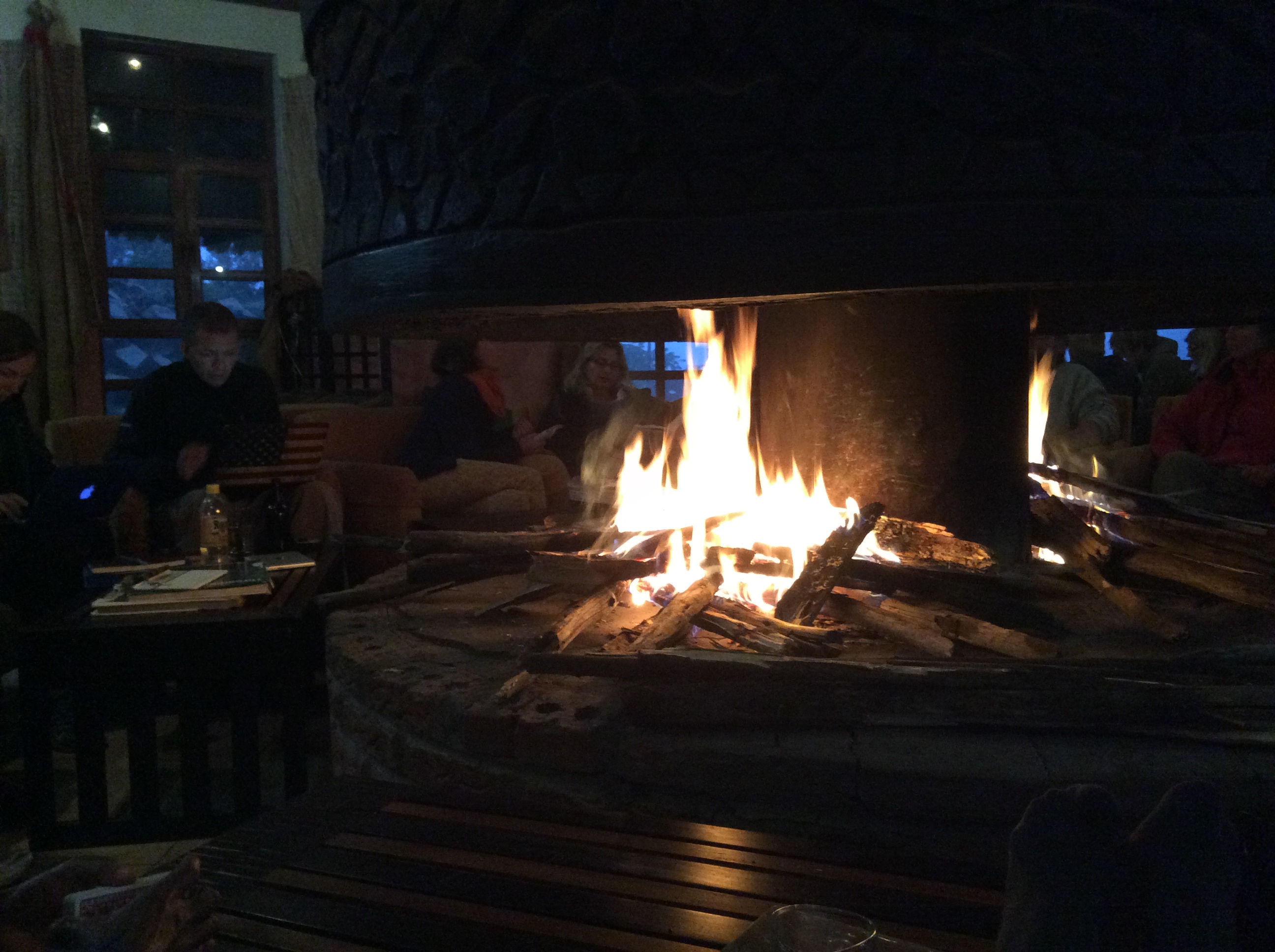
We sat around the fire

ALL of us

on The Roof of Africa,

the sign stating

“The Highest Bar in Africa”

at 3,260 meters.

We sat around the fire

All of us,

the British owner gone,

forbids natives to sit

with tourists.

We sat around the fire

ALL of us.

Shades of brown, black, cream,

peach, humanity.

I, for one, grateful for

the owner’s absence.

Whose country is it anyway?

IMG_0598

IMG_0595