The Dates You Never Heard Of


After reading about the nutritional value of dates for the brain, I headed to the nearby farmer’s market where they sell everything you can imagine from the Middle East as well as other international foods. At the dried fruit section, I studied the different kinds of dates. Medjool and deglet were familiar. Then I saw a box with three kinds of dates I had never heard of: piarom, zahedi, rabbi. They even looked a bit different. Tired of the same ole stuff to eat, I bought the box then went home and decided to research the origin and characteristics of each one.

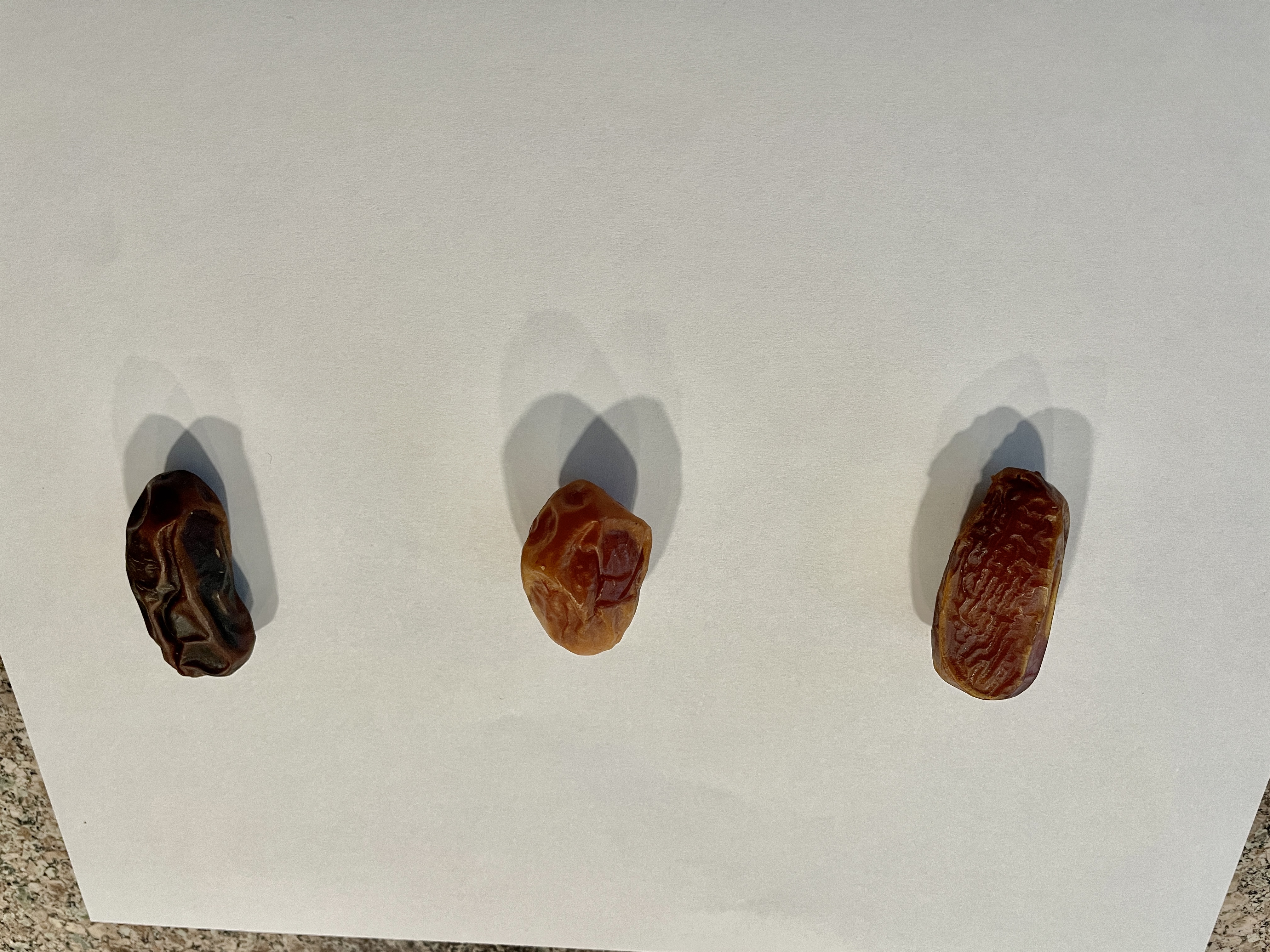
Unlike medjool dates which are considered wet, these three are considered semi-dry. The piarom are grown primarily in southern Iran. Some depending on exact origin and harvest are one of the most expensive dates in the world. They are longer and thinner and a dark chocolate color so often referred to as chocolate dates due to both color and flavor. Another common name for them is maryami. The pits are smaller and so there is more flesh per date. They contain less sugar (lower glycemic) than the wet dates like medjool.

Zahedi dates even look really different. They are shorter, a bit fatter, and golden colored. The pit is easier to remove than most dates too. They have less sugar content than most other dates and therefore can be eaten in moderation by diabetics. They are primarily grown in Iraq and Iran but some are grown in certain areas of North Africa and Asia.

Although the majority of rabbi dates are grown in Pakistan, their origin is Iran. They too contain less sugar than wet dates like medjool. They are reddish brown and usually a bit fatter than piarom dates. Their flavor depends on the soil and the weather conditions under which they are grown. Generally their flavor tends to be caramel-like and nutty.

Like most dates, these support gut health and provide electrolyte balance due to high levels of potassium and magnesium. One big advantage is their lower sugar levels. In addition to the above, like all dates they contain high levels of polyphenols. I will buy them again.

On the left is piarom, then zahedi, and finally rabbi. Some of the zahedi are very light colored.

Book 38 for 2025: “Beyond the Door of No Return”, David Diop


Translated from French and written by a Senegalese author, this novel takes place during the time of colonialism and the slave trade. In Paris of 1806, a famous botanist, Michel Adanson, is dying. He never has finished the botanical work to which he dedicated his life, and as he lays dying, his last words are the woman’s name “Maram”.

His daughter finds an unpublished memoir hidden in a cabinet. It is the story of his younger life, what happened to him in Africa, all addressed to his daughter so she can understand his story and the meaning of his last word. It is a tale both strange and sad, filled with healers and magic and tragedy. Maram, a fabled revenant, a woman of noble birth from the kingdom of Waalo, was captured and sold into slavery but managed to escape. While working on his quest to find new plants, Adanson hears about this woman and becomes obsessed with finding her. His guide, Ndiak, the son of a chief, accompanies him everywhere and they become friends. This is a story of adventure, romance, and the horrors and cruelty of the slave trade.

Note: The author won the International Booker Prize for his other novel, “At Night All Blood Is Black”. Readers of this will miss several books I am reading because I am a judge for a literary context and cannot discuss what I am reading for the next several weeks.

Book 21 for 2025: “A Trip of One’s Own: Hope, Heartbreak, and Why Traveling Solo Could Change Your Life”, Kate Wills


This book was not quite what I expected. It is somewhat memoir in that she talks about her career as a journalist accompanied by photographers and such which is not really on your own, about her marriage and divorce, the new guy, and actually traveling on her own. However, a large part of it, which is quite fascinating, is the history of the solo women travelers in history starting with the nun Egeria, who wrote about her own travels throughout the Middle East in the years AD 381-384. Centuries later the book, “Itinerarium Eerie”, provides the details of her journeys and her “boundless curiosity”.

The book provides details of the adventures of many women who traveled solo: Emily Hahn, Nellie Bly, Martha Gellhorn–once married to Hemingway, Annie Londenberry, Gertrude Bell–the first woman to ride by camel across the Empty Quarter in Saudi Arabia, Helena Swanwick, Ethel Smyth, Jean Baret–the first woman to circumvent the globe, Isabelle Eberhardt, Elspeth Beard. I realized in reading this I had actually read about one of these women, Sarah Hobson, who rode all over Persia (Iran) on horseback disguised as a man and have read several books about Gertrude Bell. In the 1700s, Jeanne Barat sailed around the world on a scientific expedition disguised as a man. In 1983, Elspeth Beard circumvented the globe on a motorcycle to heal the trauma she had suffered. Others rode bicycles, some used various forms of navigation, but all defied the norms of their time. Many encountered all sort of dangers and nearly died.

Yes, the book does give women advice on how to travel safely alone, what to pack, etc. And toward the end she tells the reader how to find adventures nearby in the countryside or streets where you live, how to open the eyes and ears, all the senses, and notice your surroundings in new ways.

Book 18 for 2025: “The Great Hippopotamus Hotel”, Alexander McCall Smith


After reading 17 serious books to date this year, I decided it was time to read something lighter and found this latest in the No. 1 Ladies Detective Agency series at the library. If you are looking for lighter reading, sort of mystery stories without murders, and insights into a different culture, Botswana, this series is for you. Start with at least several near the beginning of the series so you get to know all the main characters to fully appreciate what occurs and who’s who.

This novel gets its name from a traditional hotel located way out in the countryside far from city. It is a relaxing place with a lovely veranda and native gardens full of flowers and succulents. Strange things begin to occur–food poisoning, scorpions in rooms, laundry disappearing from the clothes line–too many for it to be by accident. The hotel manager comes to see Mma Ramotswe and Mma Makutsi for help. At the same time Mr. J.L.B. Matekoni has a male client who asks him to find him a fancy, red, Italian sport car without his wife knowing anything about it. With their customary good humor and kindness, these characters set out to solve the problems of the hotel and deal with the sports car issue.

As usual in this series, one learns that quite often people accuse the wrong person, that things are often not as they seem, and that your own prejudices and inclinations can lead you totally astray.

Book Seven for 2025: “The Map of Salt and Stars”, Zeynab Joukhadar


Two young heroines dominate this fascinating novel which switches back and forth between the Syria of 2011 and the 12th century. The latter is a girl who disguises herself as a boy to join the quest of a famous mapmaker. Nour, the first girl, lost her father to cancer in NYC. Then her mother, a mapmaker, decides to move herself and the three daughters back to Homs, Syria. They barely settle into their new life when the civil war breaks out and a bomb destroys their house. They become refugees. This is the tale of their harrowing journey from Syria to Jordan to Egypt to Libya to Algeria, then Morocco and finally to Cuenta, the Spainish city on the north coast of Africa, where their uncle lives.

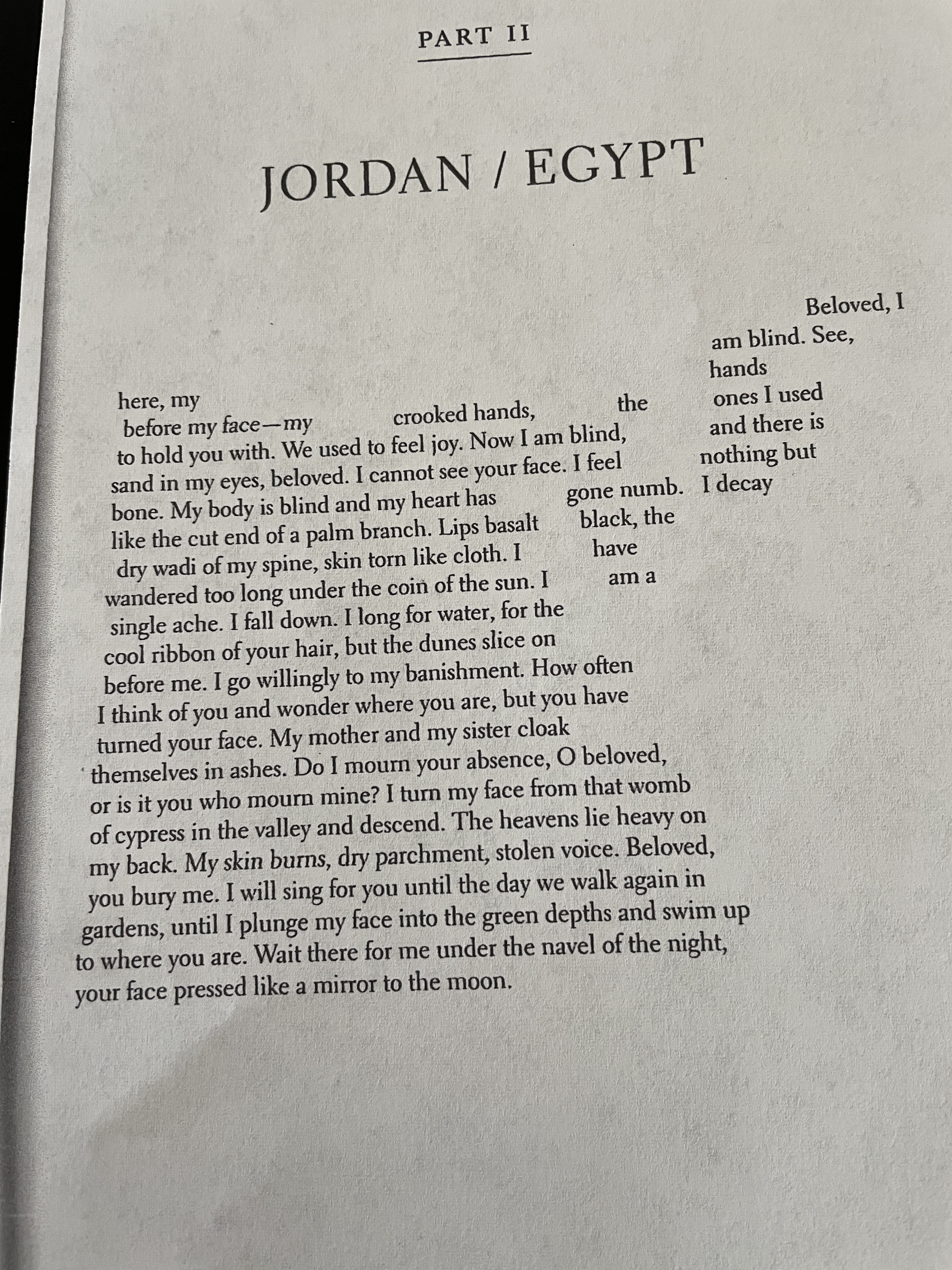
To keep sane, Nour repeatedly tells herself the story of Rawiya, the disguised girl who is an apprentice to the map maker. When he was alive, this was the favorite traditional story her father told her. The book alternates between what is really occurring to Nour and her refugee family and this ancient story. At the beginning of the section for each country through which they travel, there is a touching and beautifully written poem in the shape of the map of that country. The poem for Jordan/Egypt is printed below.

Book Four for 2025: “The Shell Collector”, Anthony Doerr


After reading his other collection of short stories, I ordered this one which is an earlier collection. Once again, he does not disappoint. One of the stories, “The Hunter’s Wife” won the O’Henry Award and has to be one of those most touching and unusual stories I have ever read. One main character, the man who makes his living guiding hunting parties in Montana, becomes obsessed with a young woman he sees in a magic show and follows her everywhere. When he first meets her, she is underage and he does nothing. Later when she is older he relentlessly pursues and marries her. After years of enduring the hardships of living in a remote cabin in the mountains, she leaves. She has always possessed the ability to feel the emotions of both other humans and animals and begins to make her living using this ability to help people. After never seeing her for twenty years, the hunter comes to one of her events. The story details the years between their first meeting and what happens when the hunter attends this event.

The title story, “The Shell Collector”, details the life of a blind expert on certain kinds of sea shells and the marine life that inhabit them, some of which are poisonous. He moves to a remote Pacific island, becomes familiar to those who live there. After a local child becomes ill and her father thinks the shell collector saves her, his peaceful life as he has known it becomes totally upended.


All the stories are notable but another one I found fascinating is “Mkondo”. The main character, Ward Beach, works for a natural history museum and goes to Tanzania to study and collect specimens. While there, he becomes fascinated with a young woman he sees rapidly running through the forest. The rest of the story details his pursuit, their life together, their separate lives, and questions the meaning of what is considered success in life.

I generally am not a short story reader but Doerr’s stories are unique, insightful, touching, and carry a sort of magic not found in many novels or stories.

Book Two for 2025: “Memory Wall Stories”, Anthony Doerr


While wandering around in the library, I found this book. His two more recent novels, ” All the Light We Cannot See” and “Cloud Cuckoo Land” remain two of the most touching and fascinating novels I have ever read so decided to try what he started with, short stories. These stories do not disappoint.

The title of the book comes from the first of the stories. It is a combination of science fiction and paleontology. Via an operation to his head a young boy in South Africa possesses the memories of an old woman. Through her memories he learns of a her deceased husband’s interest in rocks and fossils. This allows him to make a discovery that changes lives. In the next story, due to the death of her parents, a young girl in Kansas has to move to Lithuania to live with her grandfather and makes a myth come true. The following story, “Village 113”, won the O. Henry Prize. It details what happens to one woman, a keeper of seeds for an entire village, when the Three Gorges Dam was built in China. Another story tells what happens to a couple in Wyoming when they desperately want a child but cannot conceive. The shortest of the stories, “The Demilitarized Zone”, is well about that–sort of. The final story, like several others, is about memory, in this case the memories of a Holocaust survivor, who like many who survive horrible events when others they know do not, wonders why her.

I liked these stories so much that I ordered his earlier collection of short stories, “The Shell Collector.” He has won the O. Henry Prize for short stories five times and the Pulitzer for “Cloud Cuckoo Land” in 2015. I keep wondering how he knows so much about so many places. His short stories and novels are set in countries all over the world. The research must never end.

Book 39 for 2024: “The Return”, Hisham Matar


This book won the Pulitzer Prize in 2016. The subtitle, “Fathers, Sons, And The Land In Between” indicates a bit of the subject matter–how sons and fathers relate, but in this case it is a tale of horrible grief and suffering when Matar’s father is arrested and imprisoned in the notorious prison of Qaddafi in Libya. For decades Matar tried to find out what happened to his father. There is no record of his death and no one knows what happened to his body. The book details the lives of his family and their search for news of, hopes he might be alive, and what happened to Matar’s father. To this day no one knows. In 2012, 22 years after his father’s kidnapping when Matar was 19, he returned to Libya to try to learn more, met with uncles who had also been imprisoned, some for 20 years. This is the tale of his family’s suffering and hope. It also relates in detail the horrors of Qaddafi’s reign, what happened to many in his most notorious prison, and the resilience of so many who managed to survive, including close relatives of the author.

Note: After Qaddafi fell, there was hope for a new, unified government. However, as of the present, Libya is ruled by two rival administrations and is a divided country.

Book 36 for 2024: “The Storyteller of Marrakesh”, Joydeep Roy-Bhattacharya


A striking, foreign, young couple appear one evening in the Jeema of Marrakesh. The woman’s incredible beauty fascinates the observers. Suddenly, they disappear. Hassan, a traditional storyteller, invites those who observed the couple to tell what they saw and knew on that night as he presents his own stories to the crowd at the Jeema. His brother, Mustafa, has confessed to the crime of their disappearance, telling everyone he loved the woman whom he hardly knew. He is imprisoned for their disappearance. However, nearly everyone acknowledges that he had nothing to do with it. This novel presents all the different views of the couple, their disappearance, and what it means. Often observer stories contradict each other, raising the questions of what is truth, whose truth is factual, how can we know what is true and how do we define love. Hassan is determined in his quest which takes the reader through all these stories, Hassan and Mustafa’s childhood, the mysteries of the Sahara, and much more.

Book 34 for 2024: “The White Mosque”, Sofia Samatar


This memoir tells the tale of an unusual tour for a specific purpose, to follow the path of Mennonites who left Europe to escape conscription into the army since the Mennonites are pacifists. The author’s own life is unusual. Her mother was a Swiss Mennonite missionary to Somalia. Her Muslim Somali father taught the Mennonite missionaries Swahili. The two met and married. Samatar grew up and lives as a Mennonite. She teaches African and Arabic literature at James Madison Un. She is most famous for her fantasy novels and short stories which is how I discovered her writing.

In the late 19th century a group of German speaking Mennonites left Russia for Central Asia where their leader believed Christ would return. They suffered many hardships, rejection, abuse, but finally found a place that welcomed them in the Muslim Khanate of Khiva in what is now Uzbekistan. There they built a white church which the locals called Ak Metchet, the White Mosque. Their village lasted 50 years.

If you go online, you can find tours today that follow the route of these Mennonite travelers, trace their route. This book details Samatar’s experiences on the tour, the tour guides, the food, the architecture, the culture and the history: a 15th century astronomer king, the first Uzbek photographer, Mennonite martyrs. She also discusses her own unique upbringing, local beliefs and culture, how people develop their own personal identity, and the surprising interconnections people sometimes discover.