Book Seven for 2025: “The Map of Salt and Stars”, Zeynab Joukhadar


Two young heroines dominate this fascinating novel which switches back and forth between the Syria of 2011 and the 12th century. The latter is a girl who disguises herself as a boy to join the quest of a famous mapmaker. Nour, the first girl, lost her father to cancer in NYC. Then her mother, a mapmaker, decides to move herself and the three daughters back to Homs, Syria. They barely settle into their new life when the civil war breaks out and a bomb destroys their house. They become refugees. This is the tale of their harrowing journey from Syria to Jordan to Egypt to Libya to Algeria, then Morocco and finally to Cuenta, the Spainish city on the north coast of Africa, where their uncle lives.

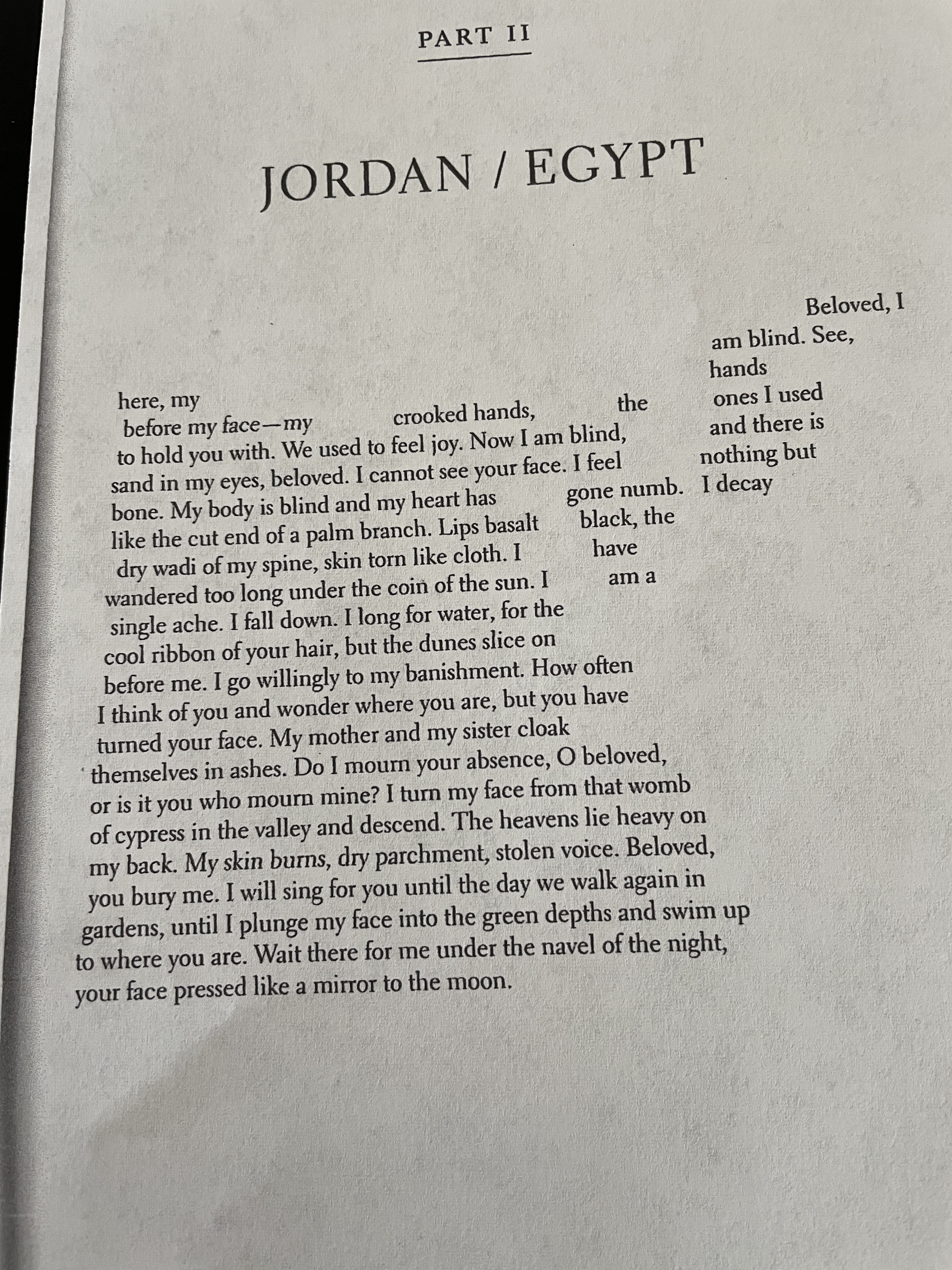
To keep sane, Nour repeatedly tells herself the story of Rawiya, the disguised girl who is an apprentice to the map maker. When he was alive, this was the favorite traditional story her father told her. The book alternates between what is really occurring to Nour and her refugee family and this ancient story. At the beginning of the section for each country through which they travel, there is a touching and beautifully written poem in the shape of the map of that country. The poem for Jordan/Egypt is printed below.

Book Four for 2025: “The Shell Collector”, Anthony Doerr


After reading his other collection of short stories, I ordered this one which is an earlier collection. Once again, he does not disappoint. One of the stories, “The Hunter’s Wife” won the O’Henry Award and has to be one of those most touching and unusual stories I have ever read. One main character, the man who makes his living guiding hunting parties in Montana, becomes obsessed with a young woman he sees in a magic show and follows her everywhere. When he first meets her, she is underage and he does nothing. Later when she is older he relentlessly pursues and marries her. After years of enduring the hardships of living in a remote cabin in the mountains, she leaves. She has always possessed the ability to feel the emotions of both other humans and animals and begins to make her living using this ability to help people. After never seeing her for twenty years, the hunter comes to one of her events. The story details the years between their first meeting and what happens when the hunter attends this event.

The title story, “The Shell Collector”, details the life of a blind expert on certain kinds of sea shells and the marine life that inhabit them, some of which are poisonous. He moves to a remote Pacific island, becomes familiar to those who live there. After a local child becomes ill and her father thinks the shell collector saves her, his peaceful life as he has known it becomes totally upended.


All the stories are notable but another one I found fascinating is “Mkondo”. The main character, Ward Beach, works for a natural history museum and goes to Tanzania to study and collect specimens. While there, he becomes fascinated with a young woman he sees rapidly running through the forest. The rest of the story details his pursuit, their life together, their separate lives, and questions the meaning of what is considered success in life.

I generally am not a short story reader but Doerr’s stories are unique, insightful, touching, and carry a sort of magic not found in many novels or stories.

Book Three for 2025: “”A Psalm for the Wild-Built”, Becky Chambers


This book is part of a group read at the church where I sing. Classified as science fiction because it occurs in a society on the moon of a different planet far into the future, it is the cheeriest science fiction I have ever read. One of the main characters, Sibling Dex, is a tea monk who travels from town to town, village to village, dispensing the right herbal tea and “advice” to the people who come to see him. He becomes frustrated and bored with this life and decides to head out into the countryside, out into the untouched nature where all the old roads are overgrown or now non-existent.

Due to past experiences, these humans have freed all the robots after they became sentient, and they have an agreement as to where each lives. In addition, humans have decided to live very differently, leave a lot of nature to nature and so live only in certain areas, in bigger towns and small villages with some nature here and there, but most of nature is now untouched and left to do whatever nature does.

Dex heads out in his tea house wagon which he pedals to generate electricity. It is self containing and he has everything he needs for at least two weeks. At one campsite not too far into the wilderness, a robot named Mosscap appears. Mosscap has volunteered to go into human territory per the ancient agreement between humans and robots and learn about humans. Dex finds this a mixture of frightening, intriguing, and confusing. Yet he agrees to allow Mosscap to accompany him on his adventure. The rest of the book is about what they discover, what they learn from each other, and the future they plan.

Book Two for 2025: “Memory Wall Stories”, Anthony Doerr


While wandering around in the library, I found this book. His two more recent novels, ” All the Light We Cannot See” and “Cloud Cuckoo Land” remain two of the most touching and fascinating novels I have ever read so decided to try what he started with, short stories. These stories do not disappoint.

The title of the book comes from the first of the stories. It is a combination of science fiction and paleontology. Via an operation to his head a young boy in South Africa possesses the memories of an old woman. Through her memories he learns of a her deceased husband’s interest in rocks and fossils. This allows him to make a discovery that changes lives. In the next story, due to the death of her parents, a young girl in Kansas has to move to Lithuania to live with her grandfather and makes a myth come true. The following story, “Village 113”, won the O. Henry Prize. It details what happens to one woman, a keeper of seeds for an entire village, when the Three Gorges Dam was built in China. Another story tells what happens to a couple in Wyoming when they desperately want a child but cannot conceive. The shortest of the stories, “The Demilitarized Zone”, is well about that–sort of. The final story, like several others, is about memory, in this case the memories of a Holocaust survivor, who like many who survive horrible events when others they know do not, wonders why her.

I liked these stories so much that I ordered his earlier collection of short stories, “The Shell Collector.” He has won the O. Henry Prize for short stories five times and the Pulitzer for “Cloud Cuckoo Land” in 2015. I keep wondering how he knows so much about so many places. His short stories and novels are set in countries all over the world. The research must never end.

Book 45 for 2024: “How To Stop Time”, Matt Haig


What would your life be like if you did not age like everyone else? How would others treat you, your family? Would they kill your mother because they think she is a witch? Could you love someone who grew old while you stayed young? Would you have to move all over the world to avoid detection?

These are the issue the narrator faces because unlike ordinary people, he does not age normally. At the beginning he is living in London as a forty-one year old history teacher but has been alive for centuries. He’s met Shakespeare, travelled the oceans with Captain Cook, and played piano at clubs in Paris.

One organization, the Albatross Society, hunts down and “protects” people like him. Their leader has one rule: do not fall in love. He is also convinced that certain groups want to find these non-agers and imprison them for research. What is factual, real? Does life have meaning without love?

Book 43 for 2024: “A Stranger in Olondria”, Sofia Samatar


As a person who diligently never fails to finish a book I start, it is difficult to admit that I have finally failed to finish a book. I made it to Book Five and quit. Having already happily read two of this author’s other books, this failure comes as a surprise.

In this fantasy novel, the narrator’s quest to find the body of an illiterate girl from his own country (he has wandered far in search) whose ghost haunts his dreams became less and less appealing. Not sure why because I generally like fantasy novels. This novel does raise some interesting questions:

-Are burial/cremation practices so sacred that one must follow what is considered sacred in one’s culture or risk exile?

-Where is home?

Book 42 for 2024: “These Is My Words: The Diary of Sarah Agnes Prine, 1881-1901, Arizona Territories


This fictional work is based on the life of the author’s great grandmother. Written as a diary with specific dates, the narrator is not yet a teen when the novel starts. Her parents are wanderers, always looking for a better, new place. Sarah’s character is that of a tough, pioneer girl and then a woman. She can ride horses, shoot to kill, manage a ranch, do whatever it takes to survive. Much of it includes a rather accurate portrayal of life in Arizonan territories as well as Texas at the time including the prejudices of many of the white inhabitants toward the Spanish speaking people already there, fights with Apaches, and the hunt for Geronimo. It is not just the story of her own life, including her relationship with the Army Captain whose job initially is to protect a wagon train, but also portrays other people living in the Southwest during that time period.

I read this as part of a book club. Reactions to the book varied widely from those of us who thoroughly enjoyed the book to at least one person who insisted it is poorly written and viewed it as a romance novel. The rest of us did not. She used an audio book edition. After her descriptions, it appears the audio book does not correctly follow the book itself and is poorly done which may have contributed to her view of this work. I borrowed this novel from the public library and it was obviously well read because it was not in the best condition.

Book 38 for 2024: “James”, Percival Everett


If you ever read “The Adventures of Huckleberry Finn” by Mark Twain, then you already know the characters in this new novel. If you have not read about Huck, then I suggest you might want to read Cliff Notes or some other synopsis of Twain’s novel. “James” takes its title from the name of one of the main characters, a slave who lives in Hannibal, Missouri. He is generally called Jim, but in reality prefers the more formal James. Basically, Everett’s novel is written from the viewpoint of James, e.g Jim. Most of the major events in Twain’s original novel are followed in this novel, but from James’ viewpoint. Huck, a poor kid, runs away to avoid his violent father and finds James hiding out on an island in the Mississippi River. Together they live off the land, float in their handmade raft down the Mississippi River, mostly at night to avoid anyone seeing them, and meet all sorts of folks, including two men, who are criminals pretending to be European royalty. It is hard to imagine how a novel about the horrors of slavery could possess any humor, but this one does. It is a quick, enlightening, and entertaining read filled with “lessons” that do not seem to be lessons because they are so intertwined with the James’ story.

Langston Hughes in Uzbekistan


It’s 1932.

Movie roles promised to 22 Black Americans.

“Black and White” in the

Uzbek Soviet Socialist Republic.

Treated like royalty, wined, dined, at

their own expense.

Hughes–ridiculous script. All went

home except Hughes. He stayed,

traveled, saw cotton grown from Aral

Sea water–now no water, desolate

desert.

In Tashkent, Uzbeks, Turkmen, Tartars

honored him, flowers, fruit.

No English.

He met a Red Army Captain from

high Pamir Mountains. Hughes

described him, Black with Oriental eyes.

Hughes called him Yeah Man.

He called Hughes Yang Zoon.

Weeks together never understanding

each other’s words.

Hughes’ poetry book

“The Weary Blues” first

American book translated to

Uzbek. Original English version

lost. He describes this new place:

“Look: here

Is a country

Where everyone shines.”

Note: You can find a version of this book translated into English from Uzbek by Muhabbat Bakeava and Kevin Young.

Book 34 for 2024: “The White Mosque”, Sofia Samatar


This memoir tells the tale of an unusual tour for a specific purpose, to follow the path of Mennonites who left Europe to escape conscription into the army since the Mennonites are pacifists. The author’s own life is unusual. Her mother was a Swiss Mennonite missionary to Somalia. Her Muslim Somali father taught the Mennonite missionaries Swahili. The two met and married. Samatar grew up and lives as a Mennonite. She teaches African and Arabic literature at James Madison Un. She is most famous for her fantasy novels and short stories which is how I discovered her writing.

In the late 19th century a group of German speaking Mennonites left Russia for Central Asia where their leader believed Christ would return. They suffered many hardships, rejection, abuse, but finally found a place that welcomed them in the Muslim Khanate of Khiva in what is now Uzbekistan. There they built a white church which the locals called Ak Metchet, the White Mosque. Their village lasted 50 years.

If you go online, you can find tours today that follow the route of these Mennonite travelers, trace their route. This book details Samatar’s experiences on the tour, the tour guides, the food, the architecture, the culture and the history: a 15th century astronomer king, the first Uzbek photographer, Mennonite martyrs. She also discusses her own unique upbringing, local beliefs and culture, how people develop their own personal identity, and the surprising interconnections people sometimes discover.