After visiting the Tony’s gallery, we headed north on mostly non-paved, narrow roads. The clouds increased; the landscape became greener if that is possible. We crossed to the Caribbean side near the Nicaraguan border.
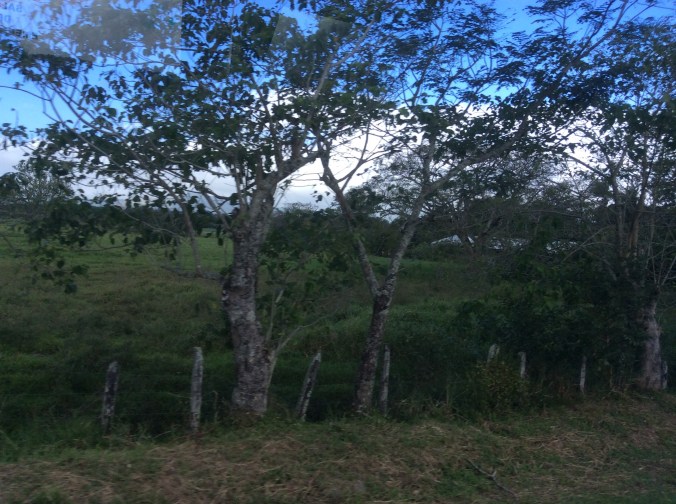


The previous photos were taken from the bus window on the way to La Anita which is located more or less just above where the a is located in the word Cordillera at the top of the map. It lies near Rincon de la Vieja National Park (Volcano Vieja) past Volcano Miravalles–the volcano covered in clouds in the previous Costa Rica post.

As soon as we arrived, we came to the veranda of the building where they process cacao. This view overlooks the road in and a small pond.
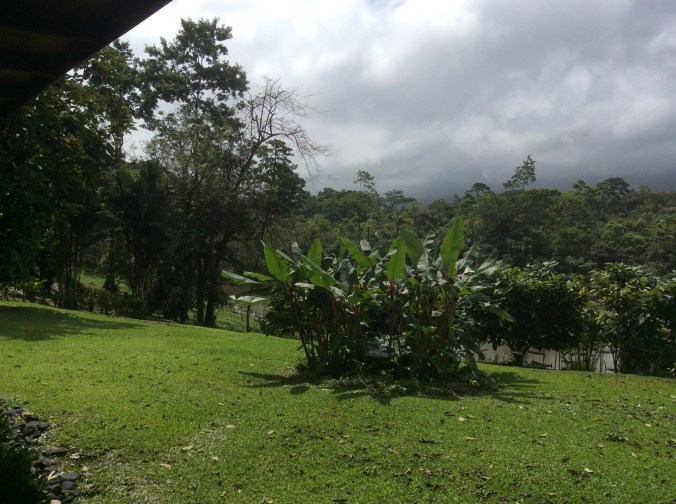
Ginger plants in front of the pond, bouquets of ginger flowers, and rain clouds greeted us.

I had no idea that the ginger roots we eat come from plants that look like this. We later ate lunch in the building in the distance. First, seated on picnic tables on the veranda, we drank pure chocolate grown on the ranch and coffee grown on another property at higher altitudes. Cacao requires lots of rain and tropical heat. This coffee is shade grown at much higher altitudes, e.g. 1500-2000 meters, by 700 families who belong to the cooperative which produces the coffee. The coffee from here (Finca la Anita, Costa Rican Dota Mountain Coffee) requires much less sugar even for those who love lots of sugar in their coffee.
The couple who own and run La Anita primarily grow organic cacao. Originally, they sold what they grew and did not process it there. They decided to accomplish what they wanted, to grow and sell the most sustainable quality chocolate in the world, they would have to control the entire process themselves. One of their specialties is a healthy replacement for Nutella, La Anita Chocolate Spread. We bought four little containers and carried them around the rest of the trip. Rather than spreading it on something, I keep it in the refrigerator and spoon out a tiny sco0p when I want a super treat.
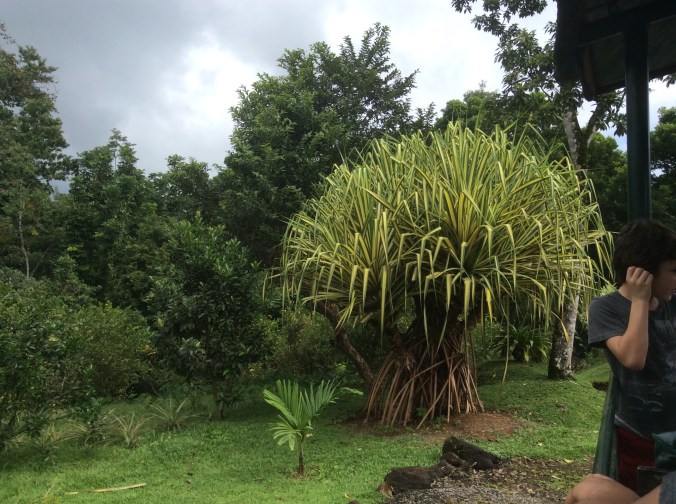
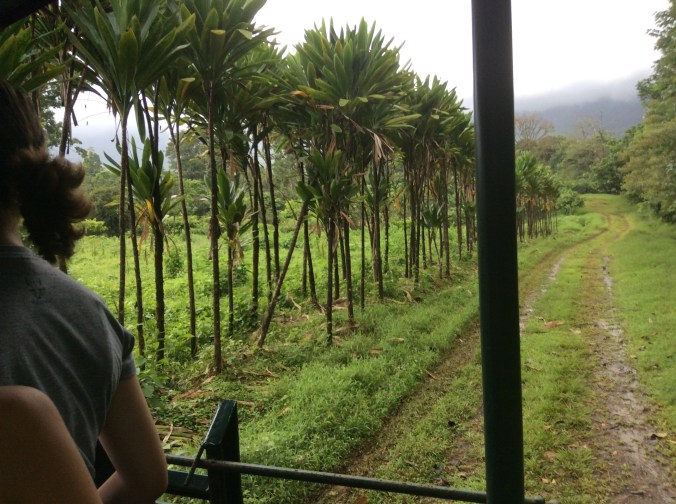
Nearly constant rain and heat produce a botanical heaven.
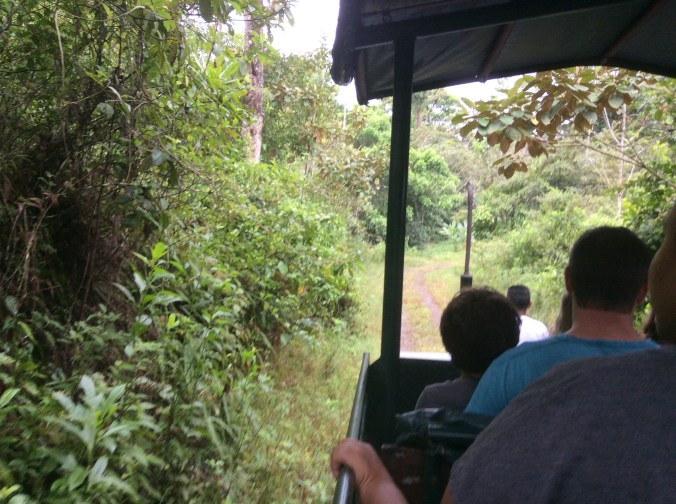
A tractor pulled wagon took us through the lushness to the area with the cacao trees grow.


We finally arrived where the cacao grows.
In addition to cacao, they grow other crops because cacao takes a long time to grow and the chocolate market worldwide is very unstable.

Open up cacao and you find all this fuzzy stuff inside. Yes, it is actually tasty. Like with coffee, you eat–actually mostly just suck on it–the outside. The bean is the seed inside.

If you want to walk around here, sandals are not a good idea–too many snakes, many of which are poisonous like the fer-de-lance. Yes, they live here. Like where I live, this requires looking at the ground and paying attention where you are walking. This is the owner. The name La Anita comes from his wife.

The view of the lake from the building where we ate lunch.

This is the hearts of palm plant which shortly after this photo was taken became the main ingredient of ceviche of hearts of palm which we ate for lunch.

Making ceviche of hearts of palm in the white square bowl.
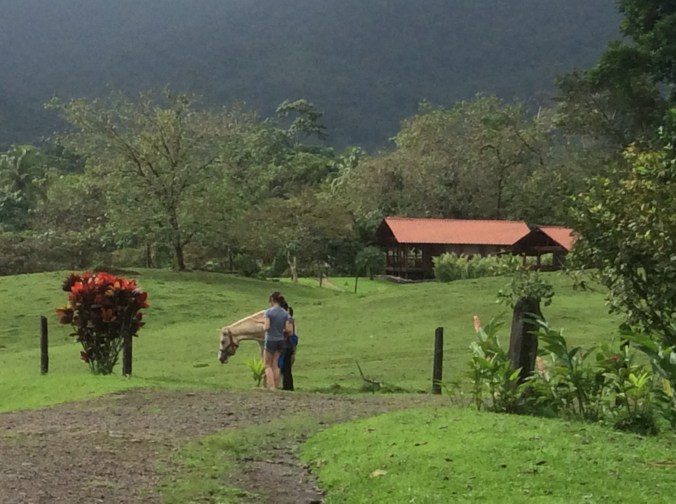
After lunch I walked down the road to the pasture with the horses. In the background are cabins they rent. From here the traveler can tour several national parks including Rincon de la Vieja National Park which is quite close.
This is one of the rainiest parts of Costa Rica, located on the northern Caribbean side. It rained several times while we were here. The rain stops for a while, a downpours arrives, it stops. This process continually repeats.

 Say his name – Bashar al-Assad. From my research and understanding, as President, Assad is most responsible for Syria’s devastation. Yes, there are many other players, but, Assad holds a special place. Responsible for making sure the first shots were fired at peaceful Arab Spring protesters, to using chemical weapons on his own people, he is a one bad dude.





 I started this post just after getting back from an India trip, always very challenging because of memories that haunt me not only through their high negative recall value, but also in that I often find myself reverting to the diffident, fearful person I used to be while living there. In fact, palpitation is the first to greet me at Bombay airport even now after nearly seventeen years of being an expat. But with every trip, I also find myself evolving as a person, as a woman. And of course, it is always fun to meet up with family and old friends, all of whom I hold very dear. But the highlight of this trip was Queen.



 Welcome to the Africa Reading Challenge.

 writingontherim