Sacred Corn


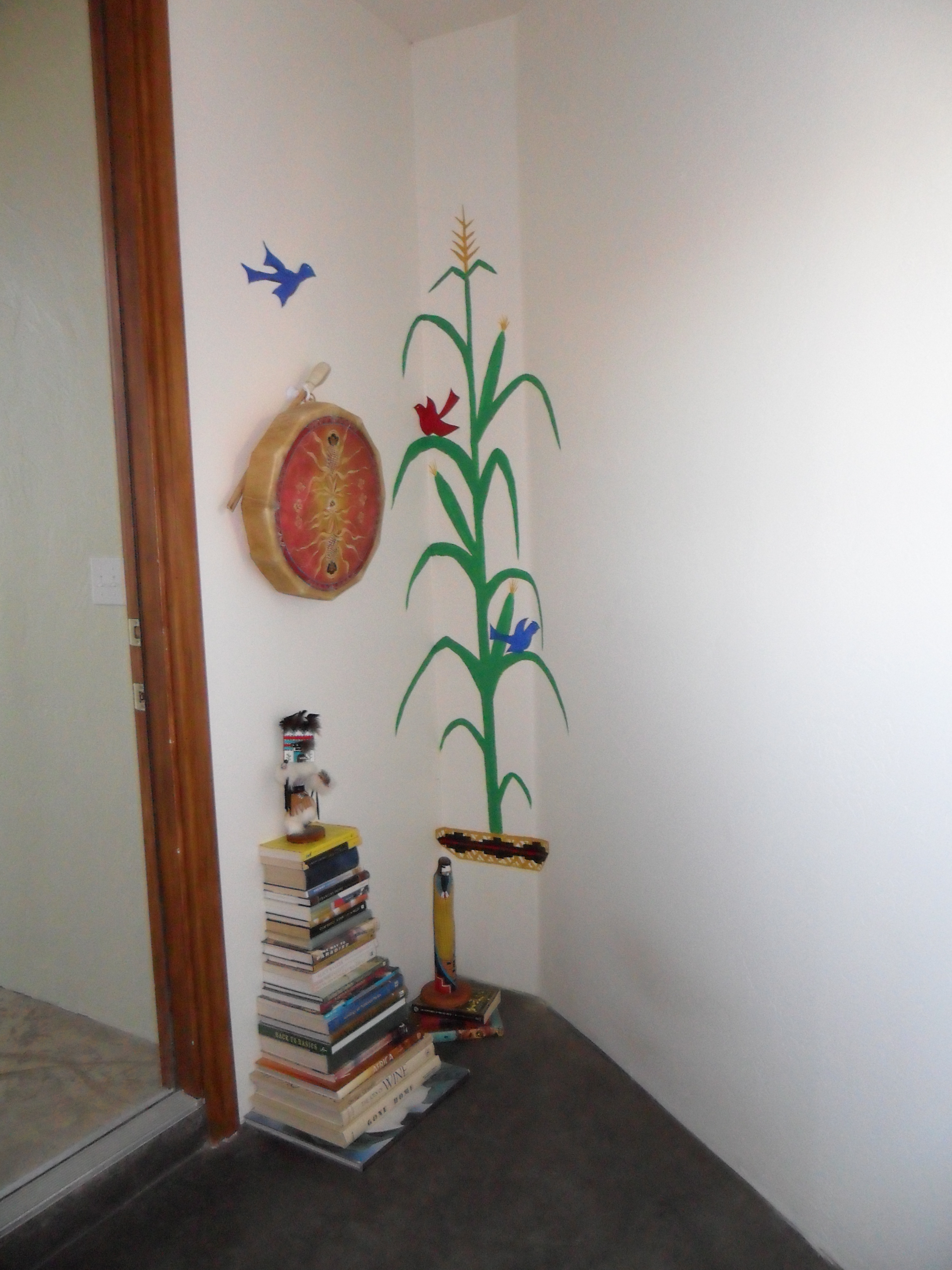
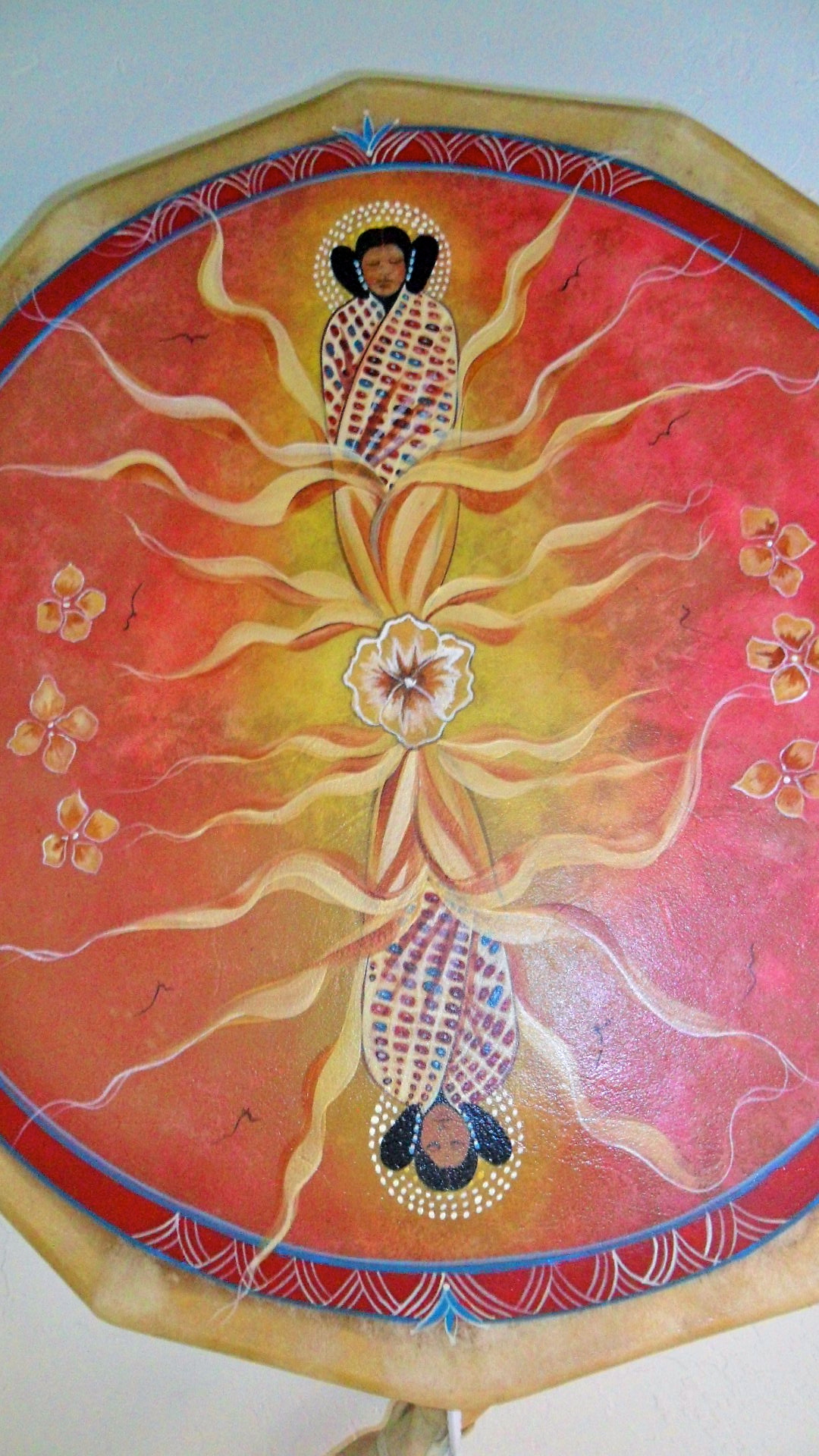
SAM_0035   In the summer on hot, humid nights, you can hear the corn grow.  My great grandfather, my grandfather, and my father grew corn.  I grow corn in that same rich loess soil of Northwestern Missouri.  Soil laid down by Ice Age glaciers thousands of year ago.  Only on a few hill tops, here and there, will you find non glacial soil. Repeatedly, daily, I walk by the sacred corn plant of life painted on my hall corner.  This sacred corn corner houses three corn maiden kachinas and a drum decorated with corn maidens.  I give thanks to corn for my house and the life I lead.
Corn Song

I sing the song of ancients:

pueblo peoples,

Anazazi, Hopi, Zuni.

I sing the song of an America long gone.

Maya, Aztec, Tolmec.

I sing the song of life:  colors of the rainbow

golden, red, white, blue.

I sing the song of now:  thick, endless

identical rows.

Pioneer, Monsanto,

anhydrous ammonia,

atrazine.

I sing the song of hope and joy:

an ancient reclaiming,

a klaidescope of colors,

butterflies and fireflies.

I sing the eternal human song.

SAM_0913

SAM_1489

This is a Navaho kachina.  Kachina are actually Hopi, but Navaho artists now make kachinas as well.  The first corn maiden kachina I bought.

SAM_1490

Spotted corn kachinas, on the left, are unusual.  It took me years to find one.  The kachina on the right was created by R Pino, who is both Hopi and Navaho.

SAM_1491

Every year Pendleton runs an art contest among Native American students.  The winner’s art work is transformed into saddle blankets.  This design, created by Mary Beth Jiron, is the latest in this Student Series. There are three corn  maidens  on each side of the blanket, representing the different varieties of corn grown by native peoples, yellow, red, blue, white, black, and spotted.

Apocalyptic Planet-Part Four: Seas Rise


As I write this title, it seems a bit counter intuitive that one of the first things I saw this morning was a newspaper discussing many small cities around the Texas Panhandle which are running out of water.  And on the TV news as I write this, the city of Amarillo announces measures being taken to curtail water use, followed by a detailed discussion, explaining how one of these smaller towns plans to address the lack of water.  Drought expands while ice melts and seas rise.

Childs explains sea behavior by comparing it to pouring water back and forth among a bunch of pans.  Ocean behavior varies from place to place.  Louisiana has been losing seacoast at the rate of twelve meters per year and large parts of the Nigerian coastline has lost as much as thirty meters per year, one of the fastest losses on earth–erosion.  The moon causes tides twice a day changing sea levels on the average of two meters each time.  Historically most sea level changes are long term changes.  A major cause of sea level change is temperature.  Half the current sea level rise can be attributed to thermal expansion.  Water warms and spreads out.  Not only does heat expand near the sea surface, but now also expands into depths not previously affected.  Findings by two oceanographers, Purkey and Johnson, indicate an increase in ocean heat 16 per cent greater than previously thought.  Oceans are the largest reservoirs of heat on earth.  Once heated, their size makes them slow to cool.

Purkey also notes that even in the depths of the seas, waves transfer heat.  However, because of the size of the Pacific, an event that occurred forty years ago in the southern Pacific will not reach the northern Pacific for approximately those forty years.  Thus, the warming and subsequent ice melt we see in the north Pacific started in the south Pacific forty years ago.  Another scientist, Carl Wunsch, notes that earth changes remarkably without human intervention.  Nevertheless, he recommends humans do something to reduce carbon dioxide emissions as a precautionary measure in addition to discouraging people from settling in low lying areas.  Unfortunately, rising seas do not bode well for much of the earth’s population who live in exactly these low lying areas:  all of Bangladesh, Venice, Shanghai, New Orleans, Bangkok, the Marshall Islands, and many US coastal cities to name just a few places.

St. Lawrence Island north of the Aleutians provides a perfect example of what is happening.  Sea ice breaks up too early, fish species they used to see are gone replaced by new ones they never saw before, and the population of seals and sea lions has altered.  Cancer rates in the villages there have risen dramatically caused in part by the toxic poisons concentrated in the meat of the seals, whales, and salmon they harvest from our polluted oceans.  In 2008, they brought a lawsuit against Exxon, Chevron, and Mobil, claiming that these companies are the world’s major contributors to global warming.  They want these companies to pay for moving their villages to higher ground.  Sea rise necessitates the move.  They lost in District Court, but the case is under appeal.  The court cited that the chain of events causing their predicament is too long to lay blame in one place.  Childs notes that we really need such places to endure, places where people know how to lead minimalist lives, places where people know how to survive.

R-R-R-Rejected!


Lynette Noni writes about rejection applied to writers. However, I am reblogging this because what she says about rejection applies to most forms of rejection. I received a rejection email this week regarding a poem I submitted to a journal, some of you might have received some other form of rejection. If anyone rejected something regarding you this past week, take a look at what Lynette has to say.

Lynette Noni's avatarLynette Noni

rejection-letter1

Rejection sucks. There’s no way to sugar-coat it. In any area of life, rejection – in one form or another – is crushing. It hurts. It chips away at our self-esteem, it kicks the metaphorical spleen of our pride, and it shreds the lingering vestiges of our hope. It’s just plain uncool.

But you know what?

Rejection is also one of the best things we can ever experience.

Without feeling the sting of rejection, we would never have the opportunity to become more than what we are. We’d never need to make the tough choices in life, the decisions addressing what matters most and what price we’re willing to pay to see our dreams come to pass. We would never get to ask ourselves, “What am I truly passionate about?”

We would also never have a reason to then ask, “Are my dreams worth my blood, sweat and tears?”

And…

View original post 1,197 more words

Apocalyptic Planet–Part Three: Ice Collapses


It may be difficult for some to believe, but over the last three million years ice dominated earth’s climate. We remain in that long ice age; widespread glaciers still exist.  For most of earth’s long, long existence no ice existed anywhere.  Currently, we are in an interglacial period in which ice has retreated back to the poles and the highest mountain reaches.  Earth as we know it has been shaped primarily by ice and to a lesser extent by volcanoes.  Once ice lay hundreds of feet deep as far south as Chicago and London.  What caused this see saw between Ice Ages and warm, wet periods where the ice retreated or disappeared entirely?  The changing tilt of the earth’s axis. Currently, the earth’s tilt is 23.5 degrees or so.  This tilt causes the seasons in non tropical areas.  Earth’s tilt changes a degree or so over time, causing the alternating periods between extreme ice coverage and warm periods.  At times the change has been so great that no ice remained even on the poles.  Usually, these changes are very slow, over thousands of years.  No longer.

Equatorial glaciers once common in the high equatorial mountains, e.g. Andes, Himalayas, a century ago no longer exist.  Ernest Hemingway once described the glacier on Kilimanjaro as “wide as all the world”.  Now nothing but a few patches of hard snow remain.  The once giant ice fields in northern Patagonia in Chili and Argentina currently lose volume at an ever accelerating rate.  While hiking and kayaking with a filming crew in this area, Childs saw just how rapidly this ice loss occurs.  In one instance a huge ice lake run off from one glacier totally disappeared in two weeks.  In Greenland an iceberg four times the size of Manhattan floated off in 2010 and finally melted in the Gulf Stream.  It narrowly missed shipping lanes and offshore oil wells.  The Larsen B ice shelf in Antarctica the size of Yosemite National Park and 700 feet deep had been stable for more than 12,000 years.  It started coming apart over a decade ago.  It eventually floated off and melted.

Why does any of this matter?  Ice keeps the planet cooler.  Solar radiation bounces off into space.  Currently, ice reflects approximately 30 per cent of incoming sunlight.  Few present animals and people are prepared for the hothouse that would exist if much more ice melts.  This is in spite of the fact that radiation from the sun has actually gone down in the last fifty years.  As the planet warms, more ice melts, more heat remains on earth, more ice melts and the cycle continues.  The current acceleration of ice loss causes many scientists to question:  where is the tipping point?  How can we stop this rapidly accelerating ice loss?

Humans are increasing carbon dioxide levels ten thousand times faster than they changed over the last 65 million years.  Our globe is warming; all climatologists agree.  At what point will it be too late to turn this around?  Indeed, can we turn this around?  And if we do, will some of the ice return?  No one knows.  Nothing like this has occurred before in human history.  All this melting ice causes sea rise.  At the current rate a one meter sea rise by the end of this century is plausible.  Many of the world’s largest cities already have a sea level problem e.g.Bangkok.  Furthermore, the water supply for much of southern and southeast Asia depends on water from rivers and glaciers in the Himalayas.  The world’s largest supply of fresh water depends on this system.  Are we ready for a hotter, drier earth?

Apocalyptic Planet-Part Two: Hadley Cells, Weather and Drought


Hadley cells, the wind systems in each hemisphere , form patterns of atmospheric circulation in which warm air rises near the equator, cools as it travels poleward at high altitudes, sinks as cold air, and then warms as it travels back to the equator.  They are named after George Hadley, an English scientific writer.  Tropical regions receive more heat from solar radiation than they radiate back to space and such areas have constant temperatures.  More simply, warm air rises (heat rises) and then flows poleward at high altitudes, cools, drops, and flows back toward the equator at lower altitudes.   Then the process repeats itself.  When the air rises and leaves these tropical areas, it loses moisture as it heads to subtropical areas.  The majority of the worlds large deserts lay in these subtropical areas.

Hadley cells are expanding.  Precipitation has declined in tropical areas since 1970.  As I mentioned in yesterday’s post, Southern Asia, the Sahel, Southern Africa, the Mediterranean, and the US Southwest are getting drier and drier.  Even wetter areas now experience long dry spells between extreme events of rain and snow.  Examples in the US include the cold and snowfalls in the Midwest and Eastern Seaboard this past winter.  Texas and New Mexico continue to experience a prolonged drought.  In the next thirty years scientists predict a 30 per cent decline in water resources.

In some places both governments and individuals create innovative and sometimes simple measures to counteract desertification.  In India near the Thar Desert, the government mandated the dispersal of grass seed to hold the ground.  Studies indicate that the grass seed grew better when planted by hand than when dispersed from airplanes.  Also in India orans, small sacred groves, have helped preserve shrubs and grasses and even trees, a genetic bank that would otherwise have been lost.  Childs describes how his friends who live on the outskirts of Tuscon have coaxed their water table fifteen feet higher, using ordinary shovels and hard work.  They built contour traps and “massaged” the ground.  Hardly worth noticing except when it rained, the rain sank into underground catches.  Their properties now look like small areas of refuge in the vast desert.  In some areas of the Sahel people have been able to plant and nurture trees in such a way that areas of green exist where they had disappeared.

Archeologists and geologists know that periods of drought occurred repeatedly for millions of years.  For humans and the animals we know, drought has never been easy.  Large areas of civilization cannot exist without water.  We can affect our future in positive ways and prepare ourselves if we choose.

Apocalyptic Planet–Part One


Usually I read only one book at a time.  Lately, I am reading several, one of which is Apocalyptic Planet:  Field Guide to the Future of the Earth by Craig Childs.  Childs is a sort of combined explorer/adventurer/scientist.  He goes to places few go to see what occurs there, the wind, the flora and fauna, the weather, the climate.  The next couple of days I intend to share some of his most pithy observations and ruminations.  We will start with the desert.  He and a friend literally wandered around the most arid and hostile portion of the Sonoran Desert in northwestern Mexico.  This desert has enlarged and become more arid due to an extended drought.

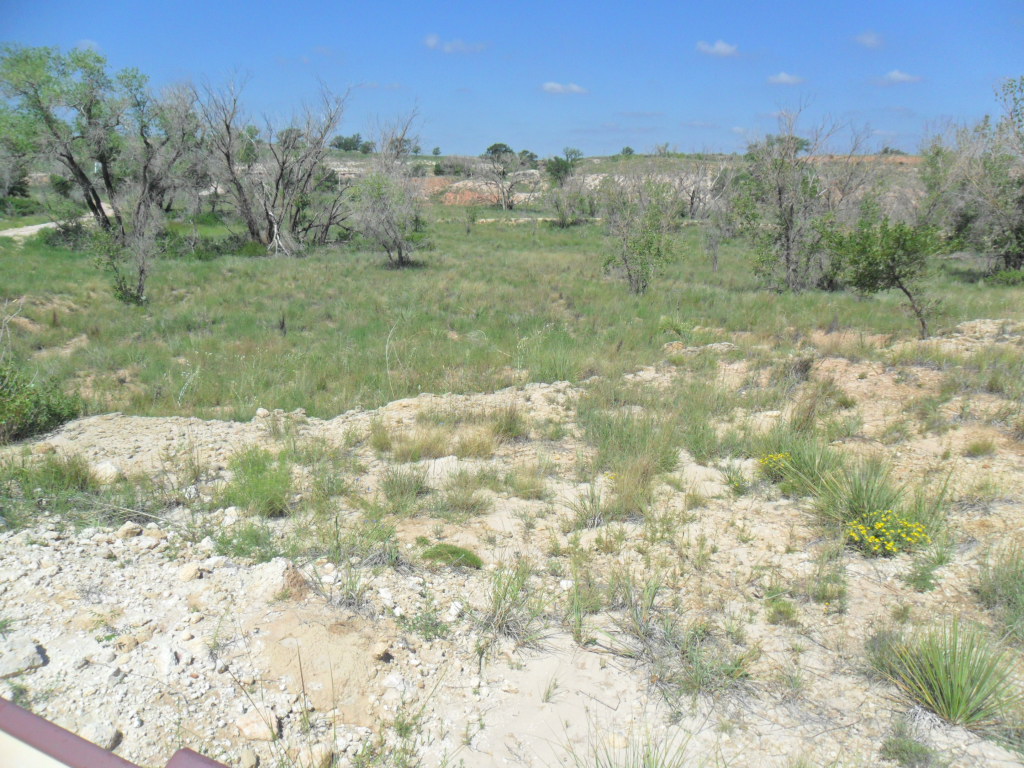
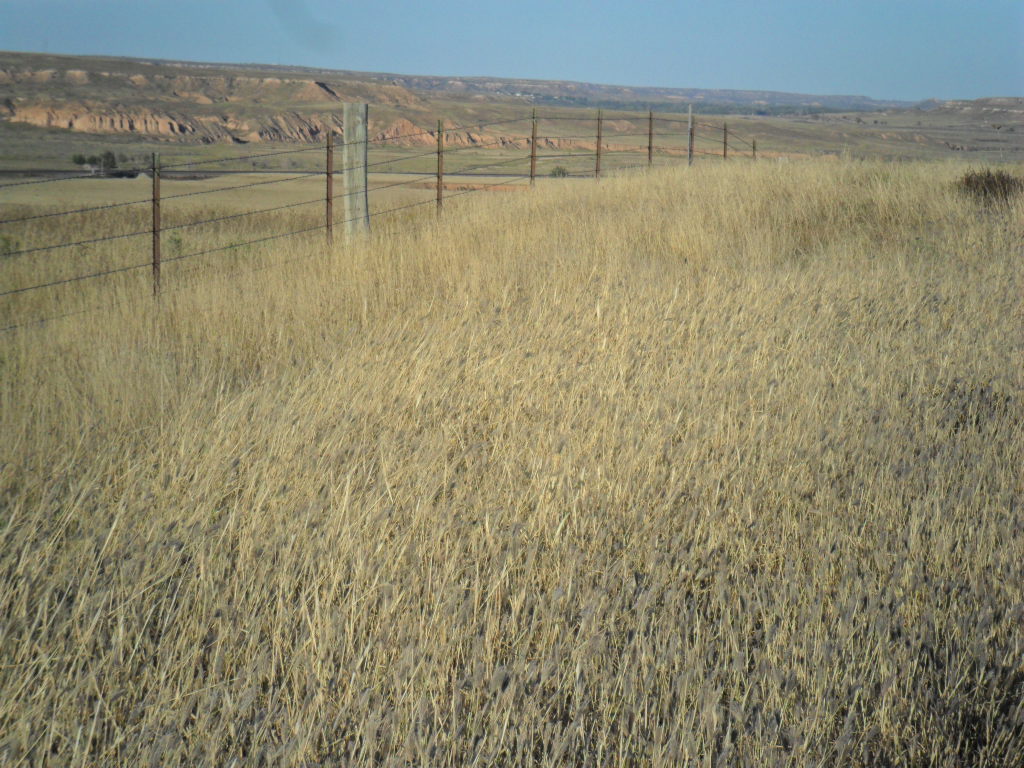
Deserts come and go.  If you live in a lovely lush green landscape, wait long enough and it, too, may become a desert.  Six thousand years ago lakes, marshes, and grassland lay where the Sahara is today.  A slight orbital change in earth’s relation to the sun caused nearby oceans to heat up, changing atmospheric conditions.  Humans living there had no choice but to move.  Forty per cent of the earth’s population lives in semiarid regions.  Even a small drought changes survival chances for the people who live there.  The Sahara, the Gobi, and the Taklimakan are growing, arable farmland decreasing.  Vulnerable areas include southern Spain, Greece, Bolivia, Australia, central Asia, and our own West.  The entire American High Plains (I live in the southern part) sits on top a giant desert.  Without pivot irrigation, only grass grows here.  In the last decade many irrigation wells have dried up or gone too saline.  The giant bulges you see in places like the sand hills of Nebraska are really a sand dune sea covered with grass.  Take away a little rain and here comes the desert.

Childs and his friend carried water with them and buried them with markers in the sand so they could find them later.  As the desert grows in parts of India, women carry water farther and farther, an average of six miles a day, four gallons at a time.  In the Sahel just south of the Sahara a difference in rainfall of just an inch or two can mean the difference between survival and starvation.  Without water, there is no civilization.

What causes these changes?  Human behavior and the increase in greenhouse gases are  part of the reason.  Humans are creating enough changes that we are moving toward more deserts, not fewer.  One climate expert, Jonathan Overpeck, thinks we are seriously underestimating the severity of drought we will face in the not so distant future.  Forget five and seven year droughts and think fifty years.  Hadley cells also affect climate change.  Tomorrow I will explain Hadley cells and how they affect our weather.

SAM_1190


Northern Arizona

SAM_1302


Eastern New Mexico


SAM_1370


Texas Panhandle

The Story Circle Network Conference and My Commitment: This Is What I Know


ad_scnconfWhen I first started blogging more than two years ago, I committed to blogging once a week.  That I managed for a year or so and then since that time, it became more sporadic.  Full time job, writing poems for my book, visitors, mini vacations, all sorts of stuff got in the way.  Really, I let it lapse, but refused to give up.  Last Thursday, I drove to Austin with my daughter and grandson for the biannual Story Circle Network Conference.  The plan:  while I conferred, they played.  The Story Circle Network is an organization for women which encourages women to write, to tell their stories, to share these stories, and when possible and desired, publish those stories in various forms from memoir to poetry.  This was my second time to attend and my first time to attend as a new board member.  A former mentor/teacher of mine, Len Leatherwood, facilitated  a workshop entitled “Transforming Your Writing Life in Just 20 Minutes a Day”, the last workshop I attended.  She blogs everyday.  I follow her blog.  No matter what, she sits down and writes 20 minutes minimum a day separate from the writing she does with her students–she teaches writing privately in southern CA.  One of her recent blogs has been accepted for publication–a piece of flash fiction.  She nearly begged us to commit to this kind of writing practice.  Previously, I had refused, flat out refused, partly thinking that if I tried it, more than half the resulting writing would be crap.  Nevertheless, she and her workshop convinced me that at least for one month I must try this.  Now all of you following my blog will be inundated with daily blog posts.  I am filled with curiosity as to how people will respond.  Maybe it will be like my Facebook posts–yes, I am an almost addict–the posts I consider most meaningful for the universe at large are the ones people ignore and the ones I consider personal trivia receive the most response.  Maybe I will track what appeals to my readers.  Some I won’t know because with blogging I share to Facebook and to a couple of professional networks, I have no clue who read what.  Once I received an email regarding a poem I posted. Although it never showed up as a like, the lady actually told me she read my poem in church!  Who would have guessed. I forgot to time myself so have no idea how long I have been here writing.

Here I am writing about why I am writing.  On the stove I smell Jasmine rice cooking.  I love Jasmine rice from Thailand.  I am a very picky rice eater and prefer to mix equally white Jasmine rice with black and red.  For one thing, it looks lovely when done–a sort of dark reddish purple.  Since I sautéd chopped garlic in olive oil, then added the rice and sautéd for about 15 more seconds, then added water and some broth just before I started writing this, the smell of Jasmine rice fills the house.  I piled a bunch of paper towels on the top before I put on the lid or you can use some cloth towel–a habit I picked up from my Iranian ex-husband.  Iranians really know how to cook rice.  I am also drinking a glass of Cupcake Shiraz which I bought on the way home from work.  And yes, Shiraz is also the name of a city in Iran where they actually grow grapes or at least used to. But of course, drinking wine is no longer acceptable in Iran or at least not publicly.  Good Muslims do not drink at all.

I did write something worthwhile while in this workshop and will share–doing this last because it won’t count as my daily writing since I wrote it yesterday.


This Is What I Know


My parents loved me, really loved me.

My mom was proud of my accomplishments.

Dad gave me a love of books, intellectual curiosity, and a

sense of wonder.

Mom gave me a love of music, beauty, and cooking.

Happiness is a choice.

I do not believe in luck.  You make your own luck.

Life is an exciting adventure.

Horses give me joy.

Singing gives me joy.

Dancing gives me joy even if I rarely have the opportunity.

Family relationships can be distressingly complicated.

I am proud of my children and their accomplishments.

Religion matters much less to me than 99 per cent of the people I know.

Ethnic and religious prejudice distress me and I do not

understand those kinds of attitudes.

I am a good writer.

I want to make a real difference in the world.

I am happy 99 percent of the time.

Blessings flood my life.

My close friends and children and grandson are more

important to me than they know.

Writing has enriched my life.

I have few regrets:

One I have rectified;

the other I cannot–

my dad is dead.

From The Guardian: Ten Rules on Writing Fiction from 14 Authors


The best list of rules for writing almost anything. If you are an English teacher these are musts to teach writing.

lenleatherwood's avatar20 Minutes a Day

Get an accountant, abstain from sex and similes, cut, rewrite, then cut and rewrite again – if all else fails, pray. Inspired by Elmore Leonard’s 10 Rules of Writing, we asked authors for their personal dos and don’ts

Elmore Leonard, Diana Athill, Margaret Atwood, Roddy Doyle, Helen Dunmore, Geoff Dyer, Anne Enright, Richard Ford, Jonathan Franzen, Esther Freud, Neil Gaiman, David Hare, PD James, AL Kennedy

Elmore Leonard: Using adverbs is a mortal sin

1 Never open a book with weather. If it’s only to create atmosphere, and not a charac­ter’s reaction to the weather, you don’t want to go on too long. The reader is apt to leaf ahead look­ing for people. There are exceptions. If you happen to be Barry Lopez, who has more ways than an Eskimo to describe ice and snow in his book Arctic Dreams, you can do all the weather reporting you want.

2…

View original post 3,420 more words